 Guide On Map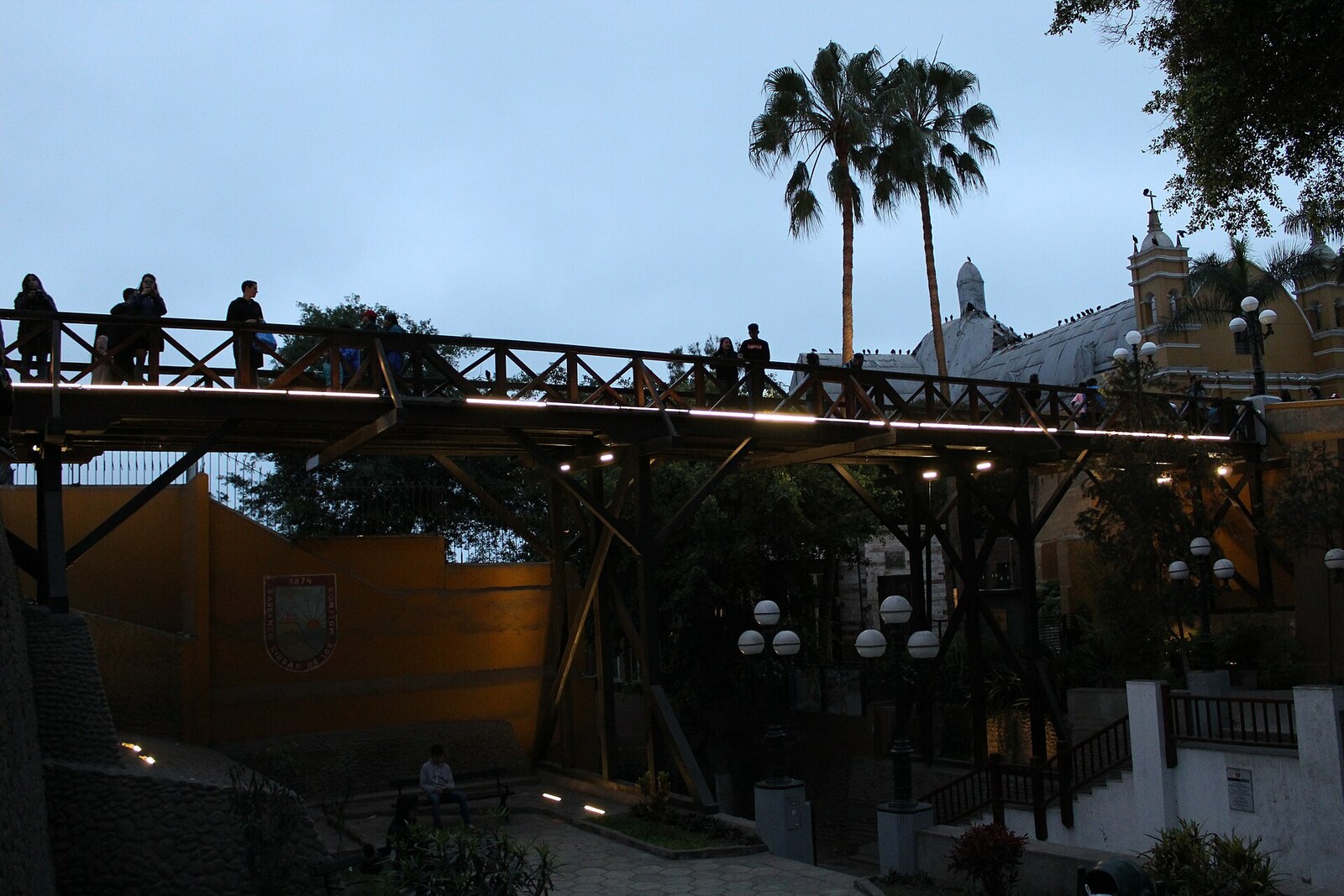
Look around first
What to notice
- Wooden deck
- Balusters
- Stone figure of Chabuca Granda
- Memorial plaque
The story of the place
The wooden deck with balusters spans the hollow of Bajada de Baños and connects its two edges. Beneath the bridge once stood the house of a family that moved to Barranco for the health of its young daughter. A stone figure of Chabuca Granda now stands at one end of the crossing, and a nearby plaque preserves her words about looking ahead through the balusters.
The wooden bridge appeared here to provide a shortcut. In eighteen seventy-six, under Barranco’s first mayor, Francisco García Monterroso, the Municipality of Barranco connected Ayacucho Street and Ábregu Street on opposite sides of Bajada de Baños. Without this crossing, residents had to descend into the ravine and climb back up. At first, the structure was called Monterroso Bridge; later, it was called Eruara Bridge, after Mayor Pedro Eruara, during whose term the crossing was repaired.
Half a century later, five-year-old María Isabel Granda y Larco moved into the house beneath the bridge. The girl suffered from a bronchial illness, and her parents moved the family to Barranco for her health. Her childhood passed in this very hollow. After becoming a songwriter under the name Chabuca Granda, she continued to come here.
By nineteen sixty, songwriting had become her profession. Chabuca then wrote the waltz El Puente de los Suspiros. Its story features this very wooden crossing: the balusters, the two edges of the ravine, and lovers separated by distance. The song became one of the best-known in her repertoire and displaced the surnames of the former mayors from the bridge’s everyday name.
The name itself existed in local legends before the waltz. According to one legend, men waited here for women walking to La Ermita and sighed after them. The custom of crossing the bridge in a single breath while making a wish for love also belongs to legend, not to confirmed history. Chabuca did not prove the legend—she gave its name a song that people remembered better than the old names.
Now a stone figure of Chabuca Granda stands at one end of the crossing. A nearby plaque records her recollection: she returned here not for the past, but to look ahead through the balusters. The wooden deck still connects the edges of Bajada de Baños, but now bears the title of her waltz.
Useful on site
Open twenty-four hours; visits recommended 08:00–20:00
Checked: June 19, 2026. Check the official source before visiting.The bridge is narrow and remains a pedestrian passage. Stop at the edge only briefly, do not block the way, and do not turn the legend of crossing it in a single breath into a risky challenge.