 Guide On Map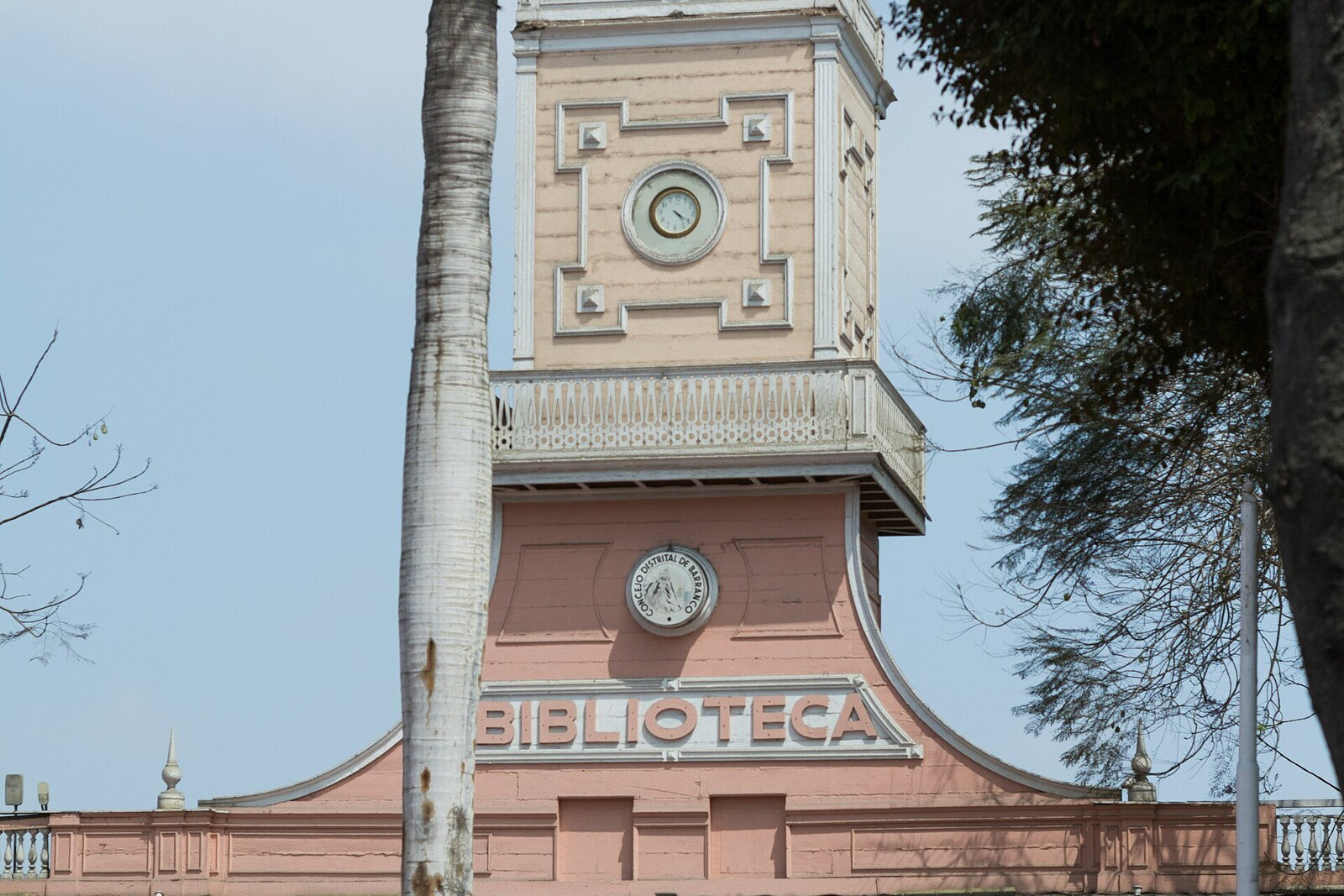
Look around first
What to notice
- Clock above the entrance
- Town hall coat of arms
- Reading rooms
The story of the place
The clock and coat of arms of the former town hall remain above the city library’s door. Behind the facade, the office rooms of city officials have given way to reading and exhibition rooms. The library keeps old municipal council meetings in digital copies for researchers to work with. Manuel Beingolea’s name is displayed on the facade, while his unpublished manuscripts and books are kept inside.
Inside, there are reading rooms for children and adults, books are lent out, and screenings, lectures, and civil weddings are held in separate rooms. The latter function came to the library along with the building: on October first, nineteen twenty-two, Mayor Enrique de las Casas opened it as the seat of the municipal council. The library was assigned only some of the rooms at the time.
A year earlier, de las Casas had decided to publish a history of the district for the centenary of Peru’s independence. Manuel Beingolea, the council secretary and an author of stories, was already planning to write such a book on his own initiative. The mayor put the commission through the council, the municipality paid for the printing, and it placed the text under direct supervision.
Beingolea received his regular salary specifically for serving as secretary. The council was then officially called the Council of San José de Surco: that was the name of the district whose capital was Barranco. Together with Elías Rodríguez, the archive’s second coordinator, Beingolea sorted through municipal papers. They found about seven thousand three hundred sixty-three case files.
The material had gaps. Some folders lacked documents, while other sources exaggerated the achievements of earlier leaders. Beingolea was accountable for the book to his employer and understood that readers knew the events he described through family memory. In the preface, he directly warned both of the shortage of papers and that a writer’s habits might have influenced his judgments.
The book “Municipal Councils of Barranco” was published in nineteen twenty-one. Beingolea organized its chapters by mayors, traced their work from eighteen seventy-six to nineteen twenty, and included information on streets, shops, public works, prices, and fees. He reprinted some documents in full. After the current building opened, Beingolea served here for another eight years and continued to maintain municipal papers. He then headed the library of the Senate of Peru for sixteen years.
Five years after his death, in nineteen fifty-eight, Barranco’s library opened in temporary premises under Manuel Beingolea’s name. Later, the books were returned to the former town hall, and its former offices became reading and exhibition rooms.
Today, the library keeps digital copies of old municipal council meetings and makes them available to researchers for on-site work. It also holds Beingolea’s unpublished manuscripts, his collection “Tales of the Past,” and an honorary diploma from the Association of Writers from nineteen forty-seven. The clock and the town hall’s coat of arms remain above the entrance; the name of its former secretary is on the facade, and his papers lie inside.
Useful on site
Mon–Fri 08:00–17:30, Sat 08:00–13:00; free admission
Checked: June 19, 2026. Check the official source before visiting.You can listen to the building’s history from the square. If the library is accessible, enter quietly and treat it as a working public place, not a museum exhibition.