 Guide On Map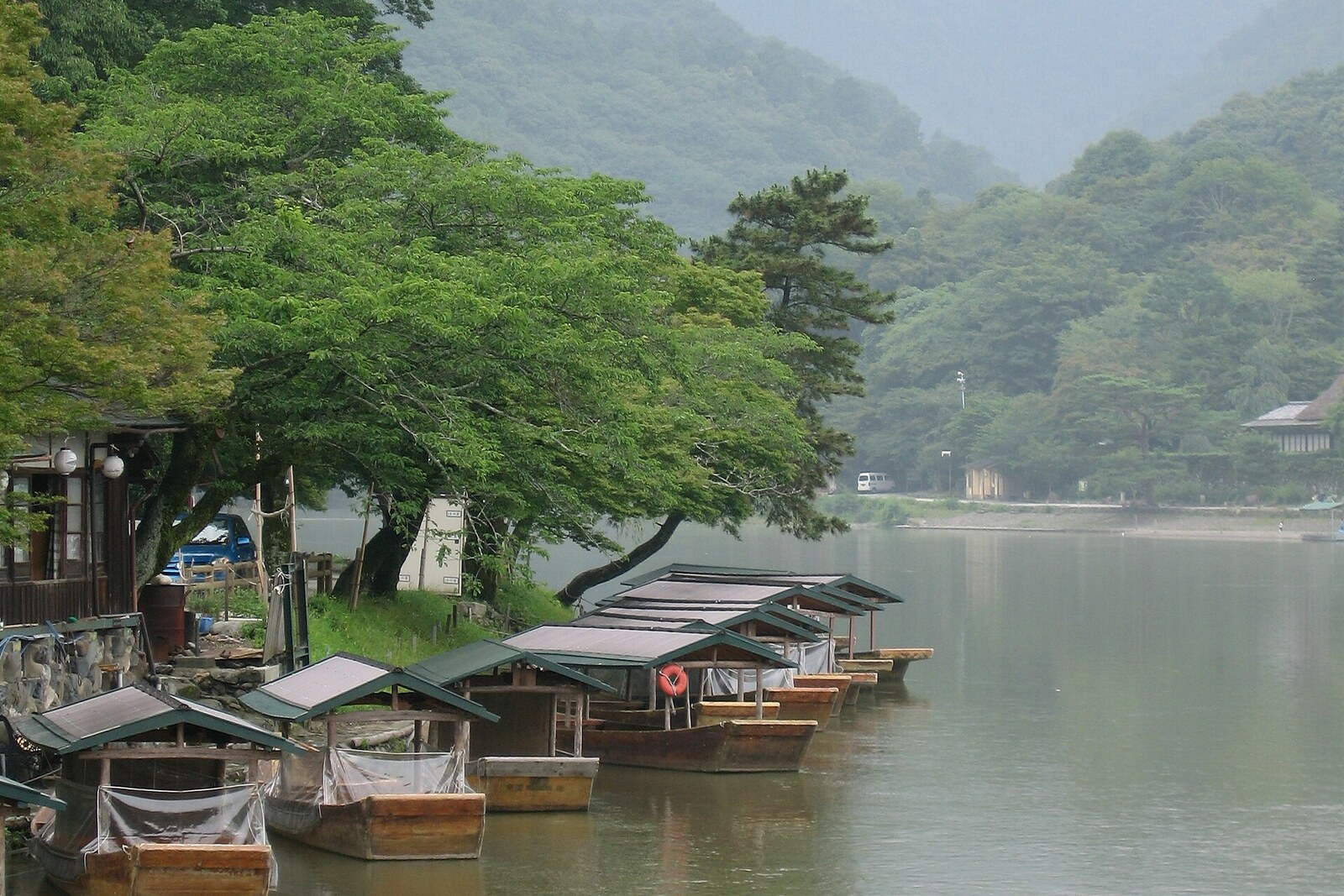
Look around first
What to notice
- Viewing platform
- Bend in the Hozu River
- Slopes of the gorge
- Three enclosures on the eastern side
The story of the place
Farther down the slope once stood the palace of a former emperor, and its lands reached the Hozu River; after the palace disappeared, Tenryu-ji was built on this land. Three enclosures on the eastern side of the spur mark the cremation sites of emperors, while the western side is occupied by a park with trails. Above the river, the bend in the Hozu River opens where the gorge reaches the plain.
From here, the Hozu River is visible where the gorge reaches the Kyoto Basin. The viewing platform occupies the southeastern spur of Mount Ogura. Its outline was compared to a turtle, and it was called Kameyama—“Turtle Mountain.” A park with paths and platforms has now been laid out on the western side of the spur, while three enclosed cremation sites of emperors stand on the eastern side.
In twelve fifty-five, the former emperor Emperor Go-Saga, who governed the court on behalf of underage sovereigns, built a country palace at the foot of Mount Kameyama. Its grounds reached the river and included the land where Tenryu-ji now stands. The palace was called Kameyama-dono after the spur. Later, the name passed to Go-Saga’s son—known in history as Emperor Kameyama.
Go-Saga had set his two sons against each other in advance. The elder, Emperor Go-Fukakusa, became emperor while still a child and expected to pass the throne to his own son. But in twelve fifty-nine, their father forced seventeen-year-old Emperor Go-Fukakusa to abdicate in favor of his ten-year-old younger brother, Emperor Kameyama. Then Emperor Kameyama’s young son was named heir, passing over Emperor Go-Fukakusa’s son.
Both brothers could maintain their own courts from the income of estates. Go-Saga gave Emperor Go-Fukakusa the lands of Chokodo—holdings in different provinces that provided rice and money. This income made it possible to feed courtiers and run the household of a former emperor, but it did not give his children a right to the throne. If their father’s decision remained in force, Emperor Go-Fukakusa’s descendants would become a wealthy collateral branch of the family.
In February twelve seventy-two, Go-Saga died here, in one of the pavilions of Kameyama Palace. Before his death, he did not name the son who was to lead the court after him, but entrusted the Kamakura shogunate with deciding the matter. From Kamakura, they asked Go-Saga’s widow and the mother of both rivals, Omiya-in, whom her husband had preferred. She pointed to Emperor Kameyama. This testimony proved decisive: Emperor Kameyama retained leadership of the court and soon passed the throne to his son, Emperor Go-Uda.
Emperor Go-Fukakusa did not give up his family’s claims. Fifteen years later, the shogunate secured Emperor Go-Uda’s abdication, and Emperor Fushimi, Emperor Go-Fukakusa’s son, became emperor. It was no longer possible to remove either branch: the throne and the imperial estates had to be divided between the descendants of the two brothers. Two lines grew out of this family dispute, and they later found themselves on opposite sides of the war already mentioned at Tenryu-ji.
Go-Saga’s body was cremated on the slope of Mount Kameyama. The next day, the bones were gathered, placed in a silver vessel, wrapped in white silk, and carried to a chapel below. The palace disappeared, and Tenryu-ji was built on its land. The site of the funeral fire remained in the park. Two more are marked nearby: those of Emperor Kameyama’s younger son and Emperor Go-Fushimi—the grandson of the displaced Emperor Go-Fukakusa. The Hozu River opens out on the western side of the same spur; on the eastern side, three enclosures preserve the makeup of the family that Go-Saga divided here by his final decision.
Useful on site
Public park area, no ticket required. Best visited in daylight: slopes and stairs lead to viewing points. Checked 2026-06-30.
Checked: June 30, 2026. Check the official source before visiting.Save your strength for the climb and let your breathing recover before the audio. The boats and rapids are far below, so here it is more useful not to look for small traces of the past, but to follow the whole river corridor with your eyes.