 Guide On Map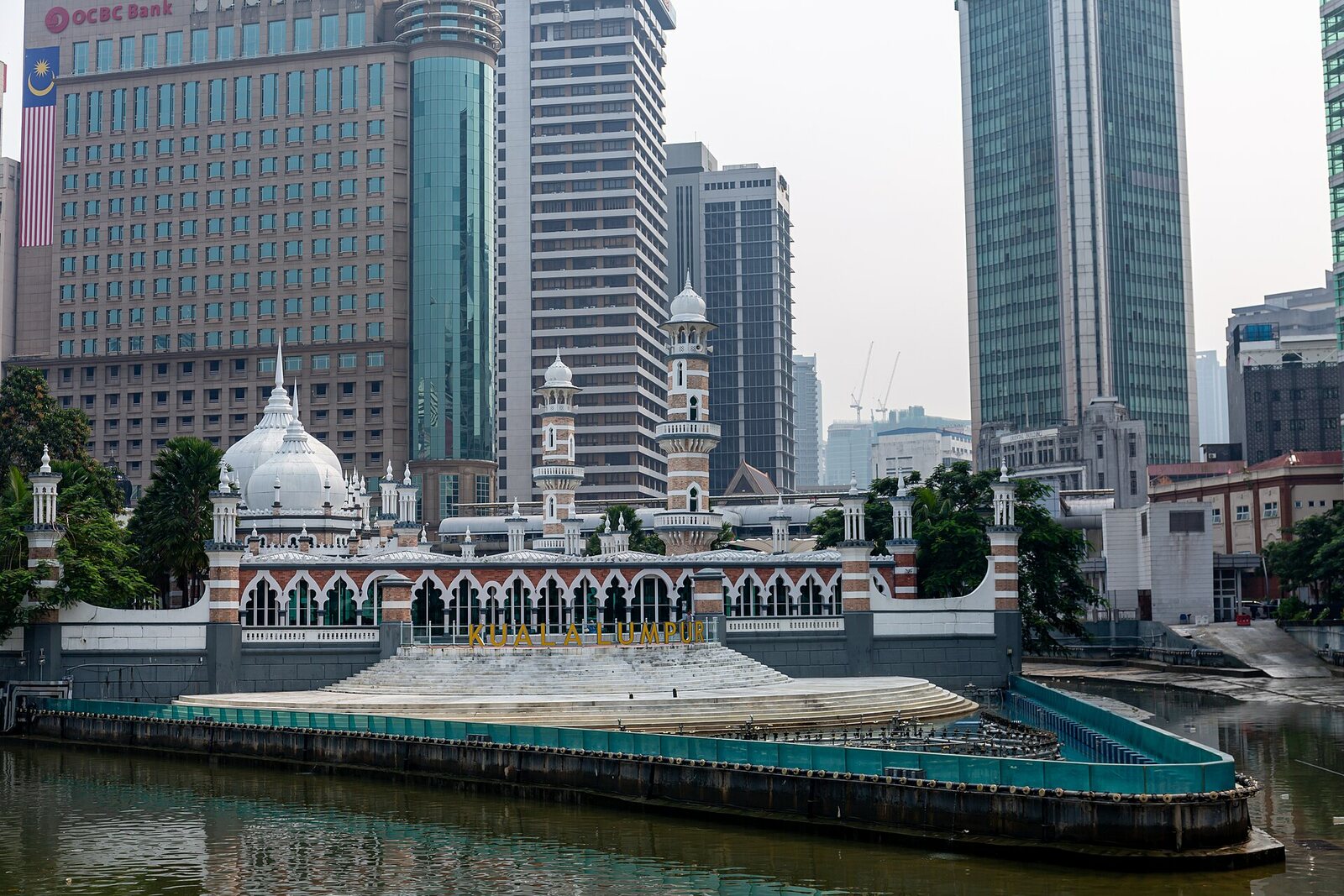
Look around first
What to notice
- Onion domes
- Two minarets
- White stone in a column
- Plaque with the current name
The story of the place
Under onion domes and between two minarets stands a historic city mosque designed in the forms of the Mughal architecture of North India. The name “Jamek” indicates its purpose: the community gathered here for the communal Friday prayer. This role later passed to the National Mosque of Malaysia, but at noon and on Fridays, people who work in the center still come here. At the entrance to the main hall, an old white stone is built into a column, and opposite it hangs a plaque with the building's current name.
In November nineteen oh six, Kuala Lumpur's imam, Haji Osman, submitted a petition to the Selangor State Council. He sought to have the new city mosque built precisely here, on the old Muslim cemetery between the Klang River and the Gombak River. The community was already losing its former mosque, and its representatives were now choosing the site for its replacement.
The former mosque stood nearby, on Java Street—today's Jalan Tun Perak. Sultan Abdul Samad, the fourth Sultan of Selangor, had set aside the land for it back in the eighteen seventies. Settlers from Sumatra, who had come to the growing tin town to trade and establish households, built a wooden mosque there with a tiered roof, like those in their homeland.
In eighteen eighty, it burned down. Haji Osman and the mosque's trustee, the merchant Abdul Samad, raised five hundred fifty-seven dollars of the required one thousand two hundred and twice asked officials to make up the shortfall. They were refused: the government did not want to create a rule under which the treasury would have to rebuild burned-down houses of prayer. The worshippers rebuilt the mosque anyway, using their own money.
Two decades later, it was ordered removed to widen Java Street. Abdul Samad had died by then, and his son Mohamed Taib, one of the city's wealthiest Malay merchants, had become the trustee. He owned houses and shops along the street and earned income from trade and real estate. Officials bought out some of his plots, demolished the shops, and planned to build a new mosque on the cleared land. Taib, Haji Osman, and another community representative agreed to give up the old plot only on condition that they received a full replacement.
Haji Osman then proposed moving the construction here, to the Klang-Gombak confluence. The site was not empty: Muslims from nearby settlements had been buried here at least since the eighteen seventies. Some graves were moved to make way for the building; other burials remained within the mosque grounds and were later encountered by builders during extensions and improvements.
Selangor's chief colonial official, Henry Belfield, agreed with the choice of site but required a building worthy of the center of the federal capital. The architect Arthur Benison Hubback prepared a design with onion domes, arches, and two minarets, drawing on the Mughal architecture of North India. It cost far more than the wooden mosque it was intended to replace.
Sultan Alaeddin Sulaiman Shah promised one tenth of his annual income. Malay elders made the first donations, and the collection was then extended across all Selangor. Money was passed through village headmen and district officials; the government added twenty thousand dollars. When funds again ran short toward the end of construction, Belfield issued the fund a loan at six percent so it could pay the contractor. The sultan settled this debt in nineteen eleven.
On March twenty-third, nineteen oh eight, Alaeddin Sulaiman Shah lowered a white marble slab from Ipoh into the foundation. Before that, nine new coins—three sovereigns and six dollars—were placed beneath it. And on December twenty-third, nineteen oh nine, the first day of the Feast of Sacrifice, the sultan opened the mosque and handed it over to the worshippers. It became Kuala Lumpur's main place for the communal Friday prayer. The word “Jamek” means a mosque where the community gathers. The building retained this role until the National Mosque of Malaysia opened in nineteen sixty-five; even now, people who work in the city center come here for noon and Friday prayers.
Sultan Abdul Samad did not build the present mosque: he died ten years before the foundation was laid. His name recalls the ruler who set aside land for the first community and the fact that this part of Kuala Lumpur then belonged to Selangor. Two slabs now stand at the entrance to the main prayer hall. An old white stone bearing the names of Sultan Alaeddin, Belfield, and Hubback is built into a column; opposite it is a plaque with the building's present name—Masjid Jamek Sultan Abdul Samad.
Useful on site
For this route, assume that exterior viewing is available. Interior access and guided programs depend on prayers, dress code, local instructions, and ongoing work; check on the day of your visit.
Checked: June 30, 2026. Check the official source before visiting.Begin with an exterior viewing. Enter only when access is permitted, observing the dress code, silence, and the attendants' instructions.