 Guide On Map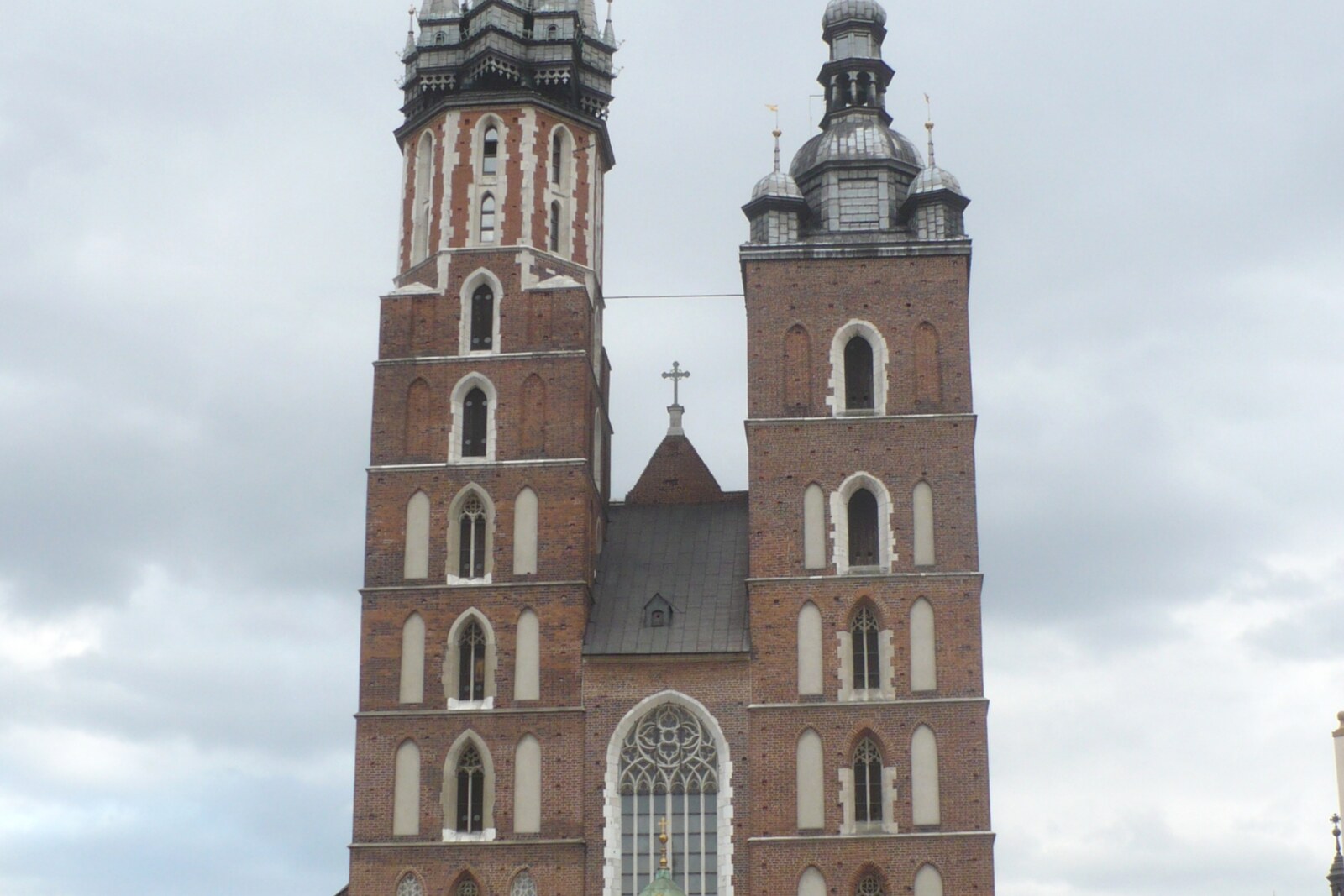
Look around first
What to notice
- Veit Stoss’s high altar
- The central figures of Mary and the apostles
- The altar wings
- The wooden framework
The story of the place
The official name of this church is the Basilica of the Assumption of the Blessed Virgin Mary. This is where the familiar Krakow name “Mariacki” comes from: dedicated to Mary. The dedication is carved in wood in the high altar. At the center, the apostles surround Mary at the end of her earthly life; above, her Assumption into heaven is shown, and at the top, her Coronation. Veit Stoss created this enormous winged structure between fourteen seventy-seven and fourteen eighty-nine. It was intended for the principal parish church of Krakow’s townspeople and took part in worship: on ordinary days, the faithful saw the wings closed; on major feast days, they were opened.
In the summer of nineteen thirty-nine, the art historian Karol Estreicher pressed to have the altar dismantled. He worked at Jagiellonian University, could read old inventories, and knew which parts were held by pins, which hung from mountings, and what would be lost in a single direct hit. The parish priest Józef Kulinowski wanted to leave the altar in the church and opposed its dismantling. Estreicher then obtained the consent of Krakow Archbishop Adam Sapieha.
The architect Franciszek Mączyński sketched the structure down to the individual screws. Several dozen priests, scholars, and firefighters climbed onto the scaffolding. The lindenwood figures weighed several hundred kilograms each, and an old hoist in the church attic helped remove them—the very lifting mechanism Stoss’s craftsmen had once used to install the sculptures. The figures were wrapped in wastepaper, packed into thirty crates, and sent down the Vistula to Sandomierz on August twenty-ninth. Small details were hidden at the university and in an artist’s basement, while the ornaments were hidden in the tomb of the parish priests inside the basilica. An empty thirteen-meter wooden framework remained in the altar area.
Estreicher expected to protect the carvings from bombs and fire. He underestimated the possibility of deliberate theft. After the occupation of Krakow, German employees and SS men began searching for parts of the altar. People who knew about the evacuation were called in for questioning. Archbishop Sapieha, wishing to stop the threats of torture, named Sandomierz and hoped that the recovered figures would be returned to the church. They truly were brought here—but only to be sent to Berlin. The hiding places at the university were discovered by sounding the walls and lifting newly laid parquet flooring. The hiding place in the tomb inside the basilica survived: the priests did not speak of it.
From Berlin, the sculptures and the framework removed in Krakow were transferred to Nuremberg, the city associated with Stoss’s origins. There, the altar was to be exhibited as a German work. Instead of an exhibition hall, the crates ended up in a fortified storage facility beneath Castle Hill: air raids had begun, and assembling the wooden structure had become too dangerous.
By then, Estreicher had left Poland. In London, he headed a commission that recorded stolen cultural property. His former university work changed: now he made file cards for removed objects, checked museum catalogs, and recorded the names of German art historians who might know the altar’s route. This produced a trail leading to Nuremberg’s underground storage facilities. On June seventh, nineteen forty-five, the American military confirmed that it had found the crates.
On November fifteenth, Estreicher descended into the storage facility and saw the figures of Mary and the apostles for the first time in six years. He then obtained permission for their transfer. On April thirtieth, nineteen forty-six, a train carrying the altar arrived in Krakow; Estreicher accompanied the cargo. After conservation, the carvings were displayed at Wawel for several years, and in nineteen fifty-seven they were installed here again.
The figures at the center of the altar are the ones firefighters lowered with the medieval hoist and transported down the Vistula. The wooden framework also spent time in Nuremberg. And some of the ornaments lay behind these walls the entire time, in the tomb of the parish priests.
Useful on site
For visitors, the basilica is usually open daily 11:30–18:00; on Sundays and holidays, tourist viewing of the main section and the altar runs approximately 14:00–18:00. Trumpeter’s tower: Tuesday–Saturday 11:00–17:30, Sundays and holidays 13:00–17:30, tickets only on the day of the visit. During liturgy and on special days, the schedule changes.
Checked: June 16, 2026. Check the official source before visiting.This is an active church: keep quiet and do not expect to enter through any portal. Check tourist access and the possibility of seeing the altar opened separately.