 Guide On Map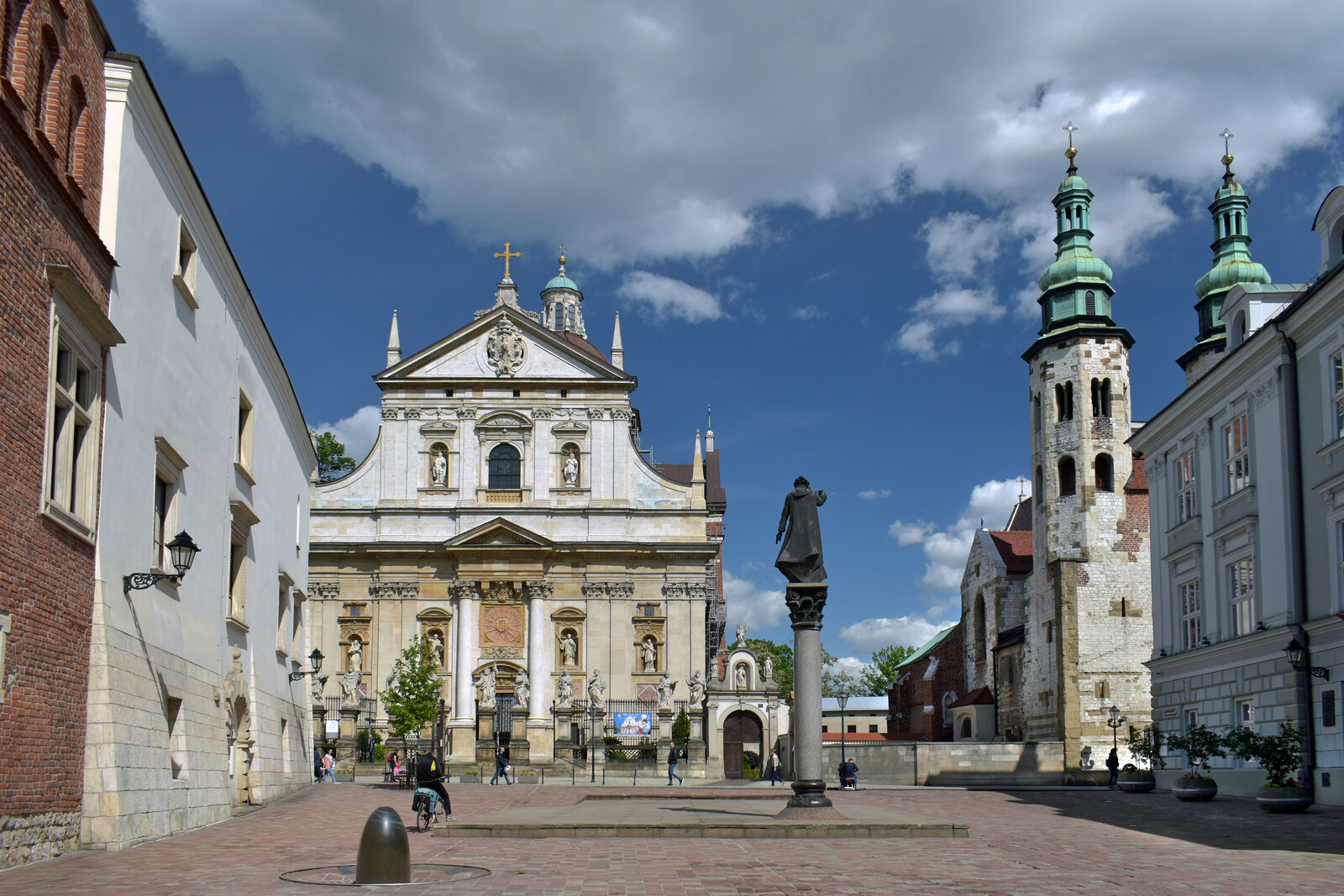
Look around first
What to notice
- Stone outline of the foundation
- Open space of the square
- Exit of Grodzka Street
- Exit of Kanonicza Street
The story of the place
The stone outline in the paving marks the plan of a small church that stood on this spot. Even before present-day Krakow, this was the market of the settlement of Okół, from which routes spread out along what are now Grodzka Street and Kanonicza Street. When the old market lost its importance, the neighboring houses were adapted for teaching rooms, and university ceremonies began to be held in the church.
The Krakow Academy, the future Jagiellonian University, was re-established in fourteen hundred. Just a year later, Piotr Wysz, the Bishop of Krakow and the university chancellor, had to decide how the law teachers would make a living. He transferred to the faculty the benefices of the Church of St. Mary Magdalene—positions with income assigned to them. Thanks to this, the jurists received funds to maintain their posts at the university.
By then, the church had stood here for about a century and a half. It was built in the middle of the market of Okół—a settlement below Wawel that existed before Krakow appeared with its present-day Main Market Square. Roads branched off here: one continued along Grodzka Street, while another led toward Kanonicza Street. When the old market lost its importance, the university acquired the neighboring houses and housed the collegium of lawyers in them.
The church became its chapel. The teachers entered it directly from the teaching rooms by a separate staircase. Solemn degree conferrals were held here, and masses were celebrated for the people whose donations supported the faculty. Piotr Wysz's decision linked the small church with the university's lawyers for four centuries.
By the end of the eighteenth century, the church was already described as empty. After the partition of Poland, Austrian officials closed it, took over the neighboring collegium for the tax administration, and sold the altars, pulpit, and benches at auction. When Krakow became part of the Duchy of Warsaw, the building remained without furnishings or purpose, and its walls crumbled into the street.
In eighteen eleven, Stanisław Wodzicki, prefect of the Krakow Department, sought its demolition. In his petition, he referred to falling stones and to the fact that the chapel narrowed the passage between Grodzka Street and Kanonicza Street. The Krakow Episcopal Consistory agreed, and then Fryderyk August, Duke of Warsaw, granted permission. Stanisław Kostka Potocki, head of the education system, objected: the chapel belonged to the educational fund, and the Board of Education had not even been consulted. The objection came too late. In the fall, the church was dismantled, and its building material was sold at auction.
The aboveground walls disappeared, but the foundations remained. In nineteen ninety-seven, their location was marked in the square's paving; the stone outline repeats the shape of the former church. The open space of its present size appeared thanks to that demolition.
The square received its current name in the second half of the nineteenth century. Mary Magdalene was a Gospel disciple of Jesus and a witness to his crucifixion and resurrection. Her name belonged to the church that stood here, and after its dismantling it passed to the square that had formed.
Useful on site
The street stop is freely accessible. Access inside the nearby churches depends on services, concerts, and the current program.
Checked: June 16, 2026. Check the official source before visiting.View the square from several sides: its meaning becomes clear when the empty outline is compared with the two active churches. Do not disturb services inside.