 Guide On Map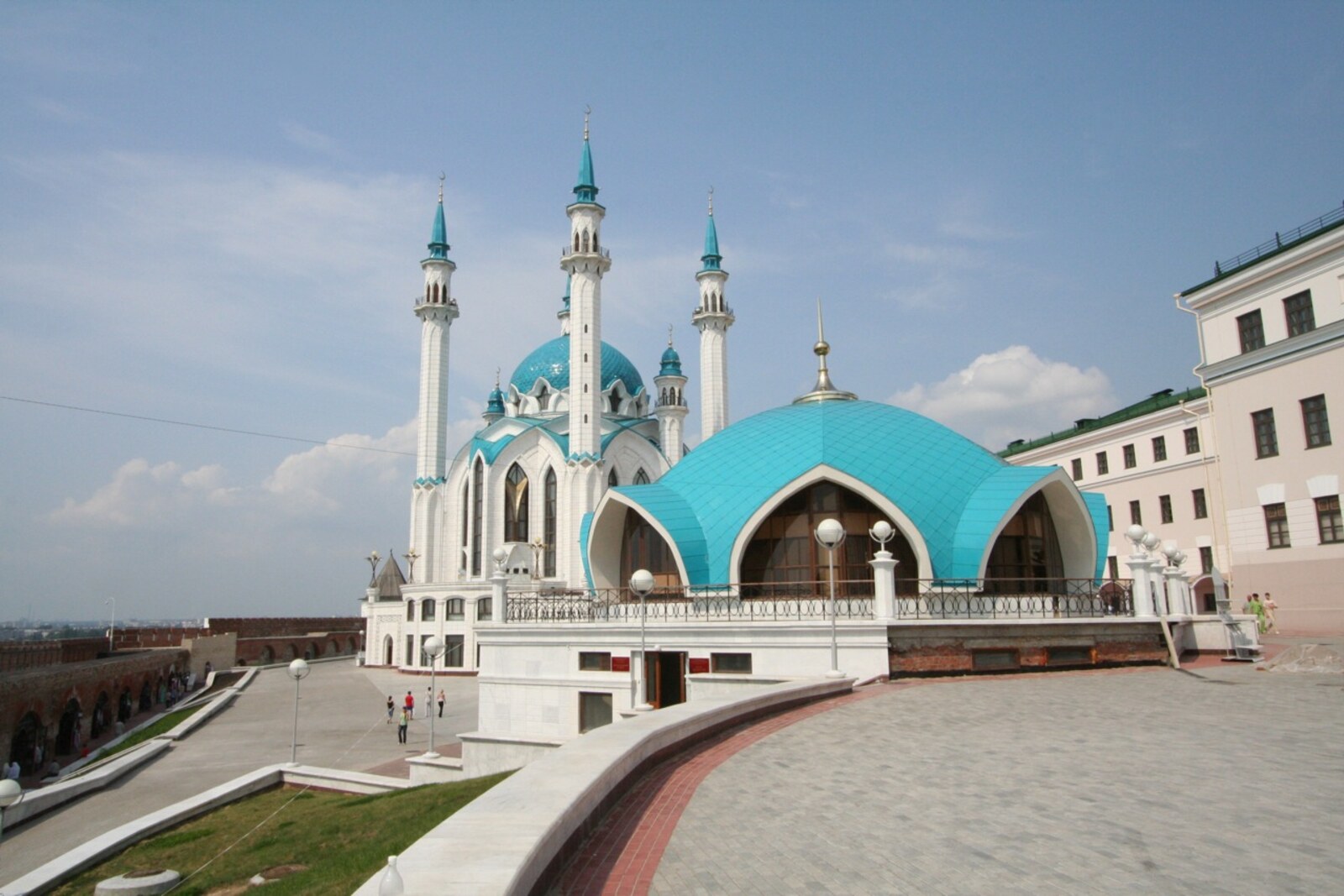
Look around first
What to notice
- Four large minarets
- Two small minarets
- Towers of the entrance portal
- White-marble walls
The story of the place
The name of this mosque belongs to a man who first tried to prevent the final battle for Kazan.
Kul Sharif was a sayyid—a man believed to be a descendant of the Prophet Mukhammed—and headed the Muslim clergy of the Kazan Khanate. At the main Kremlin mosque, he ran a large madrasa, a school that trained experts in Islam, and a library of handwritten books. His duties did not end there. The head of the clergy was part of the khanate's government and represented Kazan in negotiations.
In fifteen fifty-one, the city's situation became almost hopeless. After Sviyazhsk was built, Kazan lost part of its lands and awaited a new campaign by the Moscow army. Kul Sharif led an embassy to Khan Shah Ali and the Russian military commanders: his task was to win peace for the city. They managed to agree only on a respite. The concessions did not remove the threat, Shah Ali soon left Kazan, and direct subordination to Moscow sparked an uprising in the city.
Together with Prince Chapkun Otuchyev, Kul Sharif invited Yadigar-Mukhammed to the throne—a khan under whom the people of Kazan decided to continue their resistance. Thus, a man who had only recently been bargaining over the terms of peace found himself among the leaders of the defense.
When the assault reached the khanate citadel on October second, fifteen fifty-two, Kul Sharif gathered a detachment of shakirds, the students of his madrasa. Their usual work was studying, copying, and interpreting books; now their teacher led them to defend the place where they studied. Kul Sharif and his detachment were killed, and the mosque together with the madrasa premises was destroyed. The story that the sayyid was stabbed on the roof and thrown down belongs to legend. All that is reliably known is that he died defending the citadel.
The white-marble building before you does not belong to the sixteenth century. Even the site of the former mosque can only be identified tentatively: historians place it by the southern wall of the citadel, closer to Tezitsky Moat. No precise drawings survived, so modern architects had nothing to copy.
The present complex was built from nineteen ninety-six to two thousand five, between the Kremlin wall and the former school for future officers. The project's authors took from legend the image of a khanate mosque with many minarets: four large minarets, two small ones, and the two towers of the entrance portal restore the number eight to its silhouette. This is a modern design, not a reconstructed appearance of the lost building.
Prayers are once again performed inside. The men's prayer hall and the women's gallery are upstairs, while the Museum of Islamic History is on the lower floor; the religious and museum spaces are separate. No walls remain of the mosque that Kul Sharif led. Its purpose and its name have returned to the Kremlin.
Useful on site
The mosque is open daily from 08:00 to 20:00; on Fridays, tourist access closes approximately from 11:30 to 13:30. The Museum of Islamic Culture operates on a separate schedule.
Checked: date not specified. Check the official source before visiting.This is an active mosque: observe the clothing requirements, speak quietly, do not photograph worshippers, and do not enter during visitor restrictions.