 Guide On Map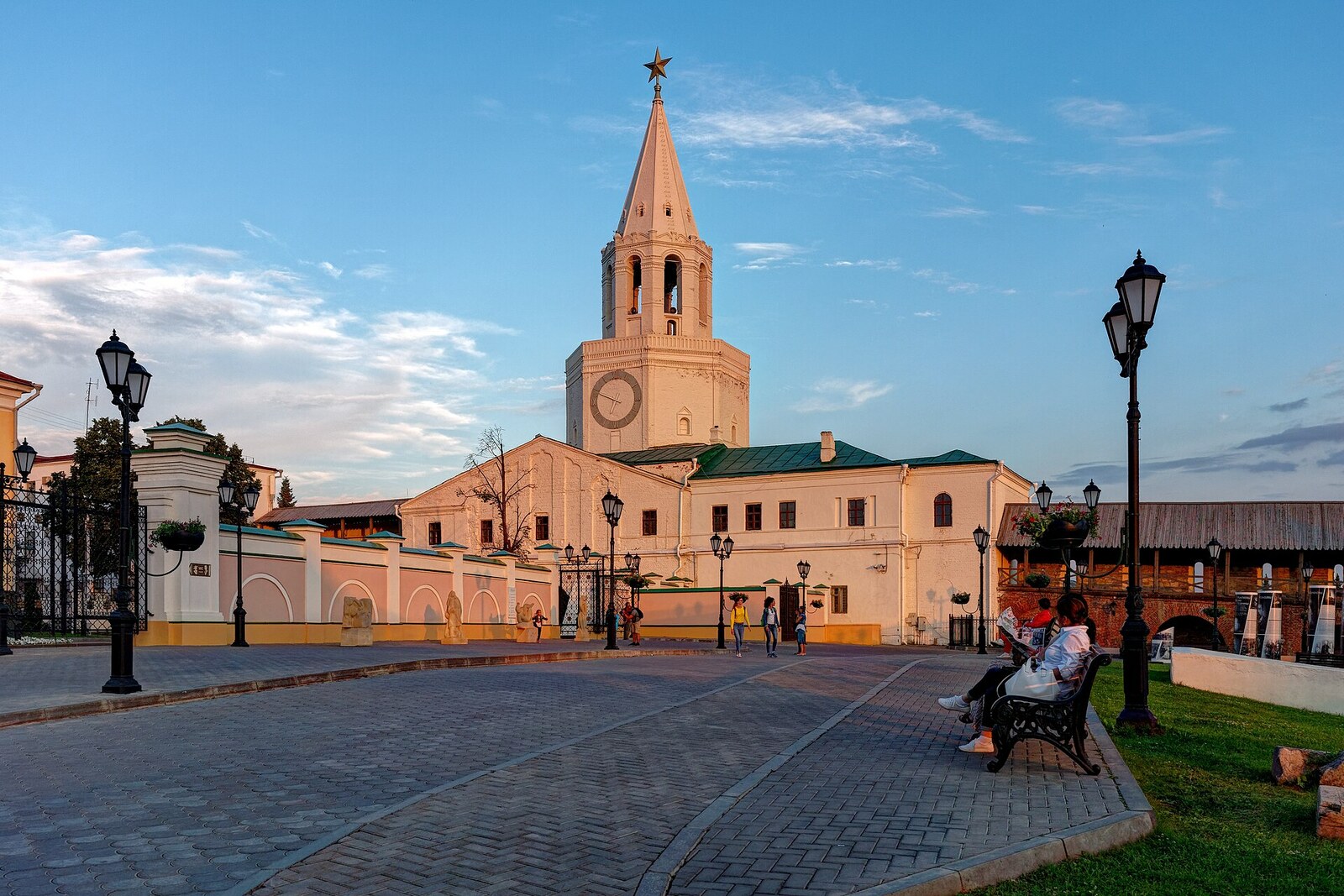
Look around first
What to notice
- White-stone lower tier
- Straight arched passage
- Brick octagons
- Clocks and star
The story of the place
Today’s straight passage through Spasskaya Tower appeared later. The Pskov craftsmen arranged the gate differently: a person entered from the side and turned at a right angle inside. Beyond the moat and drawbridge, iron-clad gate leaves held him up. If an enemy still broke through, at the turn he exposed his right side: a shield was usually held in the left hand. This is how the builders turned the main southern entrance into a tight trap.
These builders had to come from Pskov. After the capture of Kazan, Ivan IV, tsar and leader of the army besieging the city, wanted to restore and enlarge the damaged fortress quickly. At first, the walls were repaired with wood, but the work progressed slowly. Late in fifteen fifty-four, a tsar’s decree ordered two hundred Pskov masons, wall builders, and stone breakers—men who quarried and dressed stone—to be assembled and sent to Kazan by spring.
Postnik Yakovlev, who earned his living as a “church and town master,” and the mason Ivan Shiryai were appointed as leaders. They were not invited to discuss the project: the decree ordered them to go and build a new stone town. For both men, the assignment meant several years of work away from Pskov. Under their leadership, the Kremlin’s southern walls and towers were built, including the two lower tiers of Spasskaya Tower.
The gate received its name before the stone construction was completed. On October fourth, fifteen fifty-two, Ivan IV ordered a wooden Church of the Savior Not Made by Hands to be erected here. This is the name given to an image of Christ that church tradition holds to have appeared without the hand of an artist. The same image was on the tsar’s campaign banner. According to tradition, during the assault the banner stood precisely on the site of the future tower; the exact connection to this spot remains a tradition. What is reliably known is that the church was built in one day as a vow, and its name then passed to the stone church and the gate.
The high brick octagons, tented roof, star, and clocks appeared centuries later. What remains from the work of Postnik, Shiryai, and their crew is the tower’s white-stone lower section. Inside the present-day museum, the north wall of the gate church has been uncovered—the only one of its walls to survive from the sixteenth century. The tower is called Spasskaya after this church; the modern straight passage was cut through where the Pskov craftsmen had deliberately made anyone entering turn.
Useful on site
The Spasskaya Gates and the grounds are accessible around the clock; the tower museum follows museum hours.
Checked: date not specified. Check the official source before visiting.View the tower before entering or just beyond the arch, without stopping in the middle of the pedestrian flow.