 Guide On Map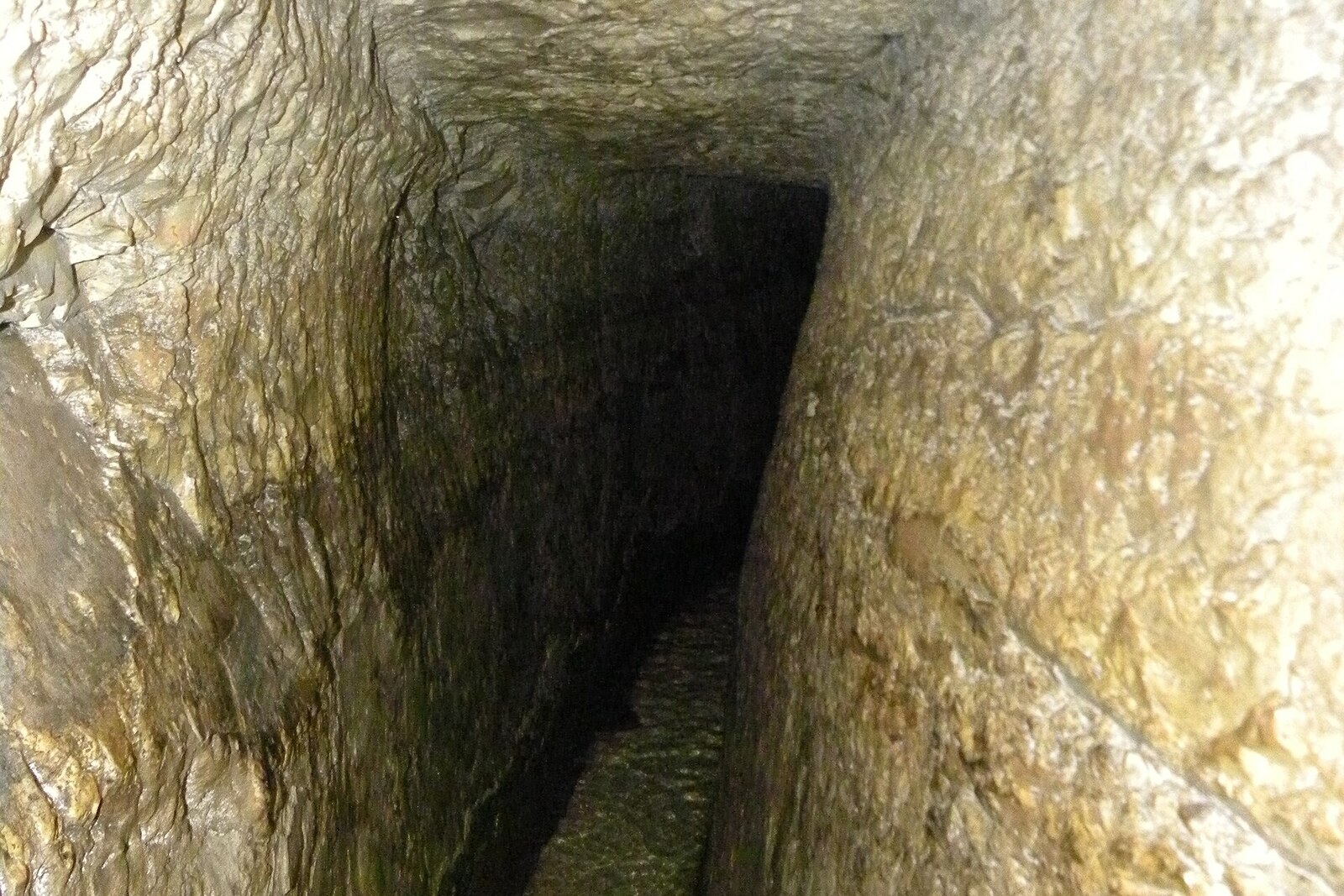
Look around first
What to notice
- Chisel marks on the walls, sharp bends in the passage, the changing height of the ceiling, water flowing underfoot, and the place from which the inscription was removed.
The story of the place
Chisel marks on the walls lead along the ancient water passage from Gihon Spring to the Pool of Siloam. The channel was cut through limestone rock from two sides, and that is why it winds, the ceiling changes height, and water runs underfoot along an uneven bed. This route allowed the city to use water without going down to the spring itself beyond the line of fortifications. At the southern exit, a short inscription about the work of the tunnelers was once carved; its original fragment is kept in Istanbul, while a recess remains in the rock.
In ancient Jerusalem, defense began not on the fortress wall, but underground. When the city was threatened by the army of the Assyrian king Sennacherib, Hezekiah ordered the springs outside the fortifications to be blocked and water to be brought inside. The logic was harsh and entirely practical: those under siege had to drink; the besiegers did not. Water became part of military calculation, and a stonecutter's pick was almost as much a weapon as a sword.
The tunnel traditionally associated with this plan was cut by two crews. One entered the rock from one side, the other from the opposite side. Between them lay a thickness of stone that gave them no way to check their positions, see their fellow workers, or draw a straight line across the surface. Today such a task would require instruments, precise measurements, and a whole team of engineers. Here there were human hearing, the experience of skilled workers, and iron striking rock.
The passage therefore did not turn out like a perfectly straight arrow. It bends, as if the route inside the mountain had to be guessed anew all the time. The two crews worked toward one another—and nearly missed each other. At one point, a rock barrier remained between them, while the directions of the excavations no longer promised a fortunate meeting. And then a sound broke through the stone.
On one side, they heard voices and blows from the other. The workers began calling to one another through the rock, corrected their direction, and the final meters became a hunt for a barely distinguishable echo. One blow became the answer to another. The stone between the crews grew thinner, the voices closer, until the two picks finally met. After that, water began to flow through the completed passage.
This moment is known not only from researchers' guesses. At the southern exit, an inscription was carved into the wall—a rarest voice from the construction itself. It contains no long list of royal titles, no solemn account of victory over enemies. Even Hezekiah's name is not mentioned there. That is why the familiar name, “Hezekiah's Tunnel,” remains a traditional and highly probable connection to the biblical water project, but not the king's literal signature beneath the completed work.
Instead, the inscription speaks of those whom ancient monuments usually leave unnamed. Of the workers. Of the tunnelers on both sides of the rock. Of voices heard in the stone, of the final blows, and of water flowing toward the reservoir. It is as if, instead of an official chronicle, a short report from the completion of the work has survived. Not the ceremonial voice of the palace, but the clamor of a cramped, wet working face.
For almost three thousand years, these lines remained where they were difficult to make out. Then another person without a title entered the tunnel's story—a boy named Yaakov Eliyahu. In eighteen eighty, he and a friend decided to see whether they could make their way through the channel from end to end. They waded through the half-light, water splashing at their feet, while the uneven walls came closer and then receded. In such a place, it is easy to think only about the next step. But Yaakov noticed letters on the stone.
He told his schoolteacher, Conrad Schick, about the discovery. Schick came into the tunnel and understood that an ancient Hebrew text stood before him. Thus one of the most important inscriptions of ancient Jerusalem was discovered not by a professor at a desk or an archaeologist during ceremonial excavations, but by a child who simply wanted to know where the dark, wet passage led.
The stone's adventures did not end there. When word of the discovery spread, someone tried to cut the inscription out of the wall. The work was crude, and the ancient text was damaged. The Ottoman authorities then removed the surviving fragment and sent it to the Imperial Museum in Istanbul. It remains there to this day.
It was a strange fate. First, the builders left their account deep underground, with almost no hope of a reader. Centuries later, a boy found it. Then an unknown hunter for antiquities nearly destroyed the inscription while trying to take possession of it. Finally, the stone crossed borders and ended up far from the wall for which it had been carved.
That is why it is especially difficult here to decide where the monument itself is. Istanbul holds the original stone inscription. In the tunnel, the place to which its account belongs remains. Yet the builders' voice still sounds most convincing here: in the bends of the passage, the tightness of the rock, and the water underfoot. The stone page was taken away, but the event it describes remained inside the mountain.
The royal plan was meant to save the city during a siege, but memory was arranged differently. Books and tradition preserved the ruler's name. The inscription preserved the moment when nameless people heard one another through stone. After long labor, the final barrier between them gave way—and water gained a path onward.
Useful on site
City of David ticket area. According to the park's official page, checked 2026-06-30: Sunday–Thursday 8:00–17:00, Friday 8:00–14:00; entry to the water system closes an hour and a half before closing. Check holidays, security, and archaeological work on the ticket page before setting out.
Checked: June 30, 2026. Check the official source before visiting.Walk only with your flashlight on, do not pass others in narrow places, and warn your companions about ledges. The original Siloam Inscription is not in the tunnel.