 Guide On Map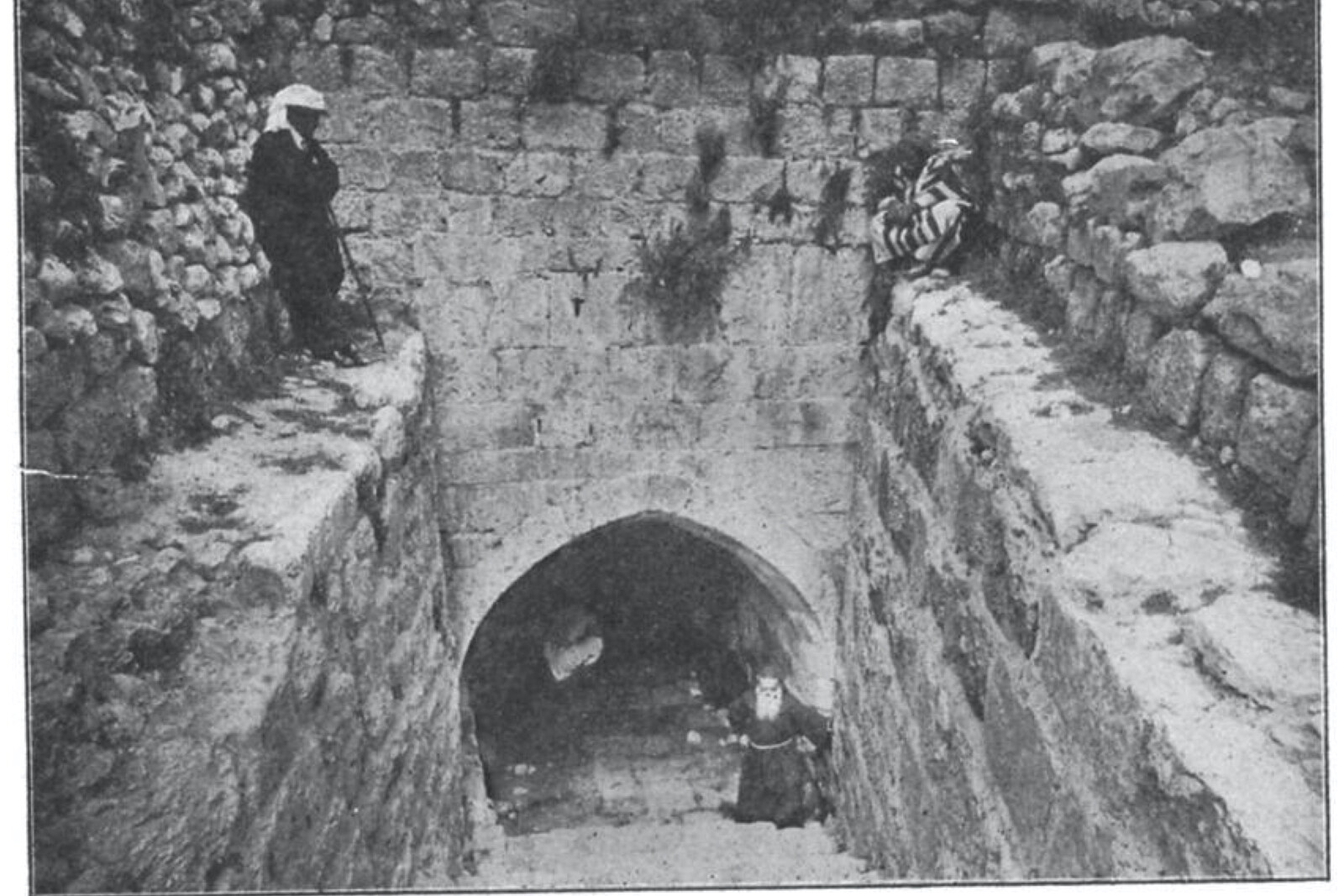
Look around first
What to notice
- Water emerging among the rock, narrow stone passageways, changes in elevation, and vertical sections of the water system.
The story of the place
Around Gihon Spring, narrow stone passageways, tunnels, and shafts with changes in elevation surround the spring. They were made to provide a route to water where going outside the fortifications could be dangerous: during a siege, whether residents could fill their vessels and return home depended on this. For centuries, people descended to the water with jars; here they rinsed cloth, waited their turn, and exchanged news. Later, pilgrims called it Gihon Spring, and tradition linked this name with Mary, who washed the swaddling clothes of the infant Jesus here.
At Gihon Spring, water behaves almost like a living creature. It does not emerge from the rock in a calm, steady stream, but pulses: swelling, then receding. Even the spring’s name is associated with bubbling, with water that seems to burst outward. For the ancient city, this was not a picturesque corner or a pleasant addition to the landscape. Gihon Spring was the reason the city could exist here at all, and at the same time its most vulnerable point.
A fortress wall can be made higher. Gates can be made thicker. A slope can be made more inaccessible. But people still have to go down for water. And if the spring lies outside the fortifications, an enemy need only cut off access to it. That is why the stone around Gihon Spring preserves traces of the same anxiety: how to reach the water without ending up under arrows. The walls, descents, tunnels, and shafts here did not appear out of love for complex engineering works. It all began with a simple vessel that had to be filled and carried home.
But once, not only the fate of a besieged city was decided at this water. Here it was decided who would become king.
By then David was already old and frail. Everyone at court understood that power would soon pass to one of his sons, but to whom exactly had not yet been decided. Adonijah acted first. He gathered supporters, held a feast, and in effect proclaimed himself the new king. Everything looked almost complete: sacrificial animals, guests, the noise of the banquet, people already counting on their place under the new ruler.
Then the prophet Nathan and Bathsheba came to David. They convinced him that there could be no further delay. David gave the order: his other son, Solomon, was placed on the royal mule and led down to Gihon Spring. Nothing about this descent was accidental. The royal mule showed that Solomon acted by David’s own will. The spring provided a place for a public ceremony. And the priest Zadok brought oil and anointed Solomon as king.
A horn sounded. The crowd cried, “Long live King Solomon!” The shouts rose from the spring to the city, and, according to the biblical account, the earth seemed to split apart from the collective noise.
At the other feast, they were still eating and celebrating. Adonijah and his guests heard the distant roar, but did not immediately understand what had happened. Then news arrived: David had already made Solomon king. And the feast instantly turned into a gathering of people for whom it was dangerous to remain together. The guests scattered. Only a few minutes earlier they had been sitting beside the future ruler; now each tried to show that he had ended up here almost by accident.
Adonijah himself sought protection at the altar. He grasped its projecting horns, hoping that the holiness of the place would grant him inviolability. So the spring became the scene of something close to a palace coup, except that instead of closed chambers there was open space, water, and an enormous crowd. One brother had been prepared for kingship at a festive table; the other was made king at the spring—and the one whose name rang out more loudly in the city won.
In this scene, two liquids come together in a remarkable way: the water of Gihon Spring, on which the city’s life depended, and the oil of anointing, which turned a royal son into a king. Water itself does not choose a ruler. But a place where people gather and without which no one can manage easily becomes a political center. To proclaim new power, a crown alone is not enough. What is needed is a space familiar to the whole city.
For Christian pilgrims, Gihon Spring acquired a completely different story and another name—Gihon Spring. According to tradition, Mary washed the swaddling clothes of the infant Jesus here. The historical reliability of this legend cannot be proven, and the tradition does not try to do so. It simply fills the ancient spring with familiar domestic life.
For centuries, women met by the water. Here they filled jars, rinsed cloth, exchanged news, and waited their turn. The stone may have remembered a royal anointing, but for most residents the spring was a place of hard, endlessly repeated work. The pilgrims’ legend sanctified precisely this ordinariness: not a throne, not a battle, not a miraculous apparition, but a mother, water, and a child’s swaddling clothes. The murmuring remained the same, but alongside kings, another family appeared in the memory of the place.
Gihon Spring has another hero as well: a man of the Victorian era with ropes, lamps, and a passion for underground mysteries. In eighteen sixty-seven, the British military engineer Charles Warren explored the water passages here. The system he discovered was later called Warren’s Shaft.
Its most impressive part is an almost vertical natural shaft. For a long time, it was thought that residents of the fortified city could reach this shaft through an underground passage without going outside, then lower a vessel on a rope to the water. It was a perfect picture of secret water supply: above, the enemy surrounded the walls, while in the darkness beneath the city, a jar slowly descended toward the spring.
Later research made this picture less certain. Archaeologists dispute exactly when the system began to be used and whether the shaft really served the purpose once assumed. Underground structures rarely preserve a clear set of instructions. They are rebuilt, expanded, adapted anew, and one era leaves its trace over another.
But that does not make the human meaning disappear. During a siege, water is not measured in tunnels or engineering plans. It is measured by the weight of a full vessel, the length of a rope, and the fear that next time there may be nothing to draw up.
That is why Gihon Spring tells several stories at once with the same sound. For the royal court, it is the sound of new power. For the pilgrim, an echo of a sacred family tradition. For the engineer, a key to the workings of an ancient city. And for its residents, water was simply that without which the next day would not come. Kings disputed the throne, researchers the purpose of the shaft, and legends changed names. The spring continued to pulse beneath the stone, reminding the city again and again what its life truly depended on.
Useful on site
City of David ticket area. According to the official park page, checked 2026-06-30: Sunday–Thursday 8:00–17:00, Friday 8:00–14:00; entry to the water system closes an hour and a half before closing time. Check the ticket page for holidays, security, and archaeological work before setting out.
Checked: June 30, 2026. Check the official source before visiting.Move slowly on wet stone and keep your hands free. Before going farther in, decide once and for all whether you are ready for a long passage through water and darkness.