 Guide On Map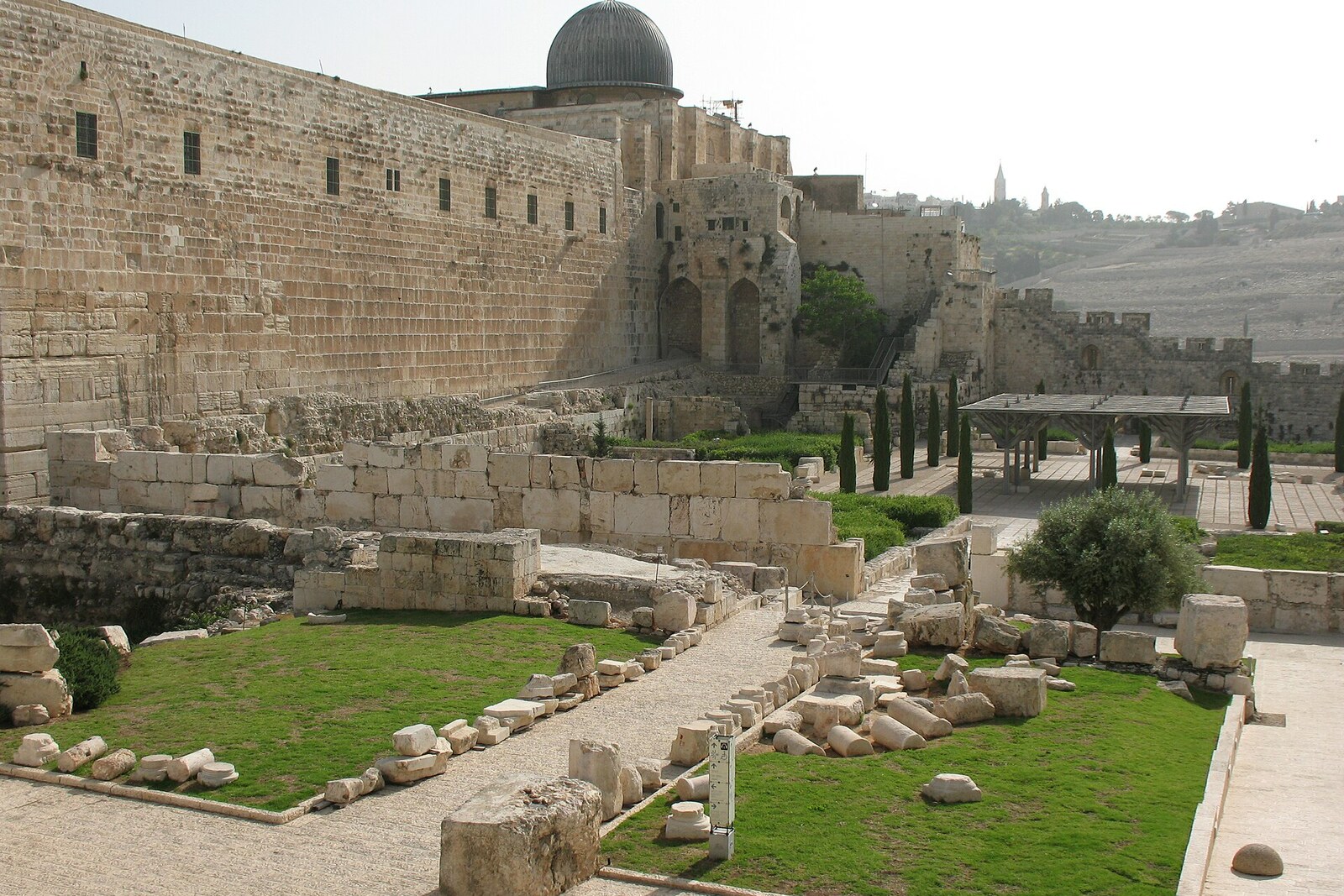
Look around first
What to notice
- The widened stone opening, Ottoman masonry, roadway, fences, and security zones.
The story of the place
Large city gates usually have solemn names: the Lions' Gate, the Golden Gate, Jaffa Gate. But this one is called the Dung Gate. The name is completely literal and even a bit provocative—especially here in Jerusalem, where almost every stone is surrounded by sacred history. But an ancient city could not survive on prayers and prophecies alone. Someone baked bread, someone carried water, someone cleaned the streets, and waste had to be hauled out of the walls. For that, there also needed to be gates.
They are mentioned in the biblical book of Nehemiah. After the return of the Jews from Babylonian exile, the destroyed walls of Jerusalem are rebuilt by the entire city, section by section. The Dung Gate falls to Malchijah, son of Rechav, the ruler of the district of Beth-ha-Kerem. The work is described with almost bureaucratic precision: Malchijah repairs the opening, installs doors, bolts, and locks. No miracle, no heavenly radiance—a official takes his section of the wall and sees it through to completion. A very Jerusalem scene: even the path for garbage must be built reliably and locked according to regulations.
The current gates are certainly not the same ones Malchijah fitted with bolts. This opening is located in the Ottoman wall from the 16th century. The ancient name survived reconstructions, changes of empires, and the disappearance of the very municipal service that once used it. It turned out that this modest utilitarian purpose proved more durable than many royal titles.
In Arabic, the gate has another name: Bab al-Maghariba, or the Moroccan Gate. And this name preserves not a biblical, but a human layer of the city. For centuries, a quarter of Maghrebis—people from North Africa—was located nearby. Pilgrims came here from Morocco and other lands of the western Islamic world; their homes, mosques, religious schools, and zawiyas (places where travelers could find shelter, food, and support) stood here.
As early as the 12th–13th centuries, the land near the Western Wall was designated as a waqf, that is, property permanently dedicated to charitable purposes. It was meant to help newcomers from the distant west of the Islamic world settle in Jerusalem. Behind this dry legal term lay simple care: a person has traveled thousands of kilometers and reached the holy city—and here, their own people greet them. Thus, next to the wall, a real community gradually grew, not just a temporary camp for pilgrims. Therefore, the 'Moroccan Gate' is not an Eastern decorative signboard, but a memory of people who lived here for generations.
In a photograph from the 1940s, Palestinian women are seen passing through this opening. They have metal vessels on their heads. There is nothing monumental in the frame: just an ordinary road, everyday concerns, heavy loads, and a familiar path home. Through these gates, they went toward Silwan to bring back water and groceries, returning to their families. The stone opening was not a monument, but a city threshold—about as familiar as an entrance door, only through it passed every day the boundary between narrow streets and the outside world.
But any Jerusalem threshold eventually becomes a military objective. In 1948, fighters from Haganah tried to break through here to the besieged Jewish quarter of the Old City. The attempt failed. The gates, through which water had been carried and garbage hauled for centuries, were locked again—not by Nehemiah's wooden bolts, but by the fire of battle.
Their appearance also changed by that time. Under Jordanian administration in 1952, the passage was widened; later, the gate underwent further reconstruction. Therefore, it is difficult to find the romantic silhouette one usually expects from old Jerusalem here. They look more like a convenient entrance: asphalt, fences, security checks, buses, service vehicles, and a dense flow of people. However, the main change occurred not in the gates themselves, but immediately beyond them.
Before June 1967, the space before the Western Wall looked completely different. One approached it through a narrow passage among the houses of the Maghrebi quarter. The wide plaza familiar to millions of pilgrims and tourists today did not exist. After Israeli troops occupied the Old City, residents of the quarter were notified at night about evacuation. According to accounts, they were given only a few hours to pack. By dawn on June 12, houses began to disappear.
Usually, around one hundred thirty-five demolished buildings and approximately six hundred fifty displaced residents are cited. Exact figures vary in sources, but the scale of the change is clear without accounting precision. In one night, an old residential quarter turned into an open space before the Western Wall. Where there had been doors, courtyards, schools, prayer rooms, and neighborhood conversations, a plaza capable of holding huge crowds appeared.
This plaza became one of Jerusalem's most recognizable places, but its spaciousness comes at a price. The stone of the Western Wall seems ancient and immovable, whereas the space before it is the result of a very recent and sharp decision. The air here seems to remember two incompatible pictures: the narrow alleys of the quarter and the wide ceremonial plaza; the domestic life of the Maghrebis and the stream of people coming to the sanctuary.
Thus, at these small gates, several Jerusalems converged simultaneously. The biblical city with its garbage, doors, and honestly placed bolts. The Muslim city welcoming pilgrims from North Africa. The city of war, where an opening in the wall became a target for attack. And the modern city of frames, turnstiles, and checks. Authorities changed, methods of control also changed, but throughout all this time, the gate remained a city boundary—a place where it is especially clear who enters, who leaves, and whose life remains on the other side of the wall.
Useful on site
Open urban space near city gates; passage, security checks, and transport stops depend on police and current security conditions. Verified 2026-06-30 based on municipal and heritage sources.
Checked: June 30, 2026. Check the official source before visiting.Do not linger in the flow of cars and buses; it is more convenient to listen to the narration from the safe pedestrian side. Checks at the gate may delay your start.