 Guide On Map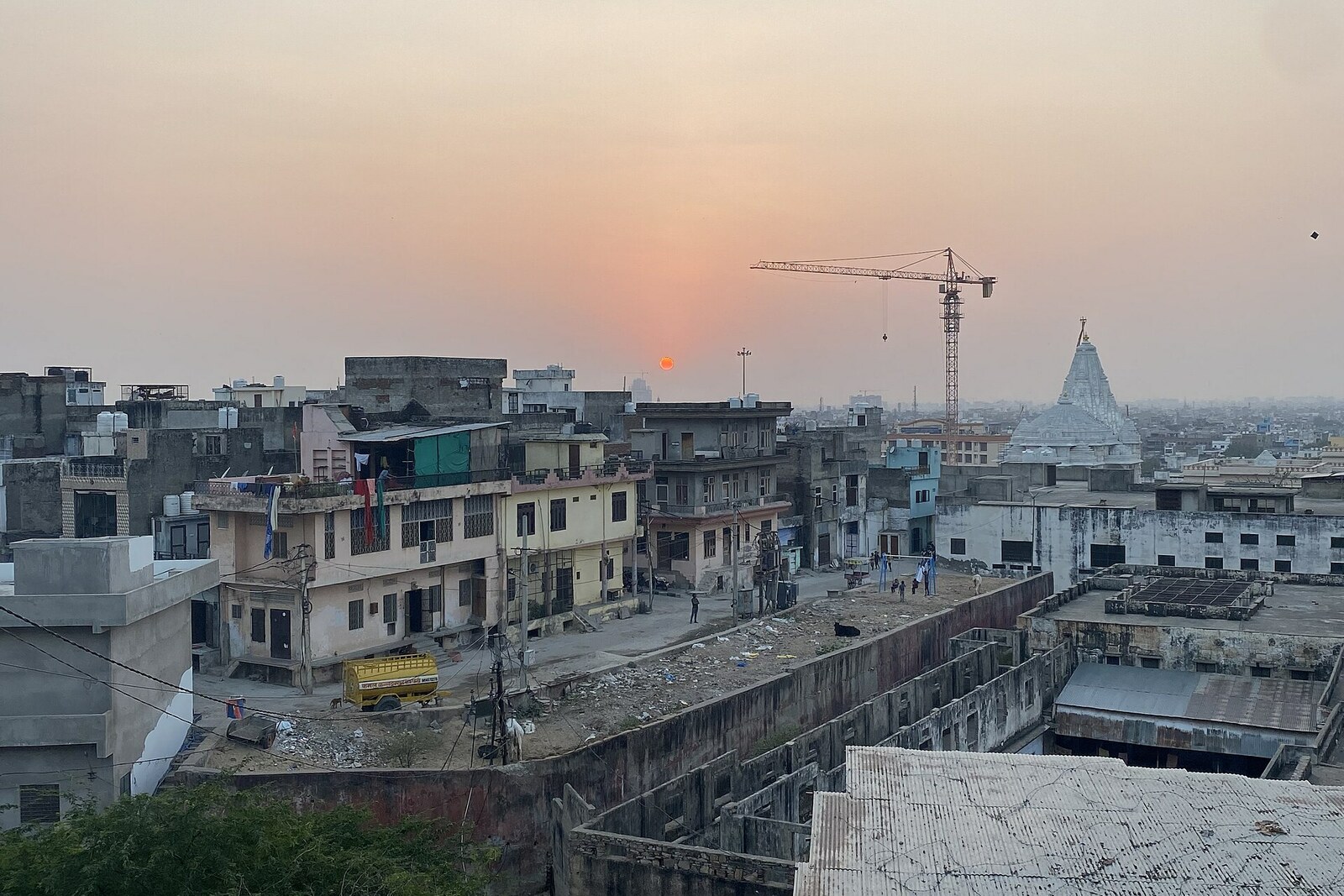
Look around first
What to notice
- The built-up plain of Jaipur
- The straight lines of the old city
- The rocky ridge
- The trail into the Galta valley
The story of the place
This rocky section of the pilgrimage trail lies on the ridge between Jaipur and the Galta valley. It has acquired no special historical name: it is a part of the route where people walking to the temples pause briefly. On the western side stretches the broad urban plain, with the straight lines of the old neighborhoods; to the east, the trail immediately begins to descend. Beyond the ridge, the view of the city cuts off, and the road enters the cramped valley.
This viewing point has no old official name or constructed terrace. It is an open stretch of ridge near Surya Temple. To the west lies the built-up plain of Jaipur, while to the east the trail heads into the narrow Galta valley. People stop here because only on the ridge do the two sides of the route come together in a single spatial relationship.
In the early eighteenth century, Jaipur did not yet exist on this plain. Sawai Jai Singh II, ruler of Amber—the former capital in the hills—was looking for a site for a new city. Amber's population was growing, water was scarce, and the slopes limited further building. Jai Singh chose the open plain and commissioned Vidyadhar Bhattacharya to prepare a plan.
At the time, Vidyadhar lived on the salary of a junior auditor in the Amber treasury: he checked accounts rather than directing famous construction projects. Now he had to place a palace, neighborhoods, markets, squares, walls, and gates on an empty site. He used Indian treatises on town planning and laid out the plain with straight streets. The commission changed his own fate as well: the treasury official became the chief architect of the new capital.
A plan was not enough—the city needed residents. Jai Singh sent special invitations to merchants and craftspeople. For them, moving meant leaving familiar markets and customers for construction on a still uninhabited plain. The ruler ordered matching shops and houses built along the main streets in advance, and assigned separate districts to particular occupations. The invited merchants agreed. By seventeen thirty-one, just four years after Jaipur was founded, builders had completed most of the streets, public spaces, and palace structures. Vidyadhar got a city, the merchants places to conduct business, and Jai Singh a new capital able to grow.
The most visible result of their risk can still be seen from the ridge: the broad built-up plain to the west and the straight lines of the old city. The viewing point itself has remained without a monument to Vidyadhar and without a historical name—simply a rocky widening of the pilgrimage trail. Beyond it, the view of the city ends; farther on, the road descends into the cramped valley that Vidyadhar did not lay out.
Useful on site
An open point with no separate hours; visit only in daylight or before complete darkness. After sunset, the descent into the valley is harder to make out.
Checked: July 1, 2026. Check the official source before visiting.Watch your footing at the rocky edge, and do not step out onto unclear side ledges for a photograph.