 Guide On Map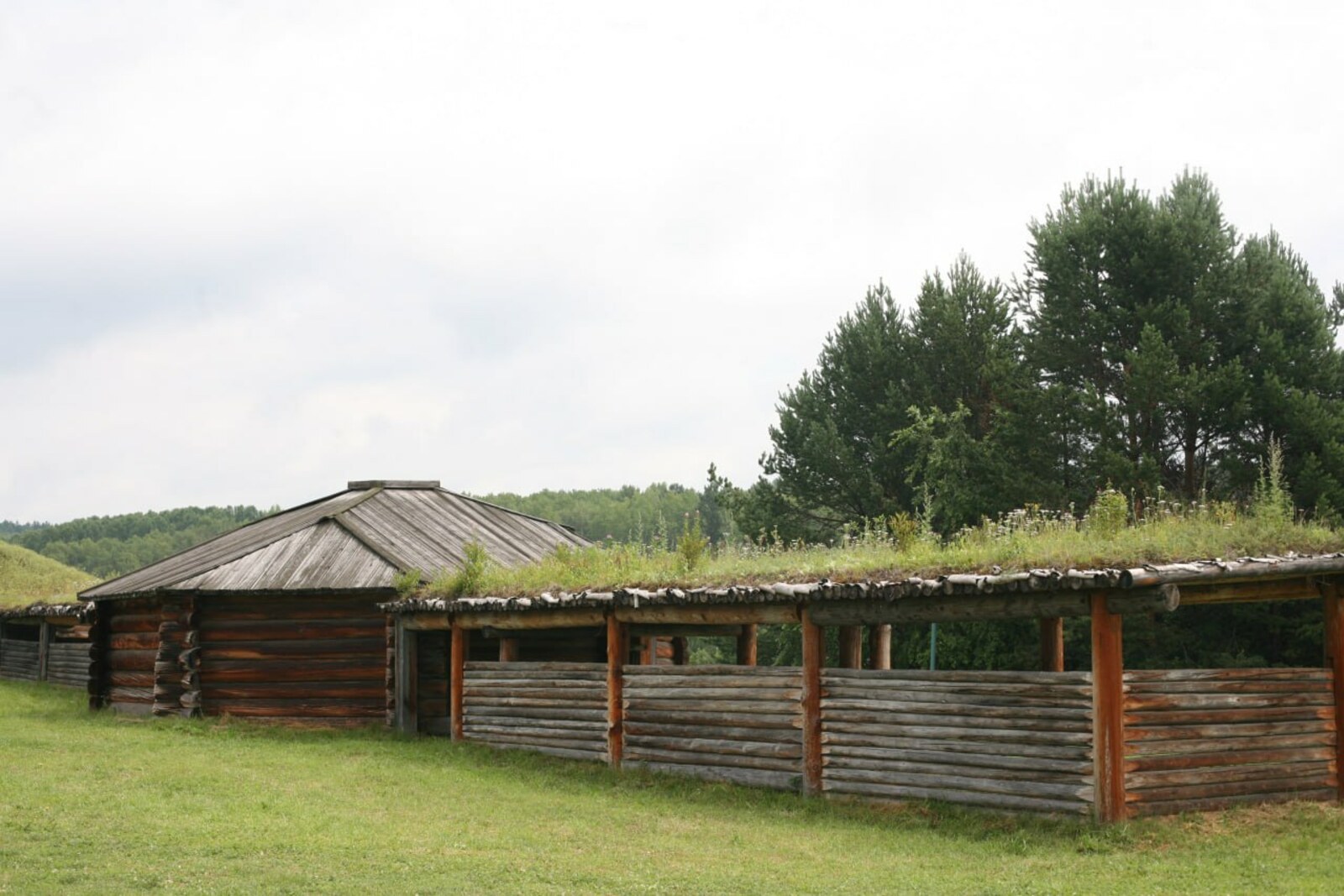
Look around first
What to notice
- Five eight-sided yurts
- Yurt entrances
- The open area in the middle
- Offset log structures
The story of the place
Five eight-sided yurts here have been assembled into a fragment of a summer settlement of the Buryats of the Lake Baikal area. Museum staff brought the log structures, built at the turn of the nineteenth and twentieth centuries, from Alaguevsky Ulus near Buguldeyka. Such settlements were established near pastures, water, and salt licks, and in autumn families left for the winter settlement, leaving their homes to await the next grazing season. The southern entrances and walls offset from one another preserve the arrangement of this seasonal dwelling.
The empty space between the wooden yurts once served as a nighttime enclosure. Families set their homes in an ellipse and brought cows, horses, and sheep inside for the night. The herd was surrounded on the outside by people’s homes.
For the owners, these animals meant a supply of meat and milk, wool for felt, and leather for clothing and footwear. A family’s prosperity was also measured by the number of head it owned. Well-to-do herders hired shepherds and sold animals to Russian merchants who sent the goods to Irkutsk. To preserve the herd meant preserving the entire household.
For summer grazing, the Buryats of the Lake Baikal area left their winter ulus in spring and moved here with their livestock. Summer camps were established near pastures, water, and salt licks—places where animals received the salt they needed. By the end of the nineteenth century, two of the four seasonal migrations of the western Buryats remained: to the summer camp and back to the winter settlement.
The log yurts themselves were not moved anywhere. Each family had a separate home. When a son began a household of his own, his parents, relatives, and neighbors jointly hewed a new yurt beside his father’s. It had to be placed so that a person leaving the neighboring home would see open space before them. That is why the homes were offset from one another, like squares on a chessboard. The entrances faced south, while the middle was left free for the herd.
In autumn, people returned to the winter settlement, while the log structure remained by the summer pasture until the next season. The word “summer camp” referred to an entire seasonal settlement: with the yurts of individual families, outbuildings, and a shared area for the animals.
The ulus here was assembled by museum staff. Five eight-sided yurts, which became the basis of the complex, were brought in nineteen eighty from Alaguevsky Ulus near Buguldeyka. They were built in the late nineteenth and early twentieth centuries. Here they were again arranged in an offset ellipse. The free space in the middle was once filled by the livestock on which the households of the families surrounding it depended.
Useful on site
According to the Taltsy museum schedule; some interiors may close earlier or for maintenance.
Checked: date not specified. Check the official source before visiting.Walk around the entire summer camp rather than limiting yourself to one yurt: its arrangement can be read in the distances between the doors, the open center, and the household items outside.