 Guide On Map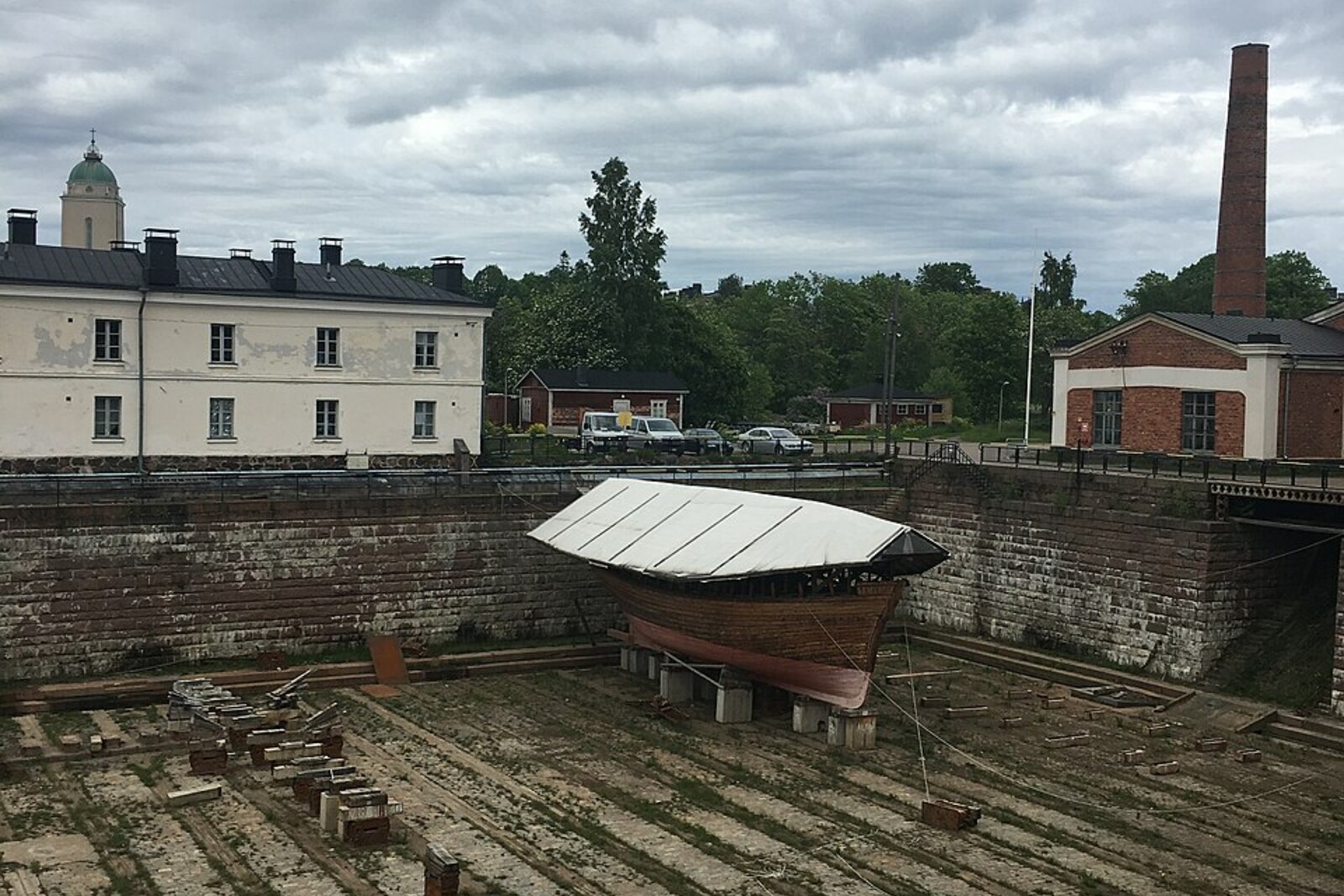
Look around first
What to notice
- Large basin
- Stone walls of the dock
- Basin gates
- Viewing platform
The story of the place
Stone walls and gates surround a huge basin that becomes part of the sea only temporarily. A vessel is brought inside by water, then the passage is closed and pumps clear the bottom: the hull remains on its supports, and work can be done around it as on dry land. This is how a natural bay between the islands became a shipyard for building and repairing ships. Each autumn, old vessels are still brought here for winter repairs, only now the water is removed by electric pumps.
In seventeen sixty-four, builders here were finishing a warship for which there was still no way out to sea. Oden had begun to be assembled two years earlier on the drained bottom of a large basin. A granite rock remained between it and the harbor.
Fredrik Henrik af Chapman was responsible for the ship—a salaried master shipbuilder of the Finnish squadron of the Swedish Archipelago Fleet. Augustin Ehrensvärd, who commanded that squadron, sought vessels for the shallow straits between the islands. Chapman designed a ship able to travel under sail and by oars. Oden became the first example of a new type. Its calculations were to be tested in the very skerries for which it had been built.
Chapman was able to begin work thanks to the engineer Daniel Thunberg. He used a natural bay between Susisaari and neighboring islets: people blocked the straits with dams and created a basin that could be separated from the sea. A ship enters such a dock by water; then the gates are closed, the water is pumped out, and the hull settles keel-first onto prepared supports.
Thunberg assigned the pumping to a huge windmill. One drive removed water, sawed boards for the shipyard, and ground grain. When there was no wind, horses turned the pumps. In this way, the builders kept the bottom dry while they built the walls and assembled ships.
To release Oden, the workers began cutting the eastern lock directly through the granite. By October seventeen sixty-four, they had completed both the ship and the passage. Oden left the basin and managed to take part in the squadron’s exercises before winter. A memorial stone recorded the two results side by side: Chapman built the ship, and the builders cut it a road to the sea.
The eastern exit was later filled in. A fragment of the stone bearing the record about Oden was found during cable laying in nineteen seventy-seven; it now lies at the edge of the Great Courtyard, not far from Ehrensvärd Museum.
The large basin is still drained in the same way. In autumn, it is filled, about twenty old wooden and iron vessels are brought in, the gates are closed, and the water is pumped out. In winter, shipbuilders repair the hulls, sails, and rigging. In spring, the basin is filled again, and the vessels leave for sea. Thunberg’s windmill was dismantled long ago; electric pumps now remove forty-two thousand cubic meters of water.
Useful on site
The viewing platform is accessible as an outdoor point on the route. The dock itself is a working area; access down into it is prohibited. Workshop hours and the visibility of work are not guaranteed.
Checked: June 30, 2026. Check the official source before visiting.View the dock only from permitted viewing areas: this is an active working area, and there is no need to go down inside or beyond the barriers.