 Guide On Map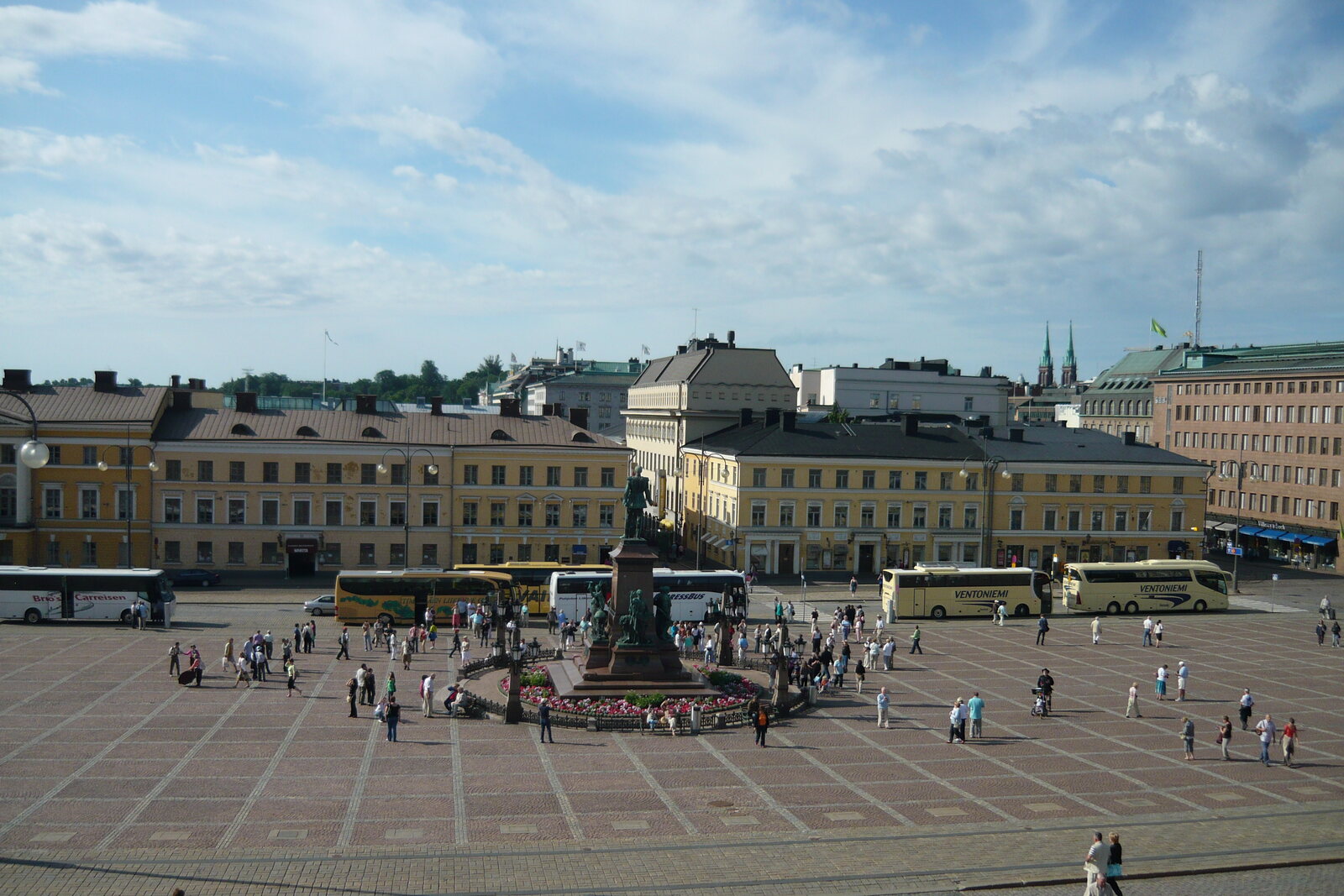
Look around first
What to notice
- Alexander II Monument
- Bronze figure of Lex
- Eastern façade of the former Government Palace
The story of the place
The former Senate House, now the Government Palace, stands along the eastern edge of the square, the university is opposite it, and the main Lutheran church rises above. When Helsinki was made the capital, the highest governing body of the Grand Duchy of Finland was moved here from Turku, and the square took its name from it. Parades, the openings of estate assemblies, and university processions took place between these façades, although most townspeople remained spectators. At the base of the monument sits the figure of Lex: a Finnish maiden is wrapped in a bearskin.
On March thirteenth, eighteen ninety-nine, Helsinki residents came here in mourning clothes and covered the base of the Alexander II Monument with flowers. The flowers were meant for the dead emperor, but the message was addressed to his grandson—Nicholas II, who was ruling at the time.
The choice of square was precise. Senate Square took its name from the Senate of Finland—the highest governing body of Finland in the years when the Grand Duchy of Finland was part of the Russian Empire, while retaining its own laws. After Helsinki became the capital, the Senate of Finland was moved here from Turku; its building occupied the eastern side of the square. The university was placed opposite it, and the main Lutheran church rose above. Military parades, the opening of the Diets, and university processions were held here. Most townspeople took part in them as spectators.
Alexander II has stood at the center since eighteen ninety-four. Ten years before the monument was unveiled, the Finnish estates announced a competition in memory of the emperor, who was killed in St Petersburg. They thanked him for decisions important specifically to Finland. In eighteen sixty-three, he convened the Finnish Diet—an assembly of four estates that passed laws—after a break of more than half a century. At the same time, the Finnish language began its transition toward equal status with Swedish in administration. The sculptors depicted Alexander II delivering a speech before that Diet.
On February fifteenth, eighteen ninety-nine, Nicholas II signed a manifesto: in matters declared to concern the empire as a whole, the Finnish Diet was granted only an advisory voice. The Finns believed that the emperor was violating the laws established for the Grand Duchy. In the Government Palace, the votes for and against publishing the manifesto were evenly split—ten to ten. The vice-chairman's vote decided that the document would nevertheless be published.
The journalist Tekla Hultin sought the repeal of the manifesto. At night, with the windows closed, she made copies of the Great Petition and distributed sheets for signatures. She lived by her newspaper work and risked her own income: soon the governor-general shut down the publication Hultin headed. The next day, she was among those who brought flowers to the monument. The participants in the silent demonstration invoked the grandfather who had convened the Finnish Diet in order to object to the grandson who was pushing that Diet away from legislation.
In eleven days, volunteers collected five hundred twenty-two thousand nine hundred thirty-one signatures. Five hundred representatives—one from each community—gathered at the Alexander II Monument before traveling to St Petersburg. They wanted to present the petition to Nicholas II in person and secure the repeal of the manifesto. The emperor refused to receive them. The delegates returned to Helsinki, and the manifesto remained in force until November nineteen five.
At the foot of the monument, the bronze figure of Lex still sits—a Finnish maiden wrapped in a bearskin. Above her, Alexander II holds his hand as though he were continuing his speech before the Diet. On the eastern side still stands the building where, thirty-six years later, one vote decided the fate of his grandson's manifesto.
Useful on site
Choose a spot with a good view and do not stand in the way of passersby; the whole episode is heard outside.