 Guide On Map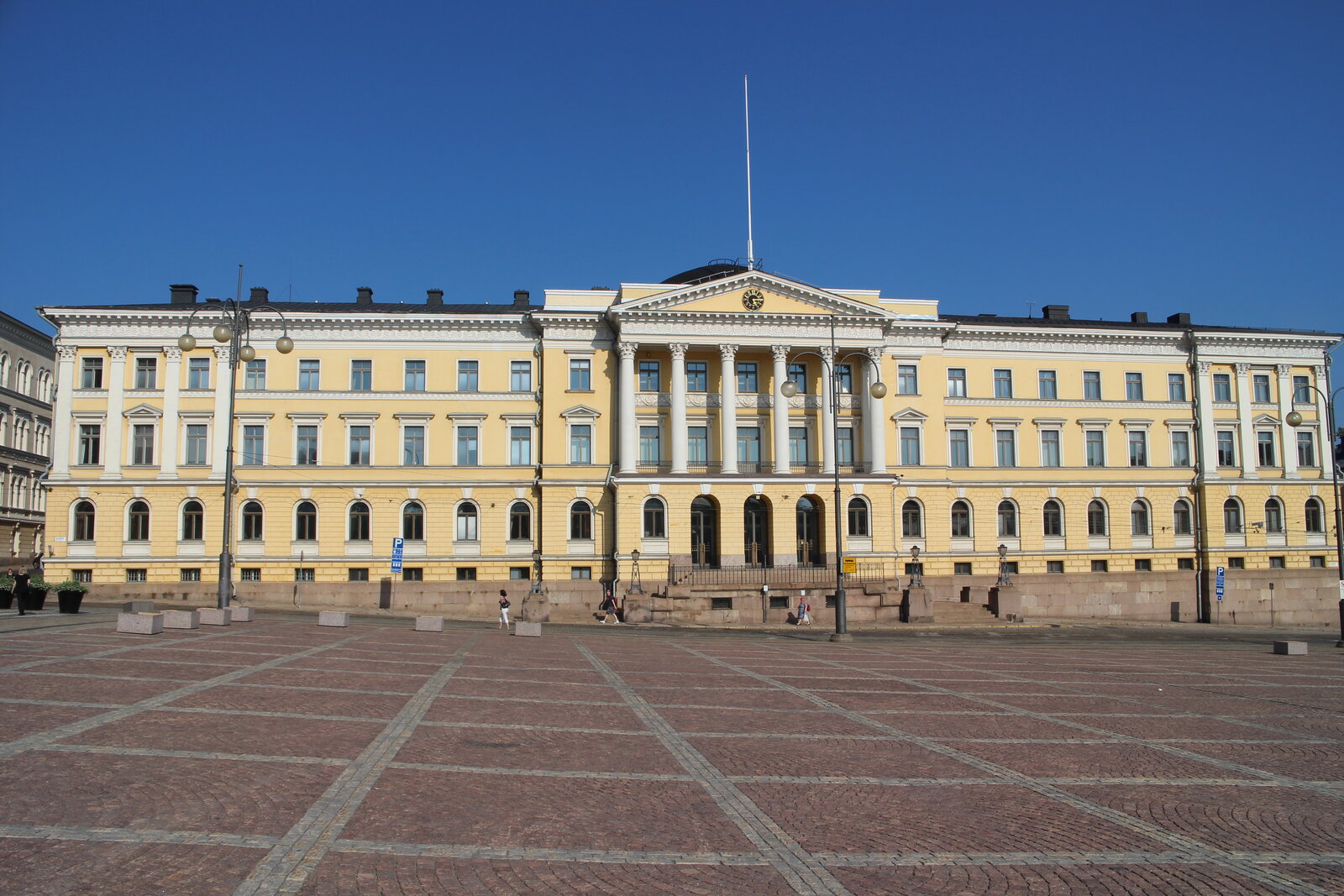
Look around first
What to notice
- Corinthian columns
- Ceremonial portico
- The square’s eastern facade
The story of the place
Behind the Corinthian portico on the eastern side of Senate Square are the Prime Minister's Office, the Ministry of Finance, and the Chancellor of Justice of Finland. After Finland gained independence, the administrative part of the former Senate became the government, the judicial part became the Supreme Court of Finland, and the building itself received its present name. Its official role has remained, but only employees are now admitted inside.
Behind the Corinthian columns is the ceremonial staircase. Until the end of the twentieth century, city residents entered here on business without passes. The building was constructed specifically for officials and visitors: in eighteen twenty-two, the Senate of Finland and the central institutions of the autonomous Grand Duchy of Finland moved here. Unlike the Diet, the Senate handled day-to-day administration and justice. That is why the building was called the Senate House.
On June sixteenth, nineteen oh four, Nikolay Bobrikov, the governor-general—the highest official in Finland, appointed by the emperor—was climbing this staircase. After the February Manifesto, already mentioned, he implemented measures that curtailed Finnish autonomy and secured emergency powers to suppress resistance. That day, Bobrikov was going to a meeting of the Senate’s Economic Division.
Eugen Schauman, an assistant cashier at the Board of Education, was waiting for him on the second-floor landing. His income was a civil servant’s salary, but he considered Bobrikov the chief agent of Russification. Schauman decided to kill the governor-general and thereby make Nicholas II see Finland’s situation. He had addressed a letter with this explanation to the emperor in advance. Schauman did not plan an escape: several months before the attack, he began drawing up a will.
When Bobrikov reached the landing, Schauman shot him three times. He then aimed the pistol at his own chest and fired twice more. Schauman died at the scene. Bobrikov was brought to the hospital and operated on in time, but died the following night.
The Senate continued to meet in this building. After Finland gained independence, its Economic Division became the government, its Judicial Division became the Supreme Court of Finland, and in nineteen eighteen the Senate House was renamed the Government Palace. The Prime Minister's Office, the Ministry of Finance, and the Chancellor of Justice of Finland now work here.
At the site of the five shots, a black granite plaque remains, installed in nineteen thirty-three. It bears a Finnish lion, Schauman’s name, the date of the assassination, and the words: “He gave himself for his homeland.” Bobrikov’s name is not on the plaque. It hangs inside, on the second-floor landing; it cannot be seen from the street, and entry to the building is now permitted only to employees.
Useful on site
View the palace from the square: it is an active government building, and the staircase and memorial plaque described in the story are not visible from outside.