 Guide On Map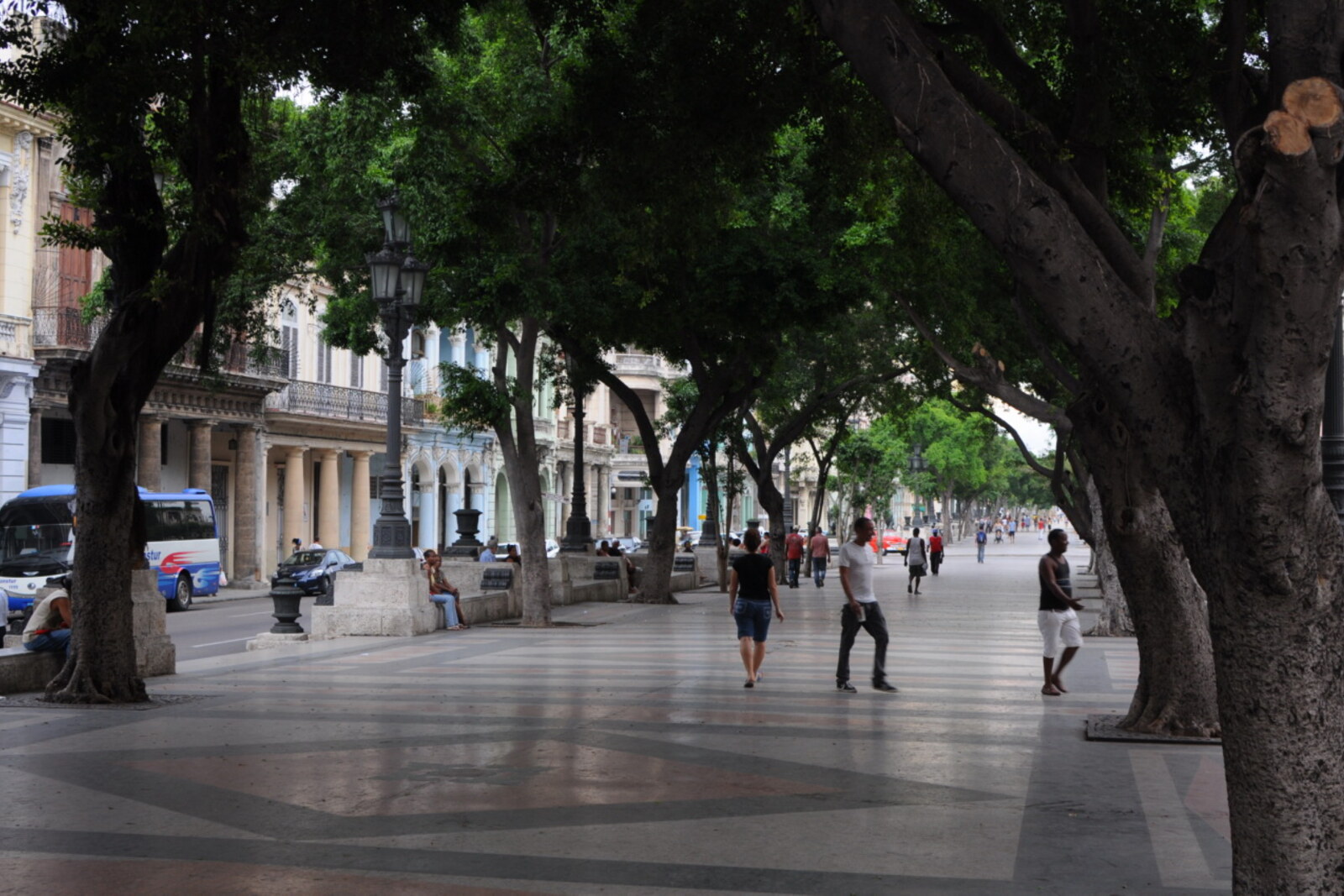
Look around first
What to notice
- Central pedestrian promenade
- Paseo de Martí sign
- Corner house on Ánimas Street
- Rafael María de Mendive School sign
The story of the place
Officially, this avenue is called Paseo de Martí, but Havana residents still call it “Prado.” It began in seventeen seventy-two, when the Spanish governor Felipe de Fonsdeviela, Marquess of la Torre, ordered a place for walks to be laid out beyond the fortress wall. Hence its first name, Alameda de Extramuros, “the promenade beyond the walls.” Later, it began to be compared with the Prado in Madrid. The wall was dismantled, the city grew on both sides, and the promenade remained on the former boundary between Old Havana and Centro Habana.
The connection with Martí also began here. In the house on the corner of Ánimas Street, then at Prado, eighty-eight, the educator and poet Rafael María de Mendive ran San Pablo School. Mendive supported Cuba’s independence and wanted to give a talented pupil the education he might otherwise lose. That pupil was José Martí, the son of a police inspector and the future organizer of the last war for Cuba’s separation from Spain.
Mendive secured the boy’s father’s consent and undertook to pay for his schooling until he completed secondary education. Martí earned the highest marks in his examinations, helped his teacher run the school, and in eighteen sixty-eight moved into the same house: his family lived far away, and he went home on Sundays. For Martí, Prado became at once a school, a workplace, and a home.
In October of that year, the Ten Years' War for independence began in Cuba. Its supporters gathered in Mendive’s house. After armed units loyal to Spain opened fire on independence supporters at the Villanueva Theatre and then shelled Café Louvre on Prado, Mendive was arrested on suspicion of ties to the rebels. A military court sentenced the teacher to four years of exile, and San Pablo School was closed.
Sixteen-year-old Martí often visited Mendive in confinement. After the school closed, he hired himself out as a messenger: he worked from six in the morning until eight in the evening and gave his earnings to his father. In the autumn, the police found his letter to a former classmate who had joined a Spanish volunteer unit. Martí called him a traitor and urged him to leave the unit. For this, the seventeen-year-old youth was sentenced to six years of hard labor. At the quarry, shackles were fastened to his leg, linked by a chain to a belt. Only his parents’ efforts made it possible to replace hard labor with exile in Spain.
Exile did not end the education that had begun here. In eighteen ninety-two, Martí founded the Cuban Revolutionary Party to unite scattered independence supporters and prepare a new uprising. In eighteen ninety-five, he returned to the island and died in battle near Dos Ríos.
In November nineteen oh four, the city council gave the former Paseo de Isabel II the name José Martí. The colloquial name “Prado” outlived every official name. The house on the corner of Ánimas is now occupied by the Rafael María de Mendive Primary School: the avenue’s sign still bears the pupil’s name, the school’s sign bears the teacher’s name, and children are once again studying in their former classrooms.
Useful on site
Around the clock, free passage
Checked: June 19, 2026. Check the official source before visiting.Walk along the pedestrian section and look to both sides several times: the difference between older and later Havana is best seen across the boulevard. You do not need to enter any buildings for this stop.