 Guide On Map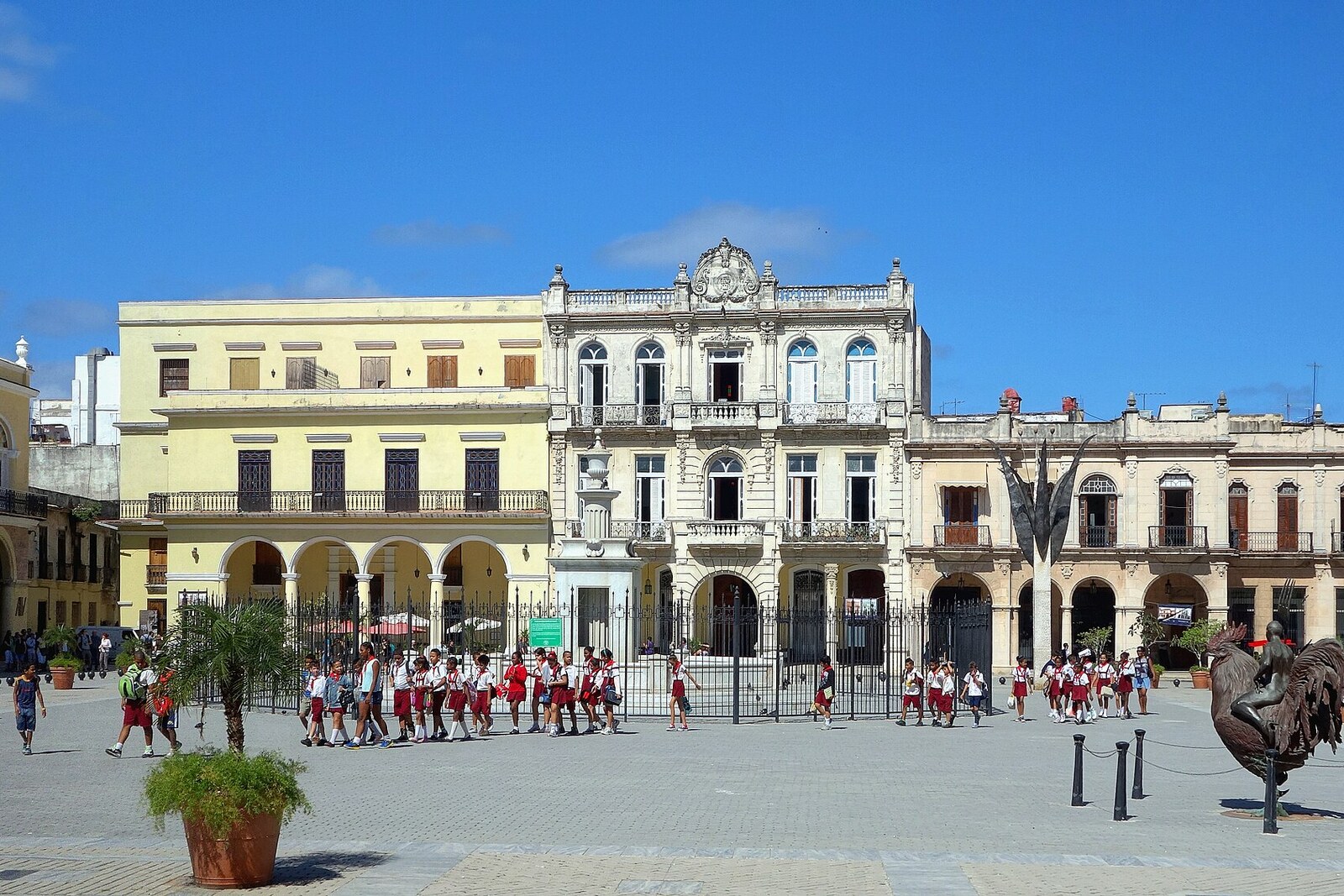
Look around first
What to notice
- The fountain in the center of the square
- The balconies of the houses around the perimeter
- The open paving
The story of the place
Plaza Vieja means “Old Square,” although residents first called it Plaza Nueva. After the construction of the fortress occupied the former public space by Plaza de Armas, the city council set aside a rectangular plot farther south in fifteen fifty-nine for a market and festivities. Wealthy families built houses around it, with commercial premises below and balconies from which they watched performances, processions, and bullfights. When the next new square appeared by the Church of the Holy Christ of the Good Journey, the former Plaza Nueva received its present name.
In eighteen thirty-five, four owners of houses on the eastern side of Plaza Vieja tried to stop a major construction project here. At the time, wooden market rows stood in the center around a fountain. Captain General Miguel Tacón, governor of Cuba and the chief patron of the city's transformations, wanted to replace them with a stone market. The owners claimed that its walls would deprive their houses of light and air. They no longer lived in those houses themselves, but they were defending the real estate they owned.
Tacón had his own stake. The cleanliness of the markets served as an indicator of the quality of his administration, and the contract went to private investors, among them Manuel Pastor, an engineer close to the governor. They paid for the construction, then received the exclusive right for several years to collect fees from traders, thus recovering the money they had invested. After the concession ended, the building was to pass to the city.
The homeowners sent a complaint to Spain. Tacón replied in a letter to the minister, addressing not the arguments but the complainants themselves: he declared one inexperienced, another a debtor, and accused a third of personal hostility. The complaint was rejected. By eighteen thirty-seven, the stone rows had been completed.
The market was named after Maria Christina of the Two Sicilies, who ruled Spain on behalf of her underage daughter. Four wings occupied almost the entire center of the square. Each stall had a counter, a chest, and equipment for cutting meat; rooms for the sellers were arranged above the rows. Enslaved women came for daily provisions for their masters' households. Black middlemen bought meat, vegetables, and fruit wholesale and distributed them through the city and its suburbs at retail—for some, this was a profitable business. By eighteen sixty-two, sixty stalls brought in forty-two thousand pesos in rent.
The stone walls did not eliminate the dampness and dirt. The Cuban physician Nicolás José Gutiérrez advocated closing covered markets as sources of infection, and in nineteen oh eight the city council ordered Mercado de Cristina demolished. The homeowners won this dispute seventy years after their complaint, when neither their opponents nor the first traders were still alive.
The present fountain was installed in nineteen ninety-seven after a model known from nineteenth-century engravings. It is not the one at which the market's water carriers filled their barrels: the old basin had already been removed in eighteen forty-seven. The stone market rows disappeared as well. Now cafés and cultural establishments occupy the ground floors of the houses around the perimeter, while open paving once again covers the place where the sixty stalls and the sellers' rooms once stood.
Useful on site
View the square first from the edge, then walk to the outline marked on the ground: this makes it easier to compare the present emptiness with the former dense development. The cafés, galleries, and other premises around it operate independently of the route and are not needed for listening.