 Guide On Map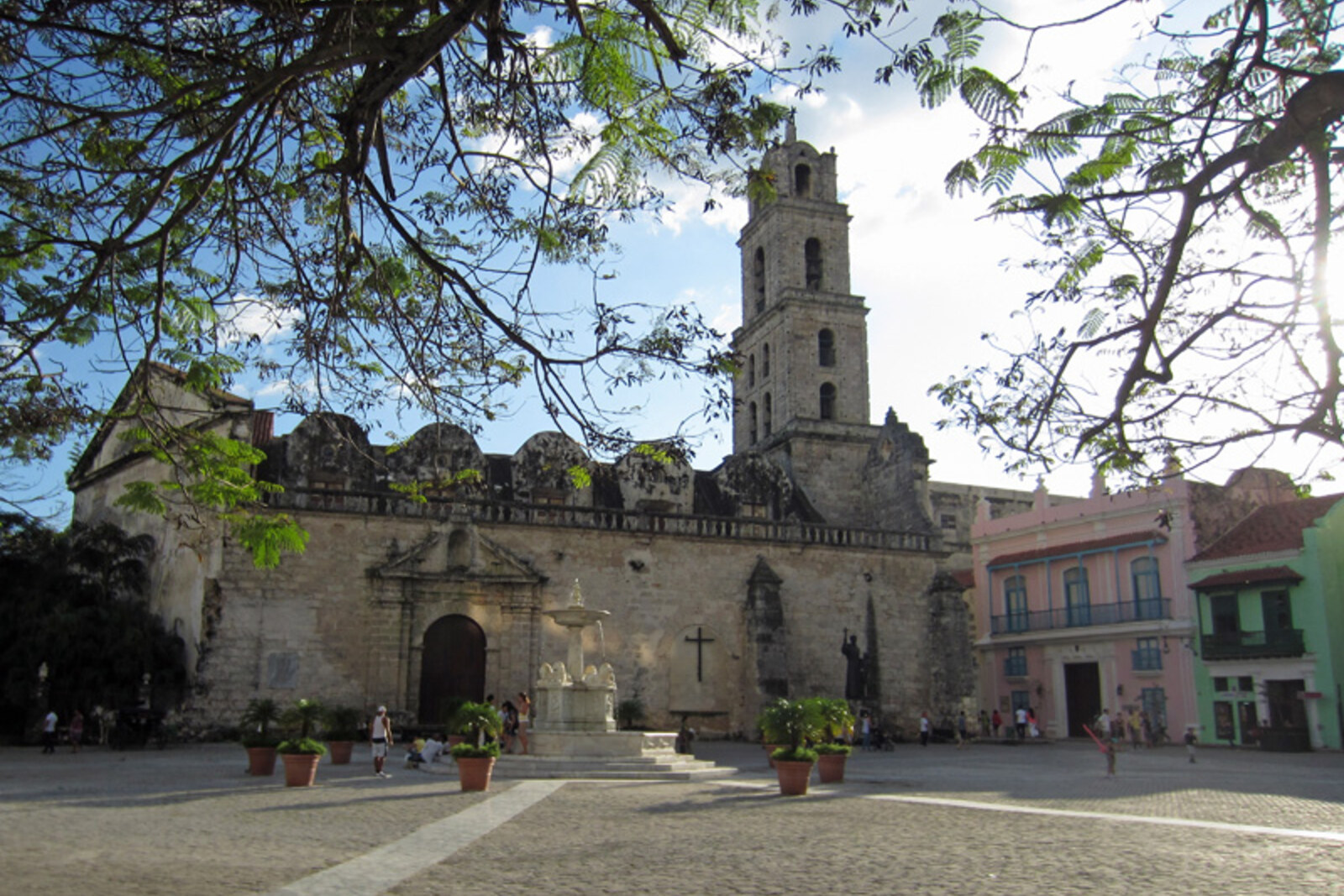
Look around first
What to notice
- Long wall of the Former Convent of San Francisco de Asís
- Tower of the Church of Francis of Assisi
- Paved space before the harbor
The story of the place
The long façade of the Former Convent of San Francisco de Asís stretches along the paved square, with the church tower visible above it. The square takes its name from the convent dedicated to Francis of Assisi. The monks of this order lived here. The first convent did not survive, and the existing buildings were constructed in its place in the first half of the eighteenth century.
In fifteen seventy, the wealthy Havana resident Juan de Rojas died. He welcomed the Franciscans, who did not yet have a permanent home in the city, beside his own dwelling and fed them at his own table: with bread, meat, and wine. In his will, Rojas directed that part of his property be given for a convent for these monks.
His main heir was his nephew, Jerónimo de Avellaneda. The condition reduced the estate he received, and he refused to carry it out. A representative of the Franciscans then appealed to the Spanish king. The king ordered the will to be examined and, if everything was confirmed, the heir to be compelled to carry out the dead man's wishes.
In fifteen seventy-five, the prior Francisco de Jiménez began gathering testimony. He sought a permanent refuge for the brothers who came to Havana and depended on the hospitality of others. Four years later, the Franciscans acquired a house and plot right by the water, beside the quay. Construction of the convent began the following year. Avellaneda's attempt to keep the entire inheritance ended with the order finally gaining a home of its own on the harbor shore.
Francis of Assisi is the Spanish name for Francis of Assisi, an Italian preacher and founder of the Franciscans. The monks dedicated their convent to him, and the name passed from the convent to the square.
There was not yet a square in front of the convent. A small sea inlet reached almost to present-day Oficios Street, and boats came up to the quay where paving now lies. When Spanish flotillas entered the harbor, their crews prepared barrels here for fresh water. There were so many barrels that they filled the entire street between the city buildings and the convent.
In sixteen twenty-eight, the city council ordered the water channel that ran here to be closed, the shore put in order, and a small square laid out in front of the convent. One hundred ducats were initially allocated for the work, and another one hundred were added the following year. The inlet was gradually filled in; ship crews received a place for their water barrels, and the street became passable again.
The first convent building has not survived: the present complex was rebuilt in the first half of the eighteenth century. The inlet disappeared as well. What remains is the exact arrangement for which the shore was cleared here: the long wall of the Franciscan convent, paved space before it, and the port beyond. Water lay beneath part of the present square, while barrels that supplied flotillas leaving Havana stood on the first strip of dry land.
Useful on site
The former church is used as a concert venue, so visiting the interior depends on separate access or an event. The square and sculptures are easy to see from outside; leave the passage by El Caballero de París clear, and keep in mind that people often gather around the monument.