 Guide On Map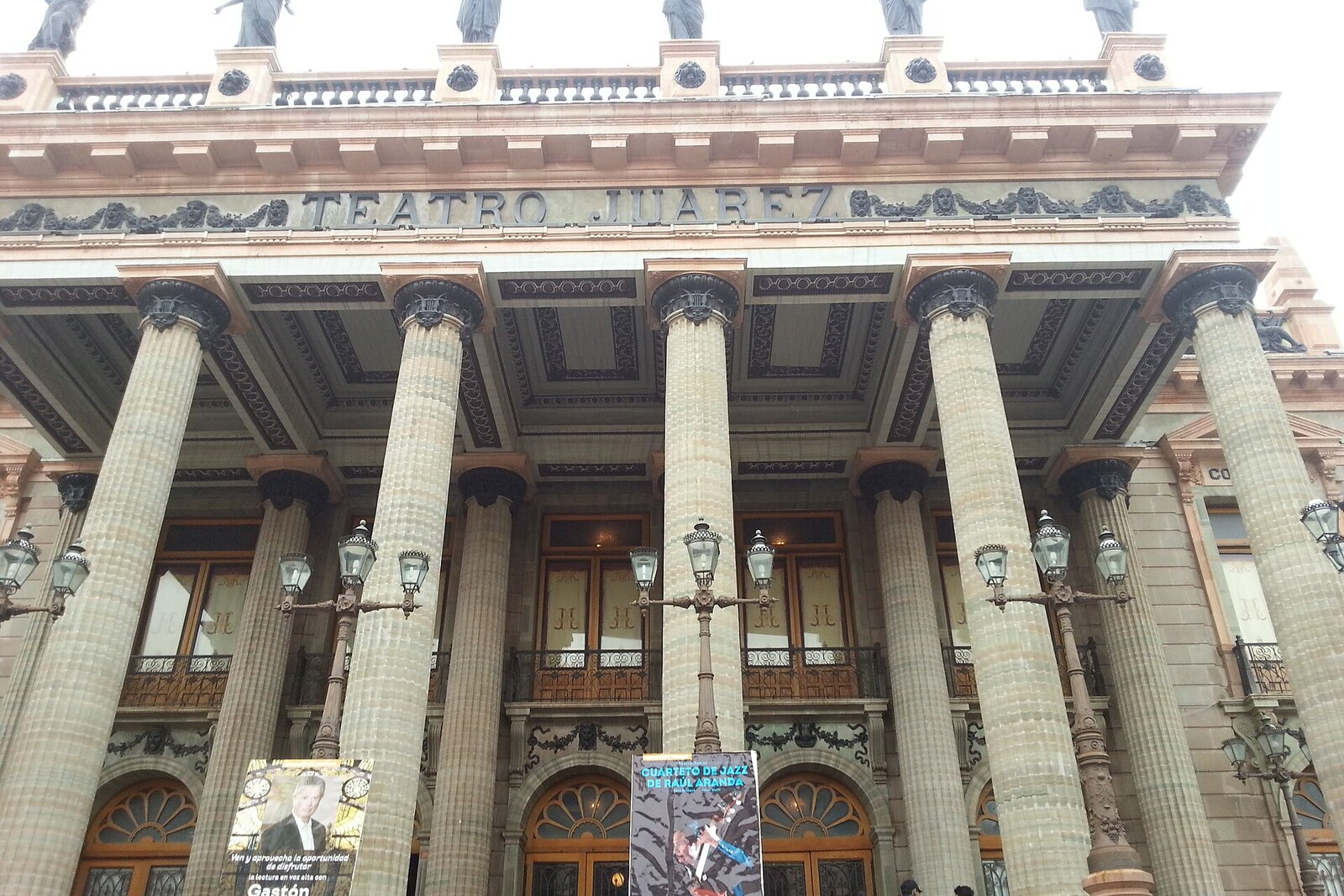
Look around first
What to notice
- Facade bearing Juárez’s name
- Church of San Diego
- Excavated cloister
- Old sacristy
The story of the place
The theater hosts opera, drama, concerts, and dance performances, and during the International Cervantino Festival it is among the city’s main venues. Before theatrical programs, the site served as Hotel Emporio with a stagecoach station, where travelers stayed and carriers worked. An old church survives nearby, and below street level archaeologists have cleared a cloister, sacristy, and passage—about forty percent of the former complex. Performances take place directly above these excavated rooms.
The surname on the facade is that of Benito Juárez, president of the liberal government, who during the civil war sought to separate church and state. His decisions literally transformed this part of the city: a monastery of the Discalced Franciscans once stood here, adjoining the surviving Church of San Diego.
Juárez led one of Mexico’s two hostile administrations and risked losing the country to his opponents. In eighteen fifty-nine, he began implementing the Reform Laws: church property passed to the state, and monastic communities were dissolved. For the Franciscans of Guanajuato City, this meant expulsion from the monastery that contained their cells, refectory, and service rooms.
Between eighteen sixty-one and eighteen sixty-three, city officials dismantled part of the monastery, reduced its atrium to enlarge the neighboring square, and sold the remaining buildings to a private company. The cells became rooms at Hotel Emporio, which also opened a stagecoach station. The residents who had lived by the Franciscan rule of poverty were replaced by guests and carriers.
The hotel operated for nine years. Then the governor of Guanajuato State, General Florencio Antillón, decided to build a theater capable of receiving large opera and drama companies. In eighteen seventy-two, the government bought Hotel Emporio and ordered it demolished. Juárez died that same year, and the new theater was given the name of the president whose laws had earlier taken this site from the monastery.
Thirty-one years passed from Antillón’s decision to the first performance. On October twenty-seventh, nineteen oh three, President Porfirio Díaz opened the theater. He knew well the man whose name was already on the facade: Díaz had previously fought as a general for Juárez’s republic against the French intervention, then launched an unsuccessful revolt in an attempt to prevent Juárez’s next reelection.
Admission to the opening was by personal invitation, and strict formal dress was required. An Italian company performed Giuseppe Verdi’s Aida. Photographs of the evening appeared in the national press a few days later: the theater was immediately presented to the country as the principal hall of prosperous Guanajuato City. Opera, drama, concerts, and dance performances are now staged here; since nineteen seventy-two, it has been one of the main venues of the International Cervantino Festival.
The monastery did not disappear entirely. The Church of San Diego survives nearby, and below today’s street level archaeologists have cleared about forty percent of the old monastery: the cloister, sacristy, porter’s lodge, and entrance passage. Performances take place above these rooms in the theater named for the man after whose laws the Franciscans left them.
Useful on site
The facade can be viewed from outside; interior access depends on the schedule, rehearsals, and box-office hours.
Checked: date not specified. Check the official source before visiting.All the main exterior details can be seen from the square; plan a separate visit for the auditorium, and do not treat it as a required part of the route.