 Guide On Map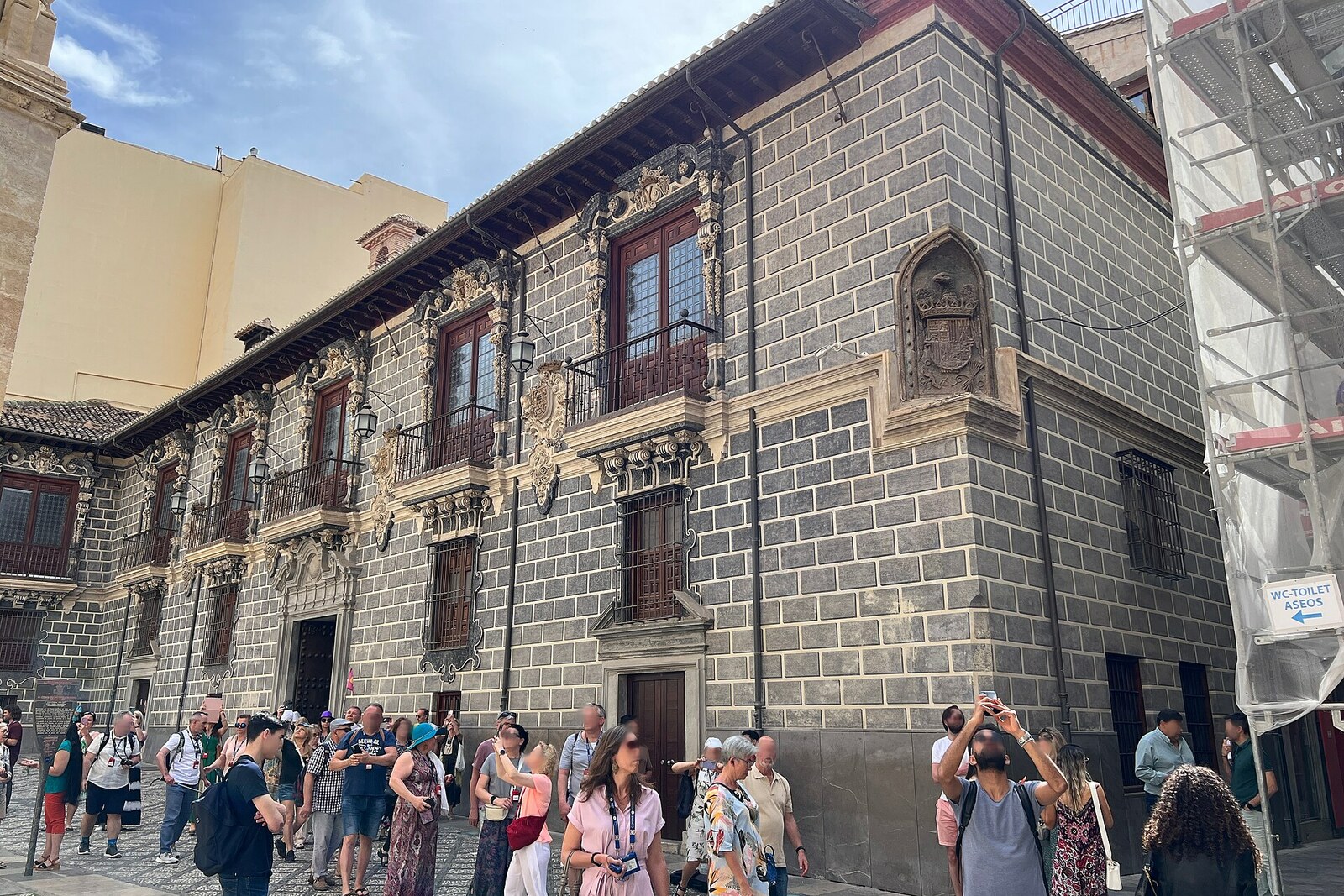
Look around first
What to notice
- Prayer hall
- Mihrab
The story of the place
The surviving prayer room with its mihrab recalls an entire teaching courtyard in the quarter of the Great Mosque of Granada, Zacatín, and Alcaicería. Here, students lived, prayed, and studied, while teachers came from Granada and North Africa. The school trained legal experts for the courts and state officials, but its curriculum also included language, mathematics, astronomy, and medicine. The building was later almost entirely rebuilt, so neither the student rooms nor the marble entrance remains.
In thirteen forty-nine, the first minister Ridwan ibn Abd Allah secured the opening of a state institution of higher learning here. Granada needed judges, notaries, officials, and theologians trained in the legal tradition accepted at court. Yusuf I, seeking to rely on such experts, approved the school’s foundation and gave it his own name—Yusufiyya. A marble foundation slab praised the sultan, although sources primarily associate the conception and organization of the madrasa with Ridwan.
Ridwan was born into a Christian family in Calzada de Calatrava. Still a child, he was taken captive during a Nasrid raid, brought to Granada as a slave, converted to Islam, and received his freedom and an education at court. He served three sultans, conducted negotiations with neighboring kingdoms, and accumulated a great fortune over decades of court service. Whether he connected the school’s foundation with his own fate is unknown. What is known is what he spent the money on.
Ridwan invested substantial funds in a waqf—an endowment of income-producing real estate that could not be taken back or divided among heirs. Its rental income went toward maintaining the building, the teachers, and the students. Ridwan paid for the decoration of the rooms, arranged rooms for students, and brought water here from the city network. Thanks to this, the madrasa did not depend on a one-time gift from the sultan: students received lodging and stipends, while teachers received permanent support.
The site was chosen opposite the Great Mosque of Granada, near Zacatín and Alcaicería. Islamic law had previously been taught mainly at mosques; now, beside one, there was a separate place where students lived, prayed, and studied at the same time. The Quran, theology, and law formed the basis of instruction, supplemented by Arabic, mathematics, astronomy, and medicine. Teachers came from Granada and North Africa, and the legal experts trained here became judges and officials of the Nasrid Kingdom of Granada.
After teaching ceased, the former madrasa was handed over to the city council, and later owners almost completely rebuilt it. The best-preserved part of Ridwan’s school is the prayer hall with its mihrab—a niche indicating the direction of prayer. The student rooms and marble entrance disappeared; fragments of the slab bearing Yusuf’s name are now in the Alhambra Museum.
Today, university lectures, exhibitions, and concerts are held here. What remains on the site is the word “Madrasa,” in the museum the sultan Yusuf’s name, and inside a room of the school that the former captive Ridwan created with his own fortune.
Useful on site
Monday–Friday 09:00–21:00, Saturday 11:00–14:00 and 17:30–20:30 (during exhibitions); closed Sundays and holidays.
Checked: June 17, 2026. Check the official source before visiting.The main details are inside, so viewing the exterior does not replace a visit. If access is restricted, listen to the account by the building and plan to see the interior separately.