 Guide On Map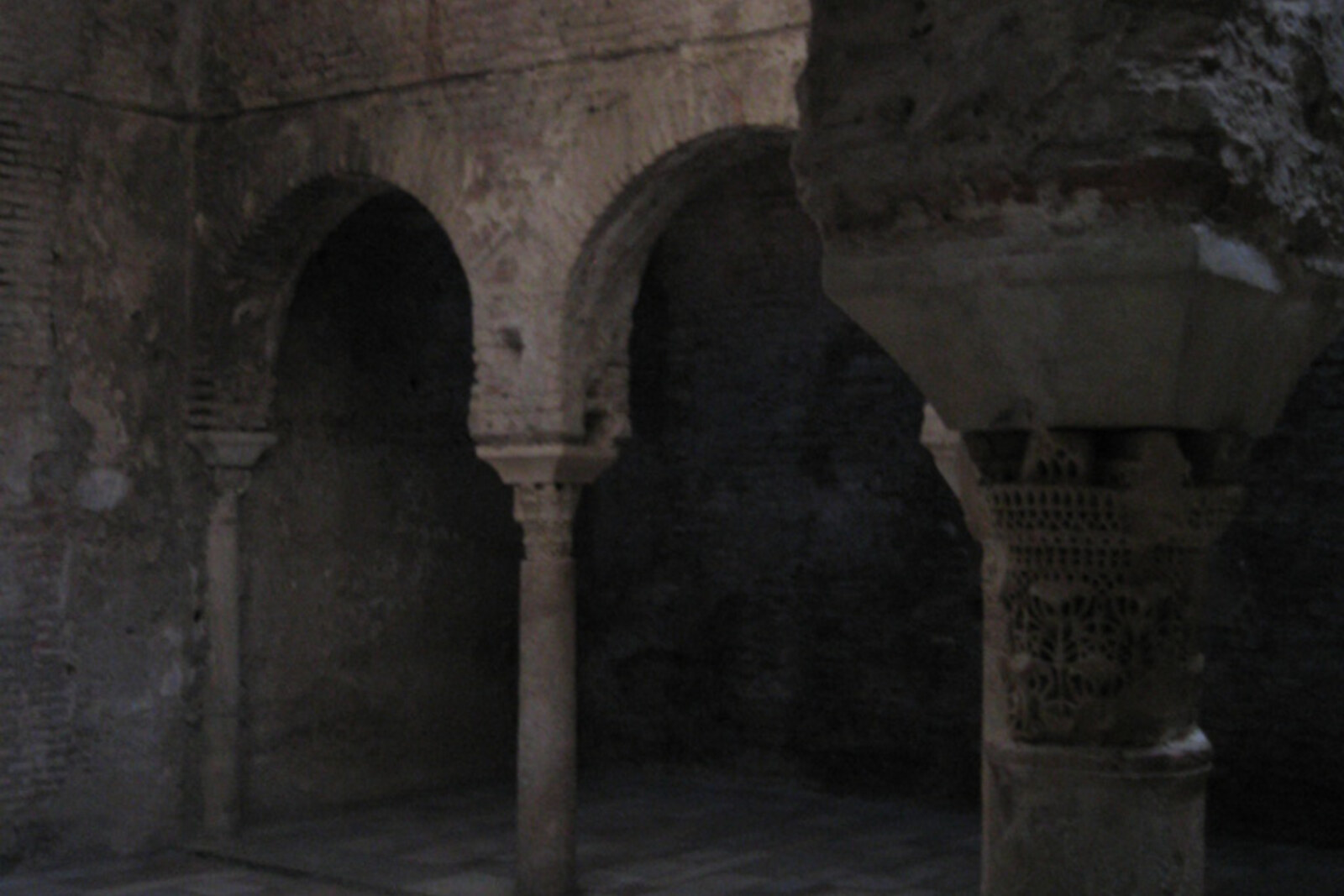
Look around first
What to notice
- Columns of the warm hall
- Darkening on the vaults
- Brick floor
The story of the place
El Bañuelo preserves the layout of a public Andalusian hammam: people moved in sequence from a cool room to a warm one and then a hot one. The columns of the warm hall support vaults with long-standing traces of soot, and beneath the brick covering, heat from the boiler in the service section once circulated. Water was brought here by a branch of the water channel, while a drain carried used water to the Darro River; the proximity of the river and road also made it easier to deliver firewood. Later, a large laundry basin stood between the columns; now the hall is once again visible at its full height.
In nineteen twelve, Gonzalo Enríquez de Luna asked for permission to clear a building on Carrera del Darro that belonged to his family. He served in the cavalry, owned land, and collected antiquities. There was ordinary real estate here as well: people lived by the entrance, and a public laundry operated behind the living quarters. The floor of the warm room had been raised by more than a meter, and the lower half of the columns had disappeared beneath fill. When workers removed the rubble, the owner found himself facing a medieval bathhouse woven into the city's rental and working life.
The present word “Bañuelo” is a later diminutive, coined when this urban bathhouse was compared with the spacious baths of the Alhambra. In a document from fourteen ninety-four, it is called Hammam al-Yawza—the Bath of the Walnut Tree. The document does not explain why it was called the walnut tree.
This was a public Andalusian hammam. Visitors left their clothes, passed through cold, warm, and hot rooms, and drew water from separate containers. In the northern service section, workers burned firewood beneath a boiler; hot air passed beneath the floor and escaped through channels in the walls. Fresh water arrived from above through a branch of the Acequia de Axares. The Darro River did different work: beneath the western wall ran a drain that carried used water out to the river. This explains the choice of a site by the water and the city road: on one side fuel could be delivered, and on the other wastewater could be discharged.
After the conquest of Granada, the bathhouse did not close immediately. In fifteen oh-nine, it was managed by Sebastián de Palacios, an Aragonese Mudéjar carpenter. He needed a sound hall for visitors, and he hired the masons Juan de Rojas and Francisco de Valencia. They relaid the floor of the warm room in brick, three fingers thick. The manager's surname gave rise to another name—the Bath of Palacios. Later, the hammam ceased operating, and the same warm room was adapted as a laundry: a large basin was installed between the columns, and the floor was raised around it.
After the clearing, Gonzalo Enríquez de Luna secured an examination of the find by specialists. He himself asked for his property to be declared a national monument, though after that he could no longer freely rebuild the plot. The decision took five and a half years to prepare and was adopted in nineteen eighteen. But the state did not buy the building, the walls continued to grow damp, and the owner had to reopen the laundry.
In nineteen twenty-one, Gonzalo tried to keep part of the house for himself. The Academy of Fine Arts refused: the entire plot had to be purchased. It was valued at a little more than sixteen and a half thousand pesetas. For another six years, no money could be found, until the Alhambra's architect, Leopoldo Torres Balbás, ordered payment from the proceeds of admission tickets to the palace complex.
Torres Balbás removed the fill and partitions, took out the laundry basin, reinforced the masonry, and left the old darkening on the vaults. Beneath the floor, he traced the medieval drain all the way to the Darro River. The warm hall now shows the columns at their full height; the large laundry basin is no longer between them.
Useful on site
Andalusian monuments schedule: 15 September — 30 April 10:00—17:00; 1 May — 14 September 9:00—14:30 and 17:00—20:30. Free entry on Sundays; closed 25 December and 1 January. Check your ticket before visiting.
Checked: June 29, 2026. Check the official source before visiting.The main details are inside, and access must be checked separately. From the street, the building reveals almost nothing; if it is closed, do not try to judge the layout from the neighboring doors.