 Guide On Map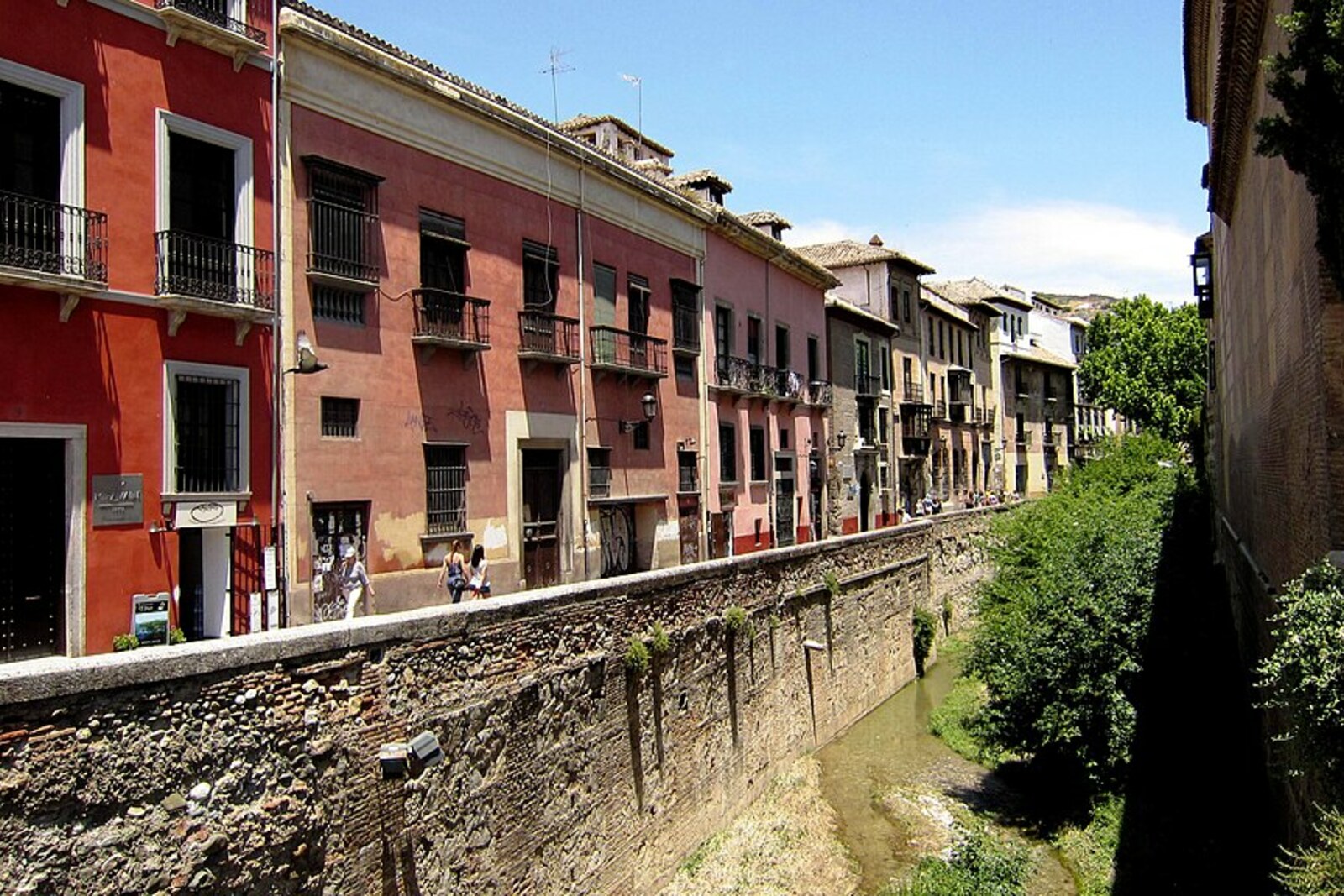
Look around first
What to notice
- The open channel of the Darro River
- The San Pedro cliff
- Church of Saints Peter and Paul
The story of the place
Carrera del Darro runs along the edge of the open channel; across the water, you can see the San Pedro slope and the Church of Saints Peter and Paul. This route once ended at Guadix Gate and bore its name. After collapses and a flood, part of the city wall along the river was dismantled, the channel was redirected, and the passage widened. On the opposite bank, beneath San Pedro, stood the mills and storehouse; nothing remains of them.
In fifteen eighty-nine, King Philip II ordered two Granada gunpowder makers to supply coastal fortresses and ships bound for the Americas. One of the suppliers was named Juan Real. His watermill stood here, on the Darro River, opposite the present-day Church of Saints Peter and Paul: water diverted from the river powered the machinery that pounded the ingredients of black powder.
A few years earlier, royal inspectors had discovered that Juan Real and his partner Francisco Trujillo were secretly selling part of their production above the set price. Both men were ordered imprisoned and their property confiscated. The punishment was then deferred. No other craftsmen with suitable mills could be found nearby, and gunpowder was urgently needed. Whether Juan would keep his workshop and avoid the earlier sentence depended on the new order.
On the night of February eighteenth, fifteen ninety, about thirteen tons of finished gunpowder lay in a new storehouse beside the mill. Between two and three o'clock, the storehouse caught fire and exploded. The blast destroyed neighboring houses and part of the city wall. Contemporaries wrote of many deaths and people left beneath the rubble. San Pedro Church, the Convent of Santa Catalina de Zafra, and buildings of the Alhambra on the opposite bank were damaged.
Juan Real immediately accused Captain Bernardino de Villalta—the very inspector who had previously uncovered the illegal trade. According to Juan, Bernardino and his relatives had tried to prevent the storehouse from being built and had threatened arson. The captain, his sister, and his nephew were arrested. The investigators then detained Juan himself and two of his servants.
How the investigation ended is unknown: no verdict survives in the documents. Historians cannot establish whether it was arson, an accidental fire, or the result of the dangerous storage of unstable black powder. Bernardino soon disappears from the papers on the case. Juan lost the storehouse, the mill, and his entire stock, and was nearly ruined. His partner could not manage the royal order alone. Yet the very next year the mill was restored, and Juan was making gunpowder again: no replacement for him could be found.
The steep San Pedro cliff opposite had existed before the catastrophe; it is wrong to regard it as a crater from the explosion. The present profile of the street took shape later. After further collapses and a flood, city builders between sixteen hundred and sixteen eleven dismantled a substantial part of the wall along the river, changed the course of the channel, and widened the passage. The road had formerly led to Guadix Gate and was named after it; the gate itself was demolished in sixteen eleven.
Juan Real's mill and storehouse are gone: they stood on the opposite bank, beneath San Pedro. What remains here are the open channel and Carrera del Darro laid out along it—a road that received its present name from the river.
Useful on site
Open street; more comfortable by day, without suitcases and with footwear for uneven stone.
Checked: June 29, 2026. Check the official source before visiting.The passage is narrow, crowded in places, and used by vehicles; stop where you do not obstruct traffic. The houses along the street should not be assumed to be open to visitors.