 Guide On Map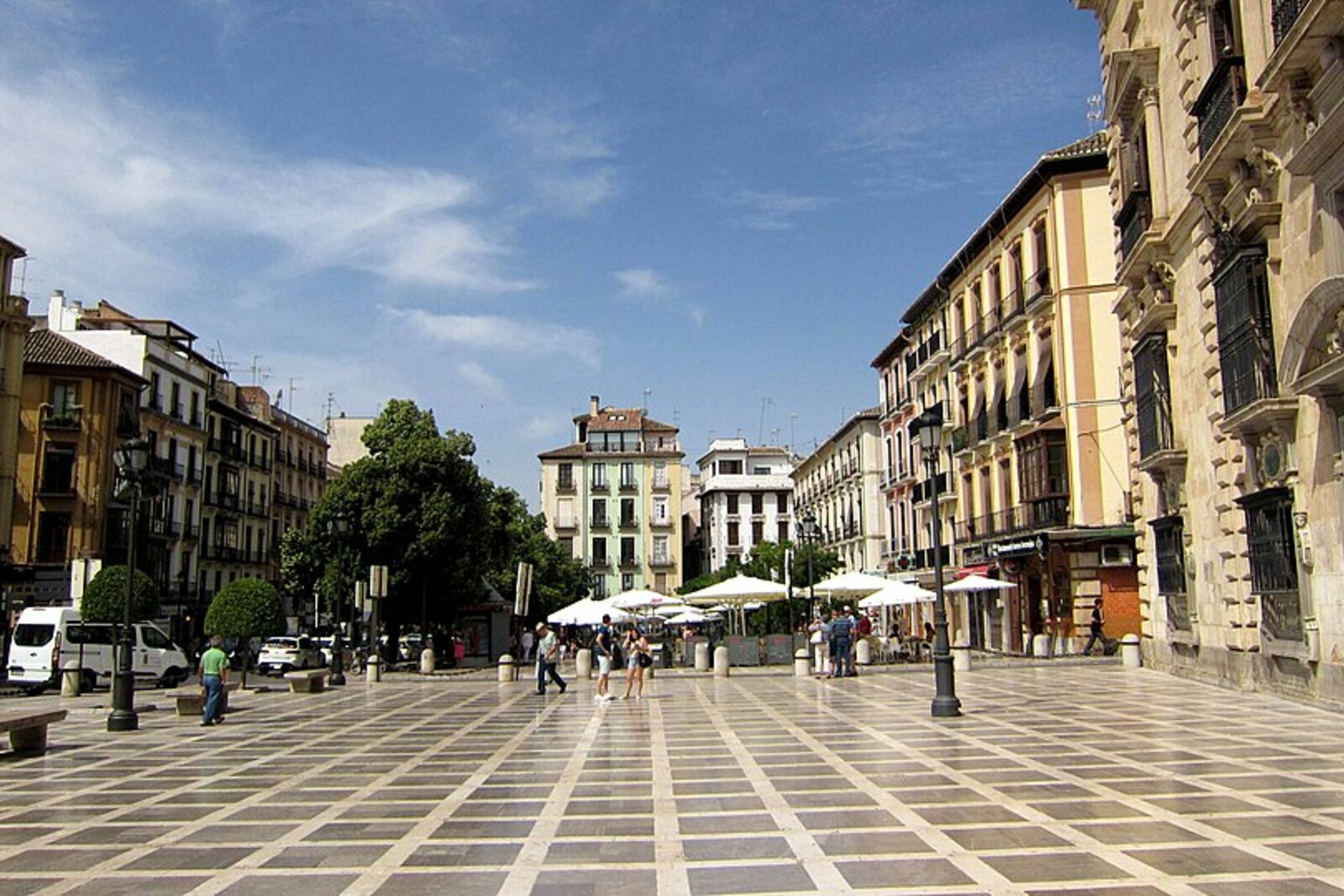
Look around first
What to notice
- Facade of the Royal Chancery of Granada
- Stone paving of the square
- Exit toward Carrera del Darro
The story of the place
The Darro River still runs beneath the stone paving of Plaza Nueva, although the river cannot be seen here. Houses once crowded between Elvira Street and the road to the Alhambra, and an old bridge stood there; then the riverbed was covered with a vault and a broad square was created above the water. Opposite rises the facade of the Royal Chancery of Granada, the former chief court of southern Spain, where the High Court of Justice of Andalusia now sits. The name New Square outlasted its newness, while the river has remained underfoot.
On the ninth of November, fifteen fifty, the sentence was read aloud to the clothing merchant Fernando de Torres from a wooden platform in the middle of this square. The inquisitors found him guilty of Judaizing—a baptized person who continued to adhere to the Jewish faith. He was ordered to wear a sanbenito, a penitential garment, for life, imprisoned, and stripped of his property.
Fernando had come from Málaga. One witness later recalled that before his marriage, he did not even own a cloak. The bride’s father gave the young couple a little money, and they opened a tiny shop to make a living. Fernando’s wife, Gracia Rodríguez, brought a dowry into the family. Together, the spouses traded in cloth and ready-made clothing, traveled to fairs, and built up a considerable fortune over several years. After Gracia’s death, the shop survived ruin and began to turn a profit again. It was then that the Inquisition arrested Fernando and entered all the property it found under his name.
The auto-da-fé in which he took part was a public proclamation of sentences. The investigation was conducted behind closed doors, while the accused were brought out here so that the townspeople could see their penitential garments and hear their punishment. For Fernando, the sentence meant prison; for his children, the loss of what their mother had earned.
Francisco, Beatriz, Isabel, and María de Torres demanded the return of their mother’s dowry and half of the property acquired jointly by their parents. The representative of the Inquisition replied that Fernando had been considered a heretic even before the wedding, and that the property had therefore supposedly long belonged to the treasury. He even tried to challenge the marriage record. The children gathered testimony from neighbors, found the dowry document, and proved that the spouses had built up the shop together. On the fourth of November, fifteen fifty-one, the court ordered the treasury to return nine thousand five hundred fifty-two maravedís and half of the items inventoried at the time of the arrest to the heirs. Fernando remained convicted, but the confiscation did not swallow up the share of the deceased Gracia.
Such a spectacle required open space, and half a century before Torres’s sentence, it did not yet exist here. The Darro River flowed between Elvira Street and the road to the Alhambra; houses crowded nearby, and an old bridge stood there. At the city council’s request, King Ferdinand the Catholic allocated money to buy and demolish the buildings. The stonemason Miguel Sánchez de Toledo covered seventy-two meters of the riverbed with a vault and, by fifteen fifteen, created a broad square above the water. The name Plaza Nueva—New Square—appeared then and outlasted its own newness.
Later, the Royal Chancery of Granada was built opposite, the chief court for the southern half of Spain. The Inquisition’s prisons stood nearby, by Elvira Street, so it was convenient to bring the condemned from there to the square, where a crowd could fit. Fernando’s platform, sanbenito, and prison have disappeared. The Darro River still flows beneath the stone paving, and the Chancery building remains a court: the High Court of Justice of Andalusia now sits there.
Useful on site
Open city square; more comfortable by day and in the early evening.
Checked: June 29, 2026. Check the official source before visiting.The river beneath the square cannot be seen—the important thing here is the level surface above the flowing water. View the facades from the edge of the pedestrian flow and keep an eye on your belongings in the crowd.