 Guide On Map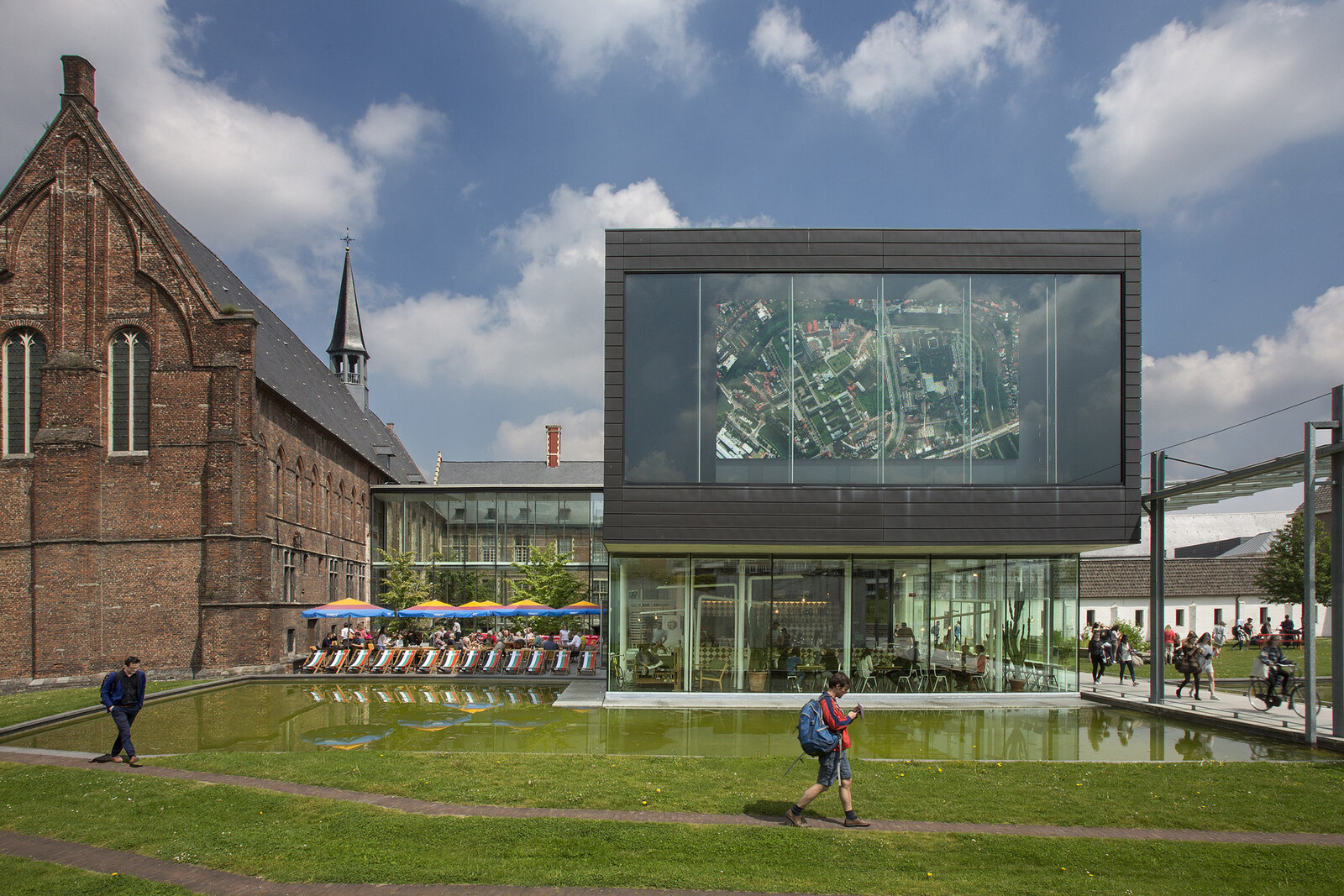
Look around first
What to notice
- Abbey buildings
- Medieval hall for the sick
- Huge aerial photograph of Ghent
The story of the place
The name STAM is made up of the Dutch words for “Ghent City Museum.” Its permanent exhibition leads through the city’s history by way of old maps, objects, and a huge aerial photograph. It was housed in the former Bijloke Abbey, and the choice of building is connected to a woman who, eight centuries before the museum opened, tried to establish permanent care for the sick here.
At the beginning of the thirteenth century, Ermentrude Utenhove, a member of a wealthy Ghent family of cloth merchants, gave one of the family houses near Saint Michael's Church for use as Saint Mary's Hospital. The sick, the poor, and travelers were admitted there. Ermentrude controlled the private house and the family income; so that the hospital would not disappear after the benefactors died, she transferred its property and administration to Cistercian nuns from the religious order.
The sisters lived in a convent founded by Utenhove near Lokeren. To care for patients, they had to travel from there to Ghent, although the order’s rule forbade nuns to leave the enclosure of the religious house for such work. Two worldly reasons for moving were added to this: there was no longer enough room for the sick, and the Dominicans who had arrived in the city planned to establish their own convent where the hospital stood.
A solution was found in twelve twenty-eight. Ferrand of Flanders gave the hospital a plot beyond the city wall of the time, and church leaders permitted a separate women’s abbey to be founded beside it. Some of the sisters moved from Lokeren. Their living quarters, places of prayer, and patients were now within one enclosure: the nuns could observe the rule and continue their care.
The plot was called Bijloke, a word meaning enclosed, fenced land. These were wet meadows by an old course of the Lys. Between twelve fifty-one and twelve fifty-five, a large hospital ward with forty beds was built here; several people could share one bed. The arrangement created by Ermentrude outlived her by seven and a half centuries. Patients stopped being admitted here only in nineteen eighty-two, when the clinic moved.
The city’s historical collection occupied the abbey buildings as early as nineteen twenty-eight, and in nineteen ten STAM opened here. Its permanent route passes through the former abbey; the neighboring medieval hall for the sick became a concert hall, while the museum uses the former infirmary section to store and conserve the collection.
Useful on site
Mon/Tue/Thu/Fri 09:00–17:00; Wed closed; Sat–Sun, holidays and school vacations 10:00–18:00; closed 24–25 and 31 December, 1 January.
Checked: June 29, 2026. Check the official source before visiting.Bijloke’s architecture remains an important part of the story even without a full museum visit. Set aside separate time for the interiors, and do not expect every object mentioned to be permanently on display.