 Guide On Map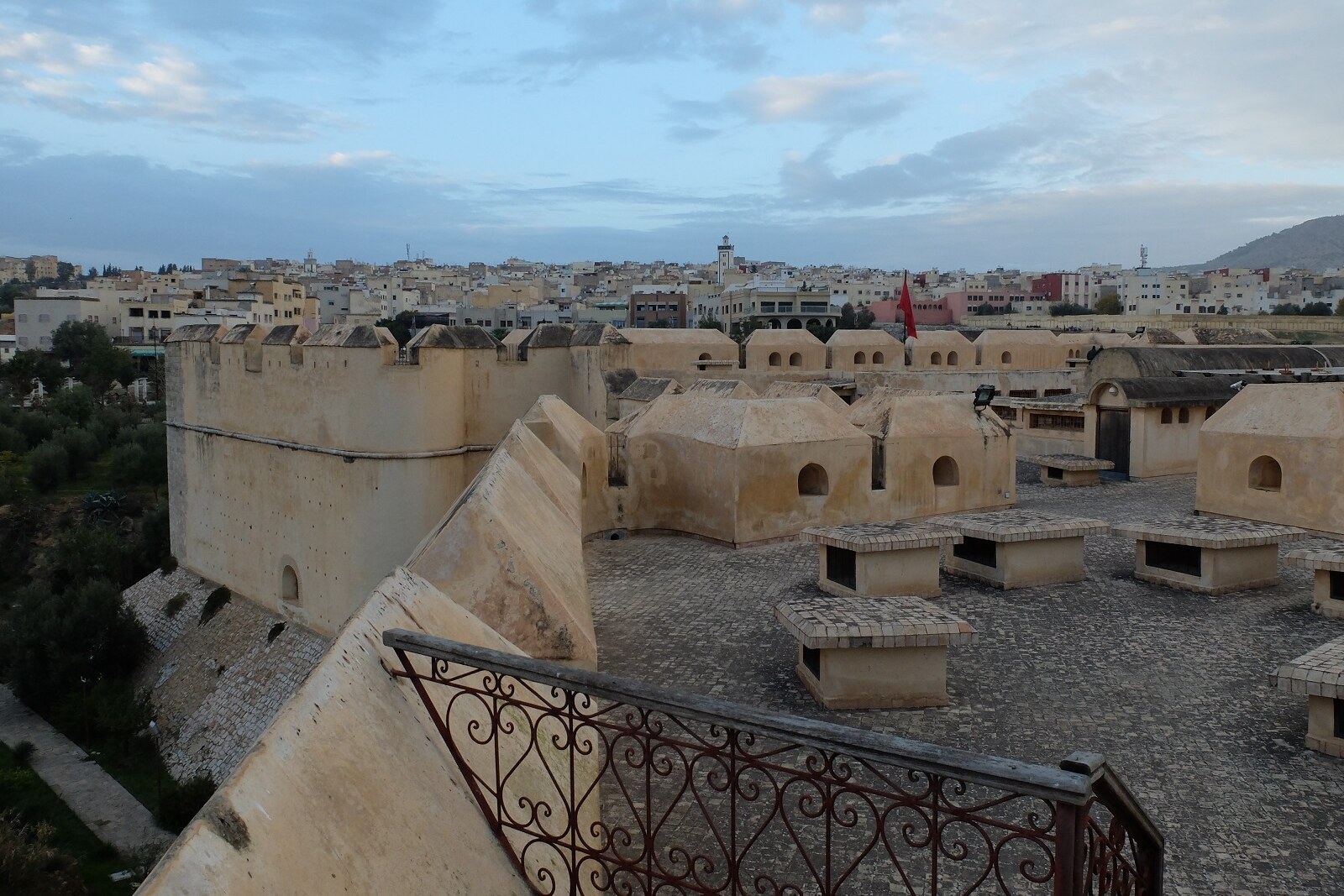
Look around first
What to notice
- Sharp artillery bastions
- Cannon embrasures on the upper platform
- Vaulted corridors
- Five-meter cannon
The story of the place
Borj Nord had another name—Borj an-Nar, the Fire Bastion. “Jaysh an-Nar,” the Army of Fire, was stationed here; the museum director calls it Morocco's first artillery unit. Fifty-six cannon embrasures were built into the upper platform. The guns could keep the northern approaches to Fez under fire, but the height was chosen for the medina below as well.
The Saadians came from Marrakesh and captured Fez in fifteen forty-nine after a stubborn siege. Five years later, supporters of the former Wattasid dynasty retook the city; the Saadians had to besiege it again. After their victory, they punished some local leaders. Fez retained its reputation as a city that accepted a new ruler only until the next opportunity to close its gates against him.
In fifteen seventy-eight, Ahmad, the brother of the Saadian sultan Abd al-Malik, fought in the battle that determined who would receive the Moroccan throne. The deposed Muhammad al-Mutawakkil wanted to regain the throne and brought in the Portuguese king Sebastian for help. Abd al-Malik defended his rule. All three died, so the battle was called the Battle of the Three Kings. Ahmad remained the victor, took the name al-Mansur—the Victorious—and became sultan immediately after the battle.
He had cannons, thousands of prisoners, and ransom money for the Portuguese nobility at his disposal. Researchers believe that European prisoners took part in building Fez's fortifications. Their experience explains Borj Nord's sharp artillery bastions, which resemble Portuguese forts of that period. Ahmad compelled specialists from the defeated army to build a structure that was meant to hold in check the most unruly city in his state.
In the fifteen eighties, a permanent artillery post rose above the northern wall. The garrison could watch the roads along which hostile tribes or claimants to the throne approached. The same guns could be turned toward Fes el-Bali. For the townspeople, the result of the sultan's decision was a fortress beyond their own walls, to which they could not block access by closing the gates.
After the restoration of nineteen sixty-two and nineteen sixty-three, the curators moved a weapons collection here from Dar Batha and the old Fez arsenal of Makina. Borj Nord thus became the first Moroccan museum devoted to the history of arms. Display cases with sabers, muskets, armor, and cannons now stand in the vaulted corridors designed for gun crews and ammunition.
One of the guns is about five meters long. According to the museum's attribution, it was fired in the Battle of the Three Kings. This cannon is older than Borj Nord itself: the victory gave Ahmad the throne, prisoner-builders, and funds, and then brought artillery here. Now the gun from that battle stands inside the fortress that its victor built above Fez.
Useful on site
Wednesday–Monday 09:00–12:00 and 15:00–18:00; closed Tuesday.
Checked: June 22, 2026. Check the official source before visiting.The weapons collection and the large Saadian cannon can be seen only inside the museum; check access and visiting conditions separately. Outside, the fortress remains a complete stop.