 Guide On Map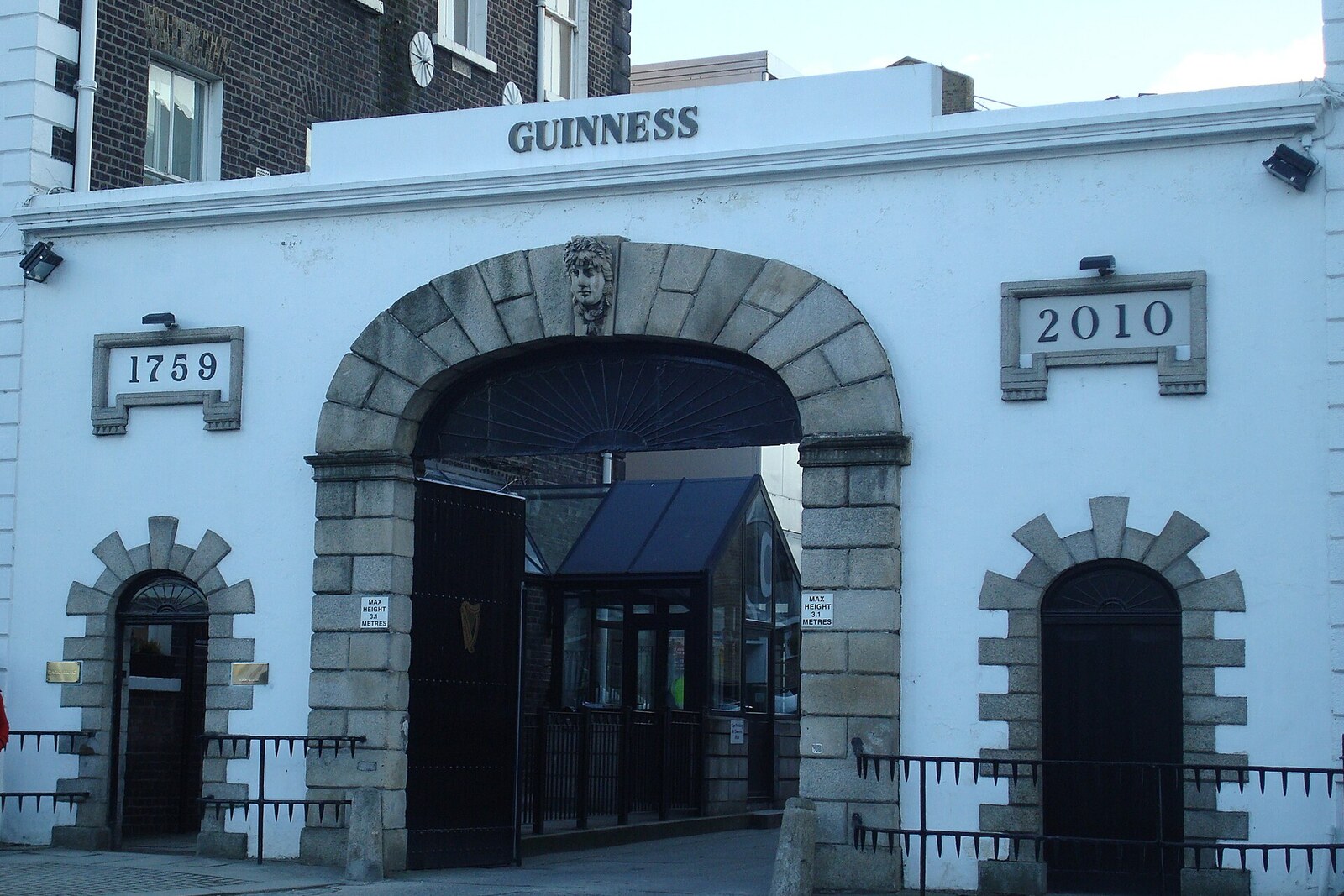
Look around first
What to notice
- Black gates
- Brick brewery buildings
- A copy of the lease agreement in the floor of the Guinness Storehouse
- The “Guinness” sign
The story of the place
Behind the black gates and brick buildings stands a working brewery. The Guinness Storehouse welcomes visitors, while in the neighboring production areas Guinness is still brewed from malt, water, hops, and yeast. Production has remained here since the eighteenth century, although the gates that gave the address its name had already disappeared by then.
The medieval St James’s Gate served as Dublin’s western entrance. It was named after a neighboring church dedicated to James the Greater, one of the twelve apostles. According to church tradition, his tomb is in Santiago de Compostela, Spain. Irish pilgrims gathered near these gates before setting off toward the sea and then on to Spain. The gates were demolished in seventeen thirty-four, but the name remained with the street and the whole site.
Twenty-five years later, thirty-four-year-old brewer Arthur Guinness arrived here. He was already making money from beer in Leixlip, but he left that business to his younger brother and decided to enter the Dublin market. On December thirty-first, seventeen fifty-nine, Guinness leased an abandoned brewery by the former gates. The agreement was made for nine thousand years, at forty-five pounds a year. He had four acres of land, a brewing kettle, a mill, and two malt houses at his disposal.
The site’s main advantage was water. The agreement allowed water to be taken from the city watercourse, but only in limited quantities. Water was needed continuously: it was used to extract sugar from crushed malt, which yeast then processed. The more beer Guinness sold, the more water his kettles required.
The city corporation decided that the brewer was taking more than he was entitled to. On May sixteenth, seventeen seventy-five, officials brought a sheriff and workers here to block off and fill in a section of the watercourse. Arthur Guinness snatched a pickaxe from one of the workers, stood before them, and declared that he would immediately dig everything up again. A committee report separately noted his “very improper expressions.” The workers left without blocking off the water.
The pickaxe settled the matter only for that day. The dispute continued for another nine years. In seventeen eighty-four, Guinness agreed to pay separately for the water—ten pounds a year. The city acknowledged his right to use the watercourse, and the brewery retained the supply without which expansion was impossible.
Arthur began here with ale, then switched to dark porter—the ancestor of today’s stout. In seventeen ninety-six, the first known export shipment to England was sent from here, and three years later Arthur Guinness stopped brewing ale and focused on porter.
Today, water for Dublin Guinness comes from the Wicklow Mountains. The original four acres have long since become part of a much larger complex, the land was bought outright, and the nine-thousand-year agreement no longer keeps the brewery on this site. The original is kept in the archive, while a copy is set into the floor of the Guinness Storehouse—visitors to the working brewery now walk over the document that promised water.
Useful on site
The gates are visible from outside. For the Guinness Storehouse, check opening hours and a time slot on the official booking page; a self-guided visit takes about 90 minutes, and advance booking is strongly recommended.
Checked: June 26, 2026. Check the official source before visiting.The gates and the outer boundary of the complex can be viewed from the city street without entering the service driveways. The Guinness Storehouse is a self-guided visit that is worth planning separately from the walk.