 Guide On Map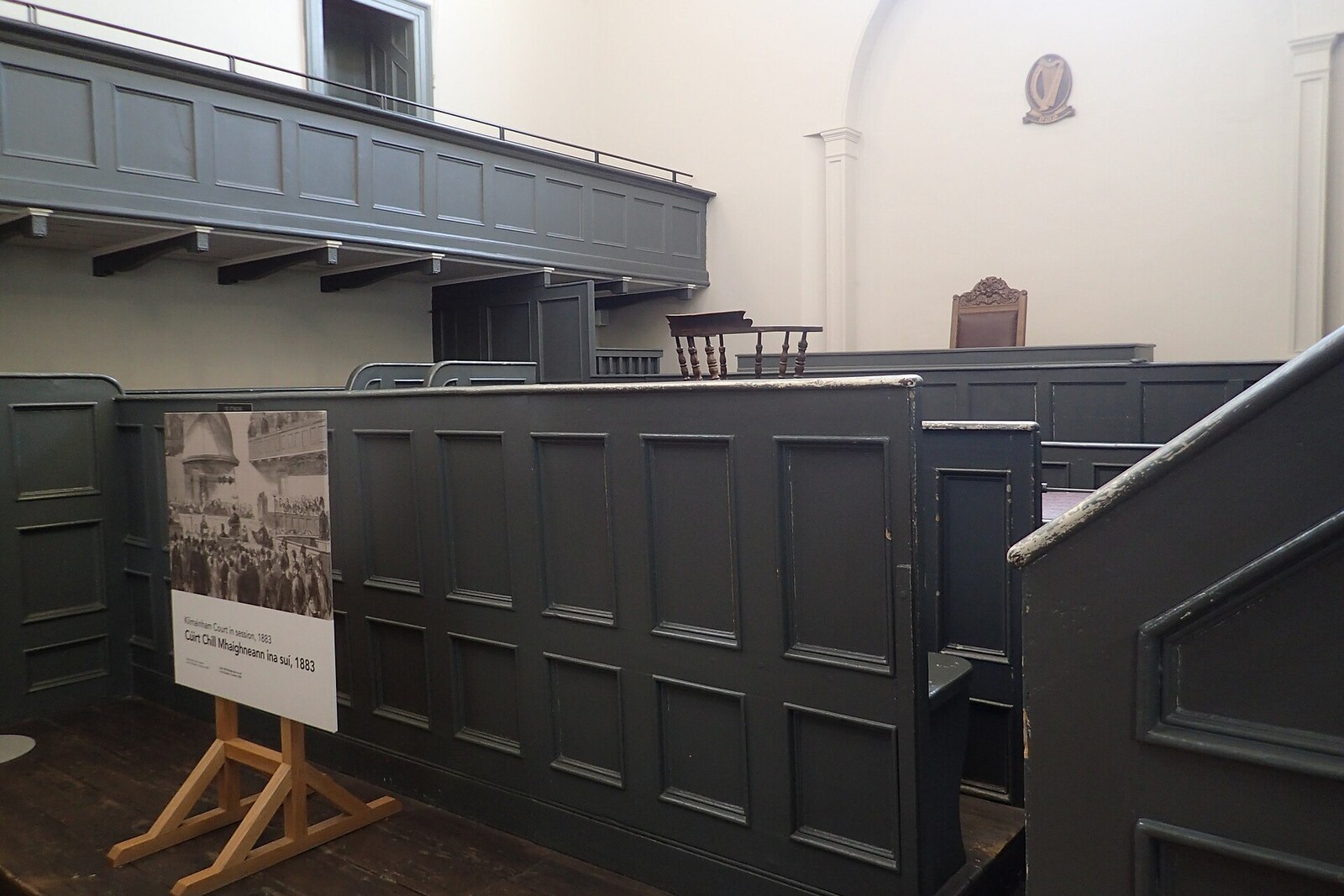
Look around first
What to notice
- The dock
- The witness box
- The restored courtroom
- The passage toward the gaol
The story of the place
The wooden benches, the narrow witness box, and the passage to the gaol make this restored courtroom a compact working space. The courthouse was built directly beside Kilmainham Gaol in eighteen twenty so that prisoners would not have to be taken out into the street. Here, magistrates first checked whether the prosecution had sufficient grounds for further proceedings. Tour groups now gather in the room, and the route then leads into the neighboring gaol through the same linked sequence of rooms.
On February seventeenth, eighteen eighty-three, James Carey was brought into this courtroom separately from the other defendants. His former comrades expected to see him beside them in the dock. Carey took the witness stand.
He was a building contractor, a member of Dublin City Council, the father of seven children, and one of the leaders of a secret republican group calling itself the Irish National Invincibles. The group intended to kill officials governing Ireland on behalf of the British Crown. On May sixth, eighteen eighty-two, its members lay in wait for the permanent under-secretary, Thomas Henry Burke, in Phoenix Park. The new minister for Ireland, Lord Frederick Cavendish, happened to be beside Burke. The attackers stabbed both men to death.
Carey did not strike the blows himself, but he knew who had prepared the attack and who had taken part in the killing. When the police arrested members of the group, they were placed in the neighboring Kilmainham Gaol. Kilmainham Courthouse had opened beside the district prison as early as eighteen twenty precisely so that prisoners could be transferred directly from their cells into the courtroom. Preliminary hearings were held here. Magistrates decided whether the prosecution had sufficient evidence to send a person to a full trial.
Carey faced the same gallows as the direct killers. For him, that meant death, the loss of income from his building business, and a family without its breadwinner. Investigator John Mallon pressured the arrested men one by one and made Carey believe that the others had already begun giving evidence. Carey agreed to tell everything in exchange for saving his own life and a promise to take his family to Africa.
On that February day, his absence from among the defendants was explained when he entered the witness box. Carey named the group’s members, described the preparation of the attack, and assigned the roles. The final trials took place at the court on Green Street, but the hearing here opened the way to them. Five of Carey’s former comrades were found guilty and hanged in May and June behind the wall, in Kilmainham Gaol.
Carey himself was sent to South Africa with his wife and children under the name Power. It proved impossible to hide him. After the ship left Cape Town, an Irish passenger, Patrick O’Donnell, who recognized who was traveling under an assumed name, shot Carey. Whether this was premeditated revenge has not been reliably established. O’Donnell claimed that he had acted in self-defense; the court did not believe him, and he was hanged in London in December.
The restored courtroom now serves as a place to wait for the tour. Visitors still pass from here into the neighboring gaol—the same sequence that, in February eighteen eighty-three, separated Carey from the men sitting with him on the same bench.
Useful on site
Courthouse Visitor Centre: daily 09:30-17:15; the Gaol is accessible only on a guided tour with online booking.
Checked: June 27, 2026. Check the official source before visiting.Plan primarily for an exterior visit: do not try to get inside without separately confirmed access.