 Guide On Map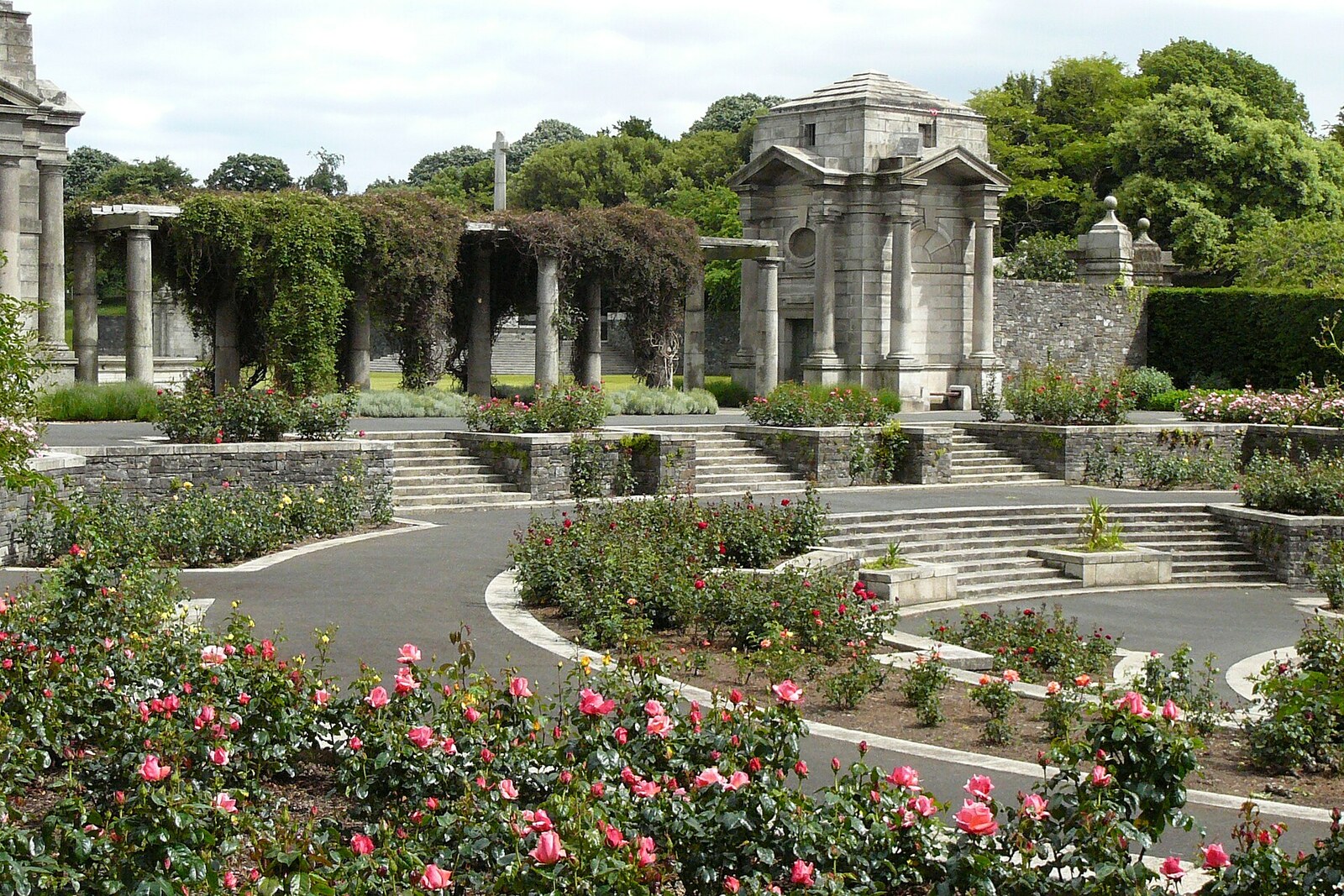
Look around first
What to notice
- Four granite pavilions
- Books of names
- Central lawn
- Granite walls
The story of the place
Four granite pavilions stand around the level lawn, and each holds books with the names of the dead. The eight books bring together almost fifty thousand Irish people who did not return from the First World War. The four pavilions recall the island’s four provinces, so the garden was conceived as a memorial for all of Ireland. Beneath this well-kept grass were once gravel workings.
On December twenty-eighth, nineteen thirty-one, one hundred sixty-four unemployed former soldiers arrived at former market gardens and gravel pits by the Liffey. Later, there were about three hundred of them. Half the workers were recruited from among veterans of the British Army, and half from former National Army servicemen, the forces of the recently created Irish Free State. This was a division for the payroll: many had served in both armies.
When they left for the First World War, the entire island was part of the United Kingdom. They returned to a country that had gone through the Irish War of Independence and partition. The old Irish regiments of the British Army were disbanded, and work was scarce. The money the new Irish government allocated for the future garden came from an unemployment-relief fund. Building a memorial to the dead was meant to provide income for the survivors.
The site itself was found after ten years of unsuccessful searching. The committee that collected donations for the memorial had proposed a veterans’ home, a monument in Merrion Square, and an arch by Phoenix Park. The plans were rejected because of cost, lack of space, and disputes over how independent Ireland should honor people who had served in the British Army. In nineteen twenty-nine, the committee’s treasurer, Andrew Jameson, approached the head of government, W. T. Cosgrave, and secured a new search for land near Phoenix Park. Thomas Byrne, chief architect of the Office of Public Works, deemed a site on the north bank unsuitable and proposed Longmeadows—“the Long Meadows”—directly across the river. The land was already under state control, and it was large enough for both a memorial and a public park. That is how the garden came to be here.
Machinery was used only where it could not be done without: across the entire project, one steamroller and two concrete mixers were permitted. The calculation was straightforward—to leave people as much paid work as possible. They filled in the gravel pits, cut back the slopes, and leveled the ground with hand tools. Multi-ton granite blocks were moved with winches, steel cables, pulleys, and telegraph poles. Seven of the eight masons who built the walls were over sixty-five. By the beginning of nineteen thirty-eight, the former wastelands had become a memorial garden.
Its creators understood the word “national” to mean all-Ireland. Four granite pavilions around the central lawn represent the island’s four provinces. The pavilions hold eight books containing almost fifty thousand names of Irish people killed in the First World War. Between the book pavilions lies a level lawn, laid out over the filled-in workings by people who returned from that war.
Useful on site
Open year-round: Mon–Fri from 08:00, Sat–Sun from 10:00; closing depends on daylight. ‘Book rooms’ by arrangement; tours on Wednesdays at 14:00 from April to October.
Checked: June 27, 2026. Check the official source before visiting.Do not expect to see the memorial volumes on every visit: indoor access may be restricted, but the garden’s layout can be read from outside.