 Guide On Map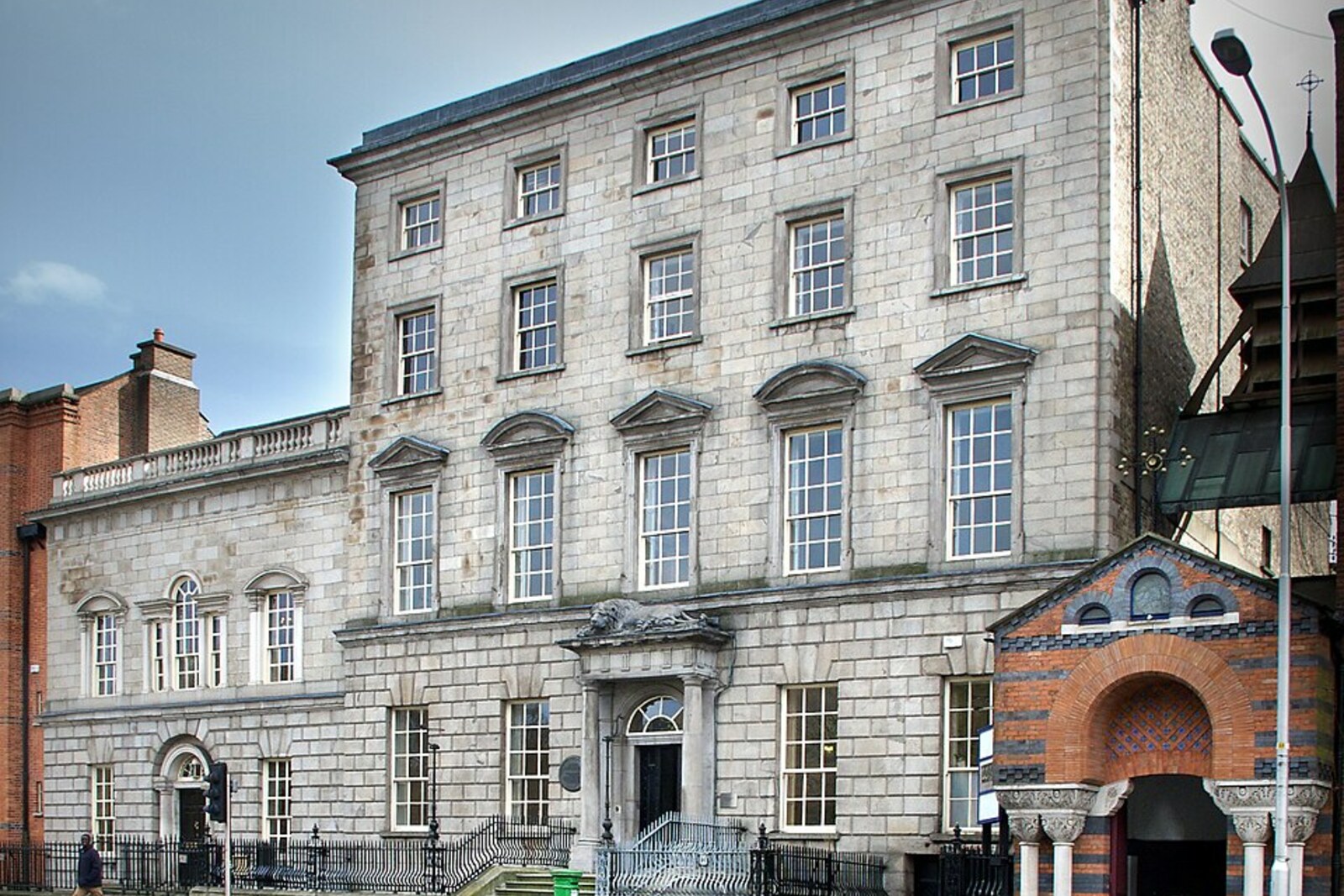
Look around first
What to notice
- The facades of two Georgian townhouses
- The garden behind the houses
- Aula Maxima
- The first copy of Ulysses
The story of the place
Newman House is not so named because John Henry Newman lived here. His own Dublin residence was on Harcourt Street. Newman's name was attached to the two Georgian townhouses on St Stephen's Green only in the late nineteen forties, in memory of the man who opened a university here.
Dublin Archbishop Paul Cullen pressed for a separate institution of higher education for Catholics. The Irish bishops rejected the state-created secular colleges, while the old Trinity College Dublin remained a Protestant institution. Cullen invited Newman, an English theologian who had recently converted from Anglicanism to Catholicism, and tasked him with assembling the Catholic University of Ireland.
On November third, eighteen fifty-four, the first seventeen names were entered in the register at number eighty-six. Newman wanted to organize teaching according to the Oxford model familiar to him: small student communities, a common table, tutors, and their own chapel. Classrooms appeared in the neighboring buildings, and later a large assembly hall, Aula Maxima, was built behind the houses.
Newman hoped to create an intellectual center for Catholics throughout the English-speaking world. What resulted was an institution whose degrees the state did not recognize and which it did not fund. There were not enough well-prepared students. After four years, Newman stepped down as rector and regarded his work as a failure.
The faculty and students did not disperse, however. From eighteen eighty onward, they were able to take the examinations of the Royal University of Ireland and receive recognized degrees. The college was then handed over to the Jesuits. It was this continuation of Newman's project that James Joyce entered in eighteen ninety-eight, as a language student from a family that was rapidly growing poorer.
In nineteen oh one, nineteen-year-old Joyce brought an article, The Day of the Rabblement, to the student magazine St Stephen's. He attacked figures in the Irish Literary Theatre for their provincialism and called on writers to look to contemporary European drama rather than seek the public's approval. In the text, he also referred to a novel by Gabriele D'Annunzio that had been placed on the Catholic Index Librorum Prohibitorum. The editors refused to print the article.
At the same time, the magazine rejected the work of another student, Francis Sheehy-Skeffington, who was seeking equal status for women at the university. Joyce and Sheehy-Skeffington did not revise their texts to meet the editors' demands. They pooled money for printing and published both essays in a single thin pamphlet, which they distributed themselves. For Joyce, it became his first separate printed publication. A year later, he graduated from the college; in the surviving graduation photograph, Joyce stands in the garden behind these houses.
In two thousand nineteen, University College Dublin and the National Library of Ireland opened the Museum of Literature Ireland (MoLI) here. Its shortened name is pronounced Molly, the name of Leopold Bloom's wife in Ulysses. Copy number one of the novel's first edition is on display inside. Joyce's student article was once not allowed into the magazine here; his major book returned to the same university buildings as a museum exhibit.
Useful on site
MoLI: daily 10:00-17:00, last entry 16:00; closed March 17, December 24-26, and January 1.
Opening hours by day
The interiors and museum objects are accessible only as part of a visit to Museum of Literature Ireland (MoLI), so check the admission conditions in advance. From the street, this stop works as a story of the changing purpose of two residential houses.