 Guide On Map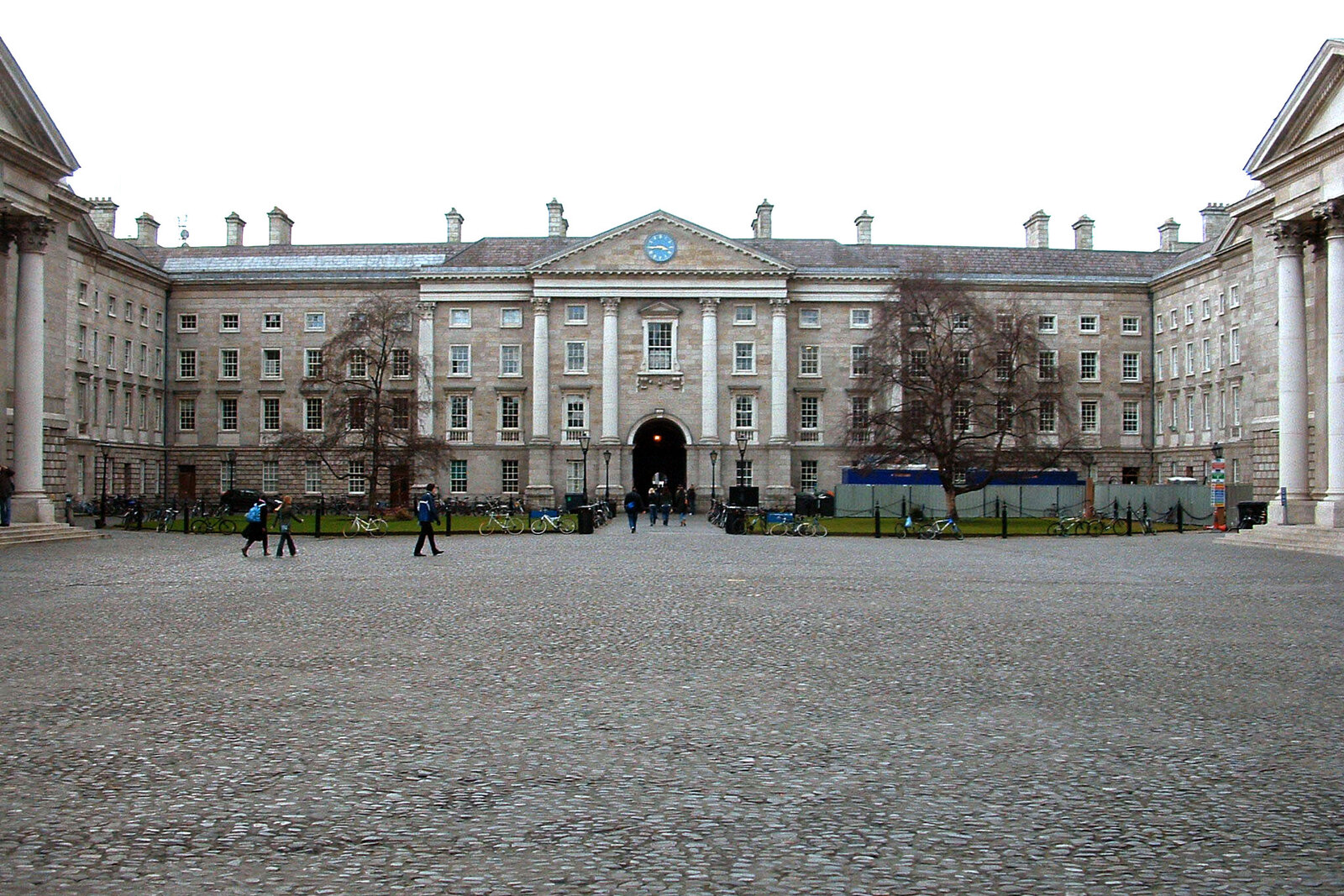
Look around first
What to notice
- Main oak gates
- Campanile
- Statue of George Salmon
- Steps of the Examination Hall
The story of the place
Front Square is Trinity College Dublin's first courtyard beyond the main oak gates. The ceremonial route through the college begins here, and once a year the rector, known here as the Provost, comes out onto the steps of the Examination Hall and announces the names of new scholars and faculty members. For a long time, entry to this square itself was a male privilege.
In eighteen ninety-two, the teacher Alice Oldham demanded that this arrangement be changed. She was paid by Dublin's Alexandra College, where she taught girls history, logic, Latin, and other subjects. Oldham herself had already earned a university degree at another institution and campaigned for her pupils to be able to enter Trinity College Dublin on equal terms with young men. Ten thousand five hundred sixty Irishwomen signed the petition she prepared.
Members of the college council refused. In their official explanation, they named a very tangible danger: if a woman passed through the gates even once, it would be almost impossible to keep track of which building or room she entered and how long she remained there. In the council's view, parents sent their sons here expecting the college to look after their morals. The dispute was specifically about these gates and the first courtyard beyond them.
The main opponent of admitting women was the Provost George Salmon, a mathematician and theologian whose statue stands beside the Campanile. He is credited with saying that women would enter Trinity College Dublin only over his dead body. There is no reliable record of this phrase; it was preserved by university tradition. Something else is known: in nineteen one, a majority of the council agreed to admit women, and Salmon withdrew his formal objection. One of his last official acts was a meeting at which the council received royal permission to award university degrees to women.
In January nineteen four, twenty-year-old Isabel Marion Weir Johnston arrived from Derry. She intended to study English and French and was due to take an entrance examination. On the day she arrived, Salmon died, so the examination was postponed until the funeral was over. Johnston was then enrolled as Trinity College Dublin's first female student. The phrase attributed to Salmon came true by chance, although during his lifetime he had stopped obstructing the council's decision.
Open gates still did not mean an equal student life. Women were forbidden to dine with the others, remain on the grounds after six in the evening, and join the two main debating societies. Johnston responded in nineteen five by founding her own Elizabethan Society. In its room in house number six, female students held debates, ate—there was no other place for them in the college—and sewed dresses for university evenings on a shared machine. Johnston herself never received a degree and later settled in London; the society she founded lasted until the restrictions were abolished in the nineteen sixties.
Since two thousand twenty-one, the position of Provost has for the first time been held by a woman, Linda Doyle. On Trinity Monday, she announces the names of new scholars from the same steps in Front Square. George Salmon's statue remains beside the Campanile, several dozen steps from the gates through which the college council once feared to let the first female student pass.
Useful on site
Outdoor reading at the gates is available regardless of the tour. Trinity Trails operates daily 09:00–17:00. The Book of Kells Experience requires a separate booking; on the official page in June 2026, there are two different blocks of hours, so rely on the interior only after checking on the day of your visit.
Checked: June 26, 2026. Check the official source before visiting.If entry is permitted, listen to the story away from the main flow of visitors. If access is limited, remain by the gates: the campus interior is not necessary to complete the route.