 Guide On Map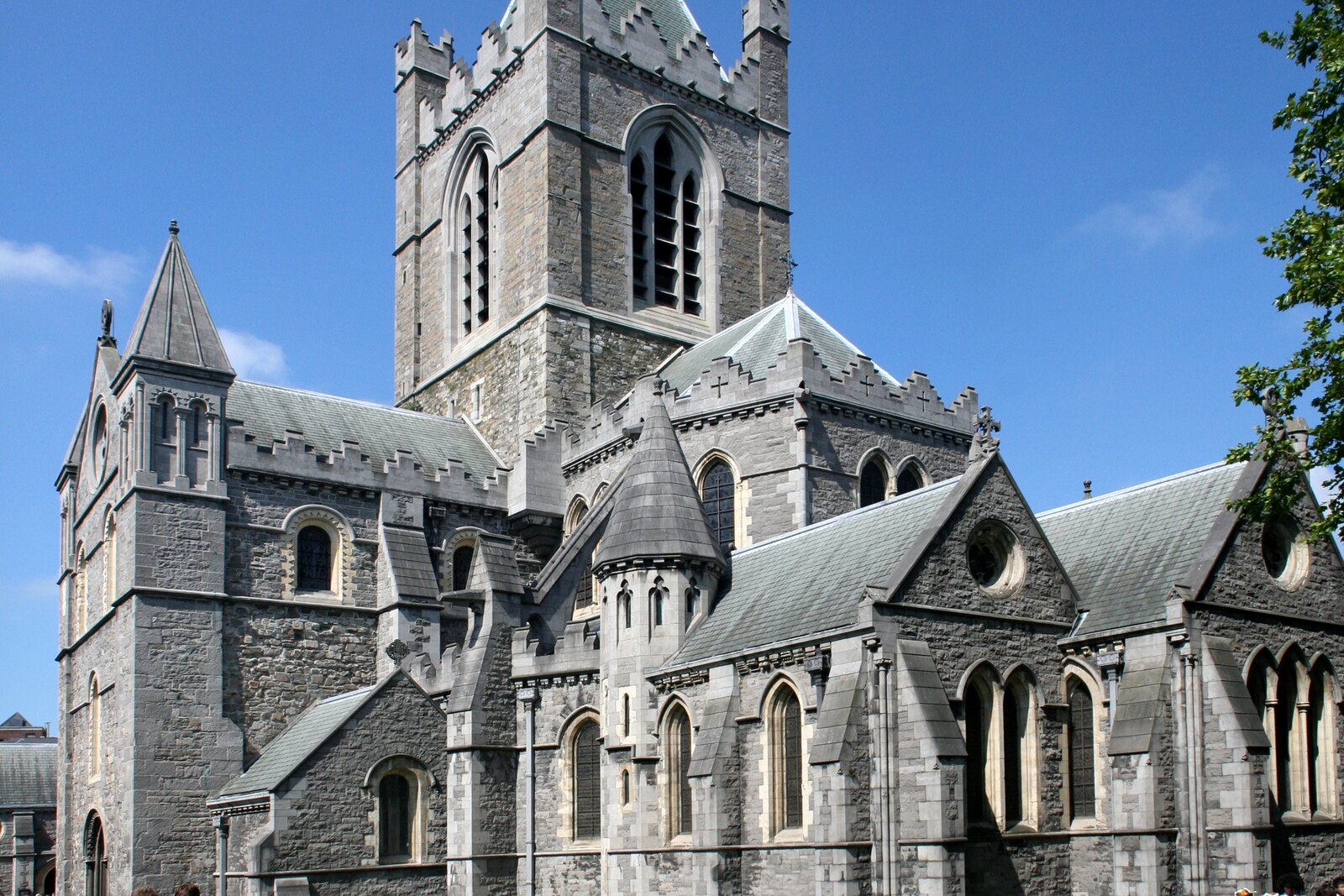
Look around first
What to notice
- Cathedral towers
- Stone portal
- Main nave
- Vaulted arches
The story of the place
In medieval Dublin, Christ Church Cathedral served as the archbishop's cathedral: services and ceremonies requiring church recognition took place here. The stone portal leads into the main nave, where vaulted arches gather the space into a tall, ceremonial hall. The cathedral's towers still recall that this was a prominent center of city power, not a parish church on a quiet street.
On May twenty-fourth, fourteen eighty-seven, Dublin Archbishop Walter Fitzsimons placed a crown here on a boy who went down in history as Lambert Simnel. They proclaimed him King Edward the Sixth of England. The dignitaries gathered in the cathedral renounced their oath to Henry VII and swore allegiance to the child.
Christ Church means “Church of Christ”; officially, the church is dedicated to the Holy Trinity. In medieval Dublin, it was the archbishop's cathedral, a place for ceremonies that required church confirmation. The conspirators needed exactly such a hall: the coronation was to turn the boy they had brought with them into a sovereign in whose name they could summon Parliament, grant offices, and raise an army.
Two years earlier, Henry Tudor had defeated King Richard the Third at Bosworth and taken the throne as Henry VII. Supporters of the deposed House of York were looking for a claimant capable of taking the crown from him. Simnel was passed off as Edward, Earl of Warwick, the nephew of Richard the Third and the last male of the former royal dynasty. The real Edward was alive and imprisoned in the Tower of London.
In Ireland, the boy was supported by Gerald FitzGerald, 8th Earl of Kildare, the chief royal governor. He had received the post under the Yorkists and now sought the return of their protégé to the throne. FitzGerald risked his estates, title, and office. Whether he believed the boy before him was the real Earl of Warwick or considered the substitution convenient, the sources do not allow us to determine. Archbishop Fitzsimons joined the plot and conducted the coronation.
After the ceremony, the Irish Parliament met in Dublin in Edward's name. The chancery issued documents that called the boy “King of England, France, and Ireland.” Then his supporters assembled Irish warriors and Flemish mercenaries and crossed to England.
Less than a month after the coronation, Henry VII routed them at Stoke Field. Thomas FitzGerald, the Earl of Kildare's brother, who commanded the Irish contingent, was killed. Simnel was captured. Henry decided that the boy had been an instrument of adults, spared his life, and sent him to serve in the royal kitchen. Later, the former king became a court falconer and received wages for caring for hunting birds.
Archbishop Fitzsimons asked for forgiveness and retained his rank. Gerald FitzGerald was also pardoned, and a few years later Henry again appointed him governor of Ireland. After the earl's death, he was buried here, in St Mary's Chapel that he had arranged. Neither the chapel nor his tomb remains in the cathedral today; an image of the coat of arms from the lost tombstone survives only in an old print.
Useful on site
The cathedral has an official weekly schedule for self-guided entry: on weekdays and Saturday, morning-to-afternoon hours vary by day; on Sunday, access is split into two windows; last entry is 45 minutes before closing. The interior is not essential to the route.
Checked: June 26, 2026. Check the official source before visiting.The main account can be heard by the exterior façade. The Heart of St Laurence O'Toole, the crypt, and the monuments are accessible only on a separate visit to the cathedral.