 Guide On Map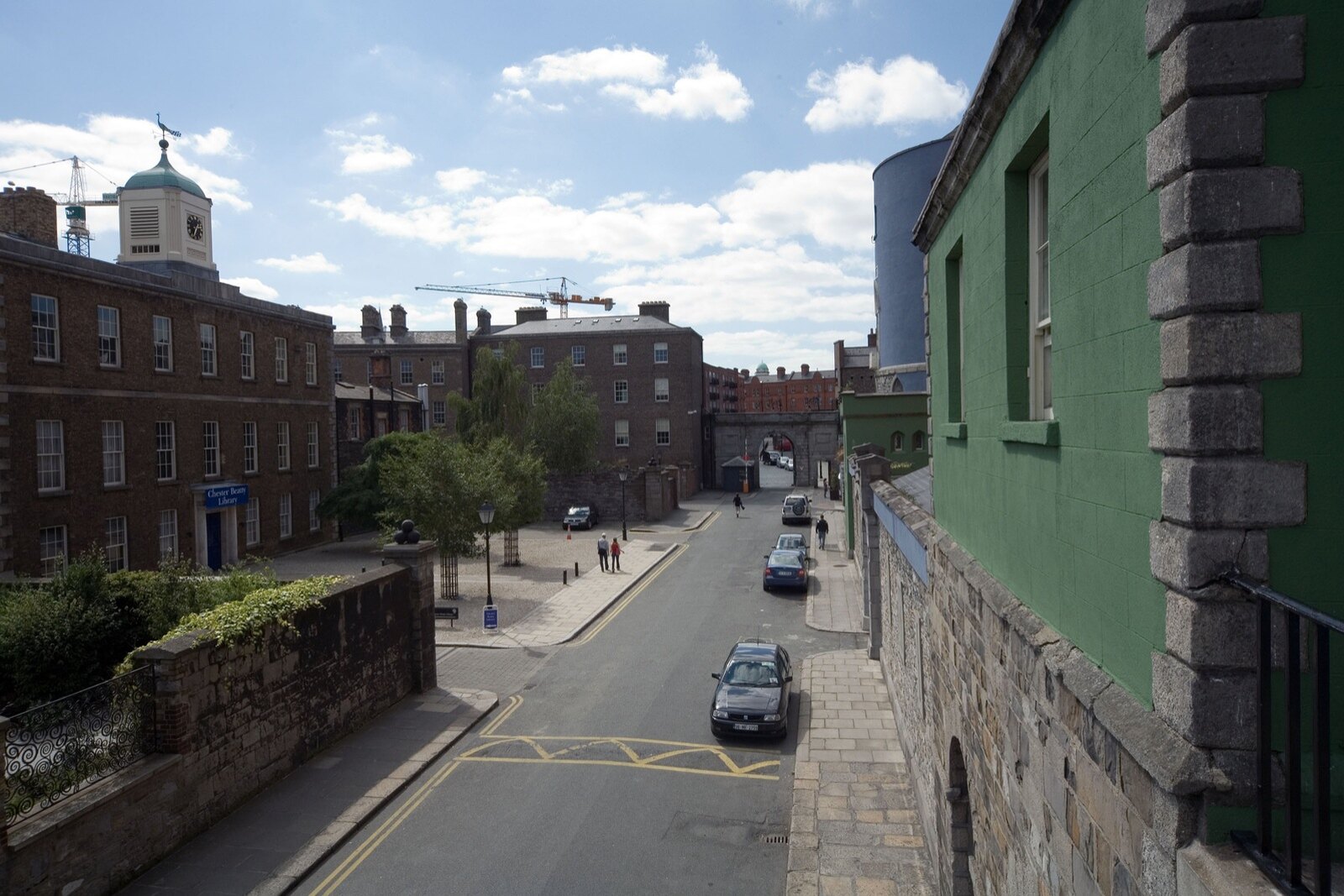
Look around first
What to notice
- Granite arch
- Two side passages
- High stone wall
- Staircase to Castle Street
The story of the place
On the western side of Dublin Castle, granite gates are divided into a central arch and two side passages, and the wall rises from here to a staircase on Castle Street. Earlier medieval masonry runs along Ship Street Little, while this section was built later. By eighteen oh seven, officials had installed the present gates, wall, and staircase to strengthen the vulnerable side of the castle.
At the western edge of Dublin Castle stand a granite arch, two side passages, and a high wall linked by a staircase to Castle Street. Medieval city masonry continues farther along Ship Street Little, but this neat stone barrier is newer. It was built after conspirators chose the wall here as the place to break into the castle.
Robert Emmet, the twenty-five-year-old leader of the clandestine republican Society of United Irishmen, was preparing a new uprising after the defeat of the rebellion of seventeen ninety-eight. By then, the Irish Parliament had been abolished, uniting Ireland with Great Britain. Emmet wanted to seize Dublin Castle along with the Irish Privy Council meeting there, and thereby signal to supporters in the city and the counties.
He financed the preparations with two thousand pounds inherited from his father, a doctor in the Irish administration. The money went on renting secret depots and making weapons: thousands of pikes, grenades, rockets, and powder-filled beams for street barricades. The attack plan took the castle’s layout into account. One detachment was to storm through the main gates, while another was to breach the weakly defended wall on the Ship Street side. The men for the first strikes gathered in houses near the intended targets.
On July sixteenth, eighteen oh three, gunpowder accidentally caught fire in a secret depot on Patrick Street. One man died, another fell into the hands of soldiers, and Emmet decided that searches would soon expose the other depots. He set the uprising for July twenty-third, although he no longer had time to contact all the commanders.
On the appointed evening, the detachment from County Wicklow did not appear, the men from County Kildare turned back, and a false rumor spread through Dublin that the uprising had been postponed. Instead of the expected two thousand men, about eighty gathered at Emmet’s depot. The carriages prepared for the attack were lost as well: one of the conspirators started a quarrel in the street and shot an officer. Shortly after nine, Emmet ordered the operation canceled; a single rocket became the signal to retreat. The detachment at Ship Street never went to the wall.
A month later, Emmet was arrested and brought to the castle he had planned to seize. On September nineteenth, he was found guilty of high treason, and the next day he was hanged and beheaded on Thomas Street.
After the rebellion, officials commissioned the state architect Francis Johnston to strengthen the vulnerable edge of the castle. By eighteen oh seven, the present granite gates, defensive wall, and staircase had appeared here. The stone barrier on Ship Street was built in response to an attack that never reached it.
Useful on site
You can explore the outer edge at any time from the public street. According to official notices, Dublin Castle State Apartments have been closed to the public since 2026-05-05, and the entire campus is expected to close to the public from mid-June 2026 until January 2027; do not count on using the passage from Dame Street to Ship Street.
Checked: June 26, 2026. Check the official source before visiting.Stay on the public street and do not try to enter through the closed gates. The whole point of this stop is revealed at the complex’s outer boundary.