 Guide On Map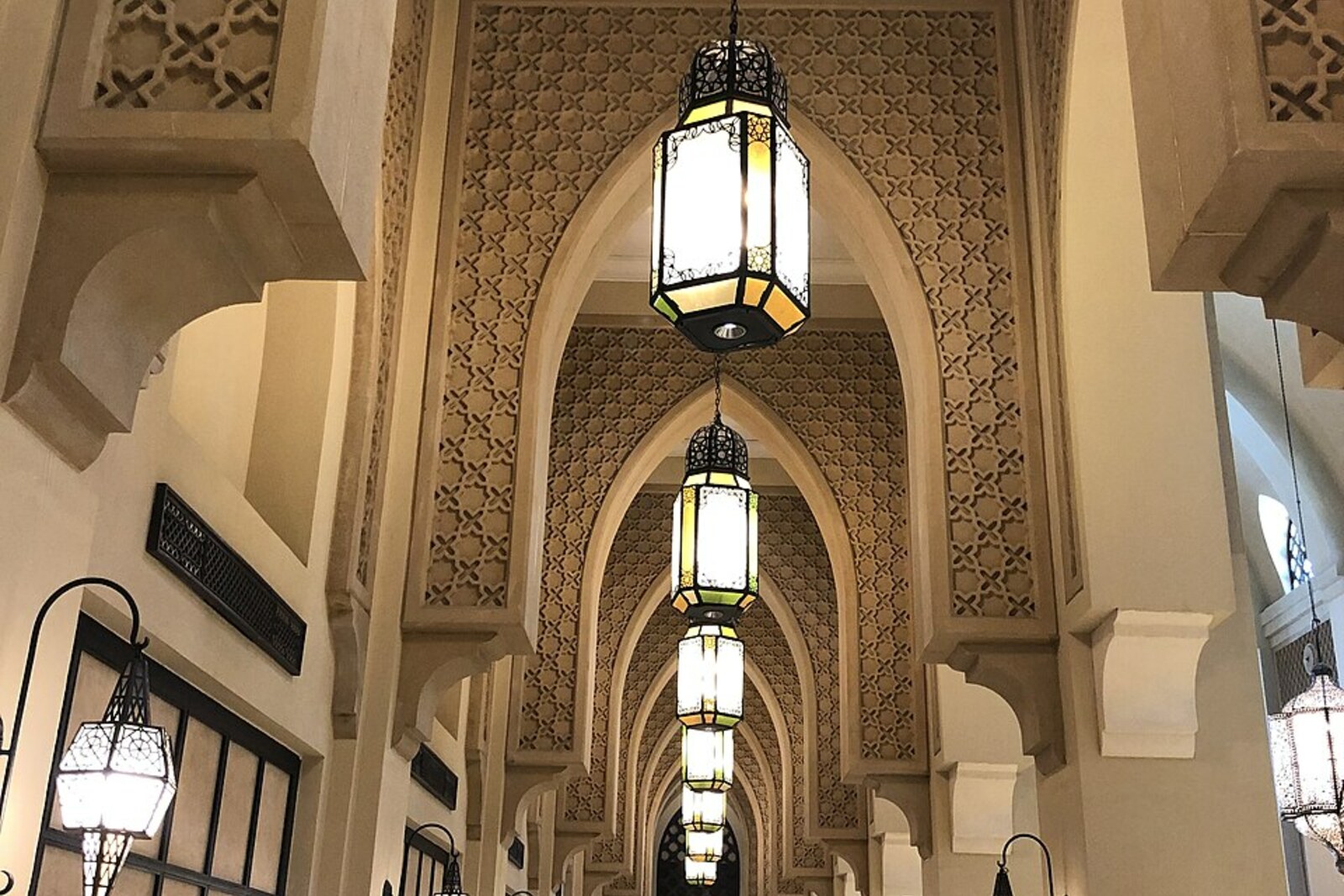
Look around first
What to notice
- Stone arches, dark beams, wooden screens, and views of the lake and Burj Khalifa framed by passageways.
The story of the place
The interior passageways connect restaurants and shops, while the lake and Burj Khalifa remain visible through the openings between them. People come here after walking around the water, sit down at tables, wait out the heat in the cool corridors, and watch the shore grow dark. On an ordinary evening, guests from neighboring hotels, local groups, and tourists meet here, for whom the view of the fountain becomes part of dinner. On festive days, the bridge from the promenade becomes a controlled entrance to tables that have been reserved in advance.
Beyond the bridge begins Souk Al Bahar—the “sailors’ market.” The name promises a port, shops, and a long history of trade, but what stands before us is a contemporary complex. Its arches, stone walls, dark beams, and wooden screens are arranged to recall an old Arab market. This is not a preserved quarter, but a carefully staged set in which the past serves as a backdrop for restaurants, shops, and evening gatherings.
The set is especially convincing after sunset. Light falls on the stone, water shimmers beyond the arches, and voices and the clatter of dishes drift out from the restaurants. It feels as if the noisy city of skyscrapers has been left outside, though it is only a few steps away. Burj Khalifa rises in one direction, the lake opens out in the other, and between them Souk Al Bahar plays the role of a cozy living room—with cool corridors and tables from which the city’s spectacle can be watched over dinner.
In two thousand fifteen, food critic Samantha Wood decided to turn such a dinner into a small adventure. She was known as FooDiva and hosted evenings called Dine Around Dubai. Over several hours, a small group visited five restaurants, while the route remained secret almost until the final day.
That evening began at La Serre. Chef Izu Ani came out of the kitchen himself to talk about the beef tartare. He marinated the meat with salt, thyme, and garlic. It mattered to him that the flavor did not remain only on the surface, but penetrated inside. Explanations like these usually take a minute, yet they are what create the feeling of a personal acquaintance with a dish: suddenly, behind the plate, there is a person who argued with a familiar recipe and worked to achieve the right nuance.
When the last sip remained in their glasses, the group set out on foot for Souk Al Bahar. At Rivington Grill, a table opposite the fountain was already waiting for them. One after another, chicken liver pâté, Devon crab, prawn cocktail, Welsh rarebit, and miniature fish and chips appeared on it. British food had found itself in an Arab interior, beside an artificial lake, beneath the tallest skyscraper in the world. In Dubai, this combination did not look contradictory. On the contrary, people here like to gather different traditions in one place and turn dinner into a route through several countries.
Yet Souk Al Bahar also remembers a very different evening from that same year.
On the thirty-first of December, at around half past nine, the neighboring sixty-three-story Address Downtown hotel caught fire. It was New Year’s Eve, when enormous crowds gathered around the lake and tables with views of Burj Khalifa were booked in advance. Instead of the usual wait for midnight, flames rose above the hotel.
Guests, residents, and visitors to the hotel’s seven restaurants were evacuated from the building. People were also led out of Souk Al Bahar. Fire engines arrived from nearby stations, safety inspections began in the complex, and the parking lot was closed. A space usually arranged for unhurried walks and long dinners became part of a large evacuation within a matter of minutes.
The contrast was almost theatrical, though what was happening was entirely real. On one side were arches, lanterns, festive tables, and a dressed-up crowd. On the other was the burning facade of a high-rise hotel. Contemporary Dubai is often seen as a city without pauses, where one opening follows another and every new building tries to surpass the last. But that night showed how quickly the familiar order can change, and how many people work unnoticed behind the scenes of this vast urban performance.
By the following morning, Souk Al Bahar had almost returned to ordinary life. Restaurants and retail spaces were again receiving visitors. The hotel, meanwhile, was closed for an indefinite period, and its guests were accommodated in other hotels. A strange boundary ran between the two neighboring buildings: here food was already being served again and doors were opening, while there people were still dealing with the consequences of the fire.
Three years later, the New Year’s arrangement around Souk Al Bahar looked different. The bridge leading to the complex was closed to everyone without a special pass. A security coordinator explained it simply: without the restriction, it was impossible to control the dense crowd and avoid a crush. The bridge ceased to be an ordinary passageway and became a kind of gateway. Behind it were restaurants with tables booked in advance; before it were thousands of people trying to get as close as possible to the main celebration.
Among the guests that evening was the Chinese tourist Min Yang Zu. Together with her parents, she had covered around six thousand kilometers and spent eight hours on the road. She was turning twenty-five, and the family dinner at Souk Al Bahar was meant to end with welcoming midnight at Burj Khalifa.
This story gives a strong sense of the place’s pull. People cross countries and time zones for a few evening hours, reserve a table, receive a pass for the bridge, and wait for the moment when light flares around the tower. For one family, it becomes a birthday; for the restaurants, the most demanding night of the year; for the security services, a difficult task of crowd management.
Souk Al Bahar itself remains between all these stories. It looks like an old market, though it was built recently. It bears a maritime name, though its main body of water is a decorative urban lake. It hides contemporary restaurants behind stone arches and wooden screens. Here, you can try British dishes, hear the story of French tartare, meet travelers from China, and find yourself only a few steps from one of the world’s most recognizable towers.
That is why its architecture works as more than decoration. An old market was usually a place where goods, languages, rumors, and people from far away met. Contemporary Souk Al Bahar does roughly the same thing, only instead of caravans, hotel guests, food groups, and festive crowds come here. And the bridge connects more than just the two shores of the lake. It joins the glittering city of the future to the image of a market that never existed here, but that proved a surprisingly fitting stage for real life.
Deeper into the story
An old image in a new district
Souk Al Bahar is valuable as an honest example of the cultural packaging of Downtown Dubai. It does not pretend to be a historic bazaar, but uses the form of a bazaar to create a sense of a local language beside the tower and the fountain.
Useful on site
Passageways and restaurants operate according to the schedules of the complex and individual tenants; check the place you need separately.
Checked: June 27, 2026. Check the official source before visiting.You can enter and look around the common spaces without ordering from a restaurant; a table with a particular view is a separate choice that is best arranged directly with the establishment.