 Guide On Map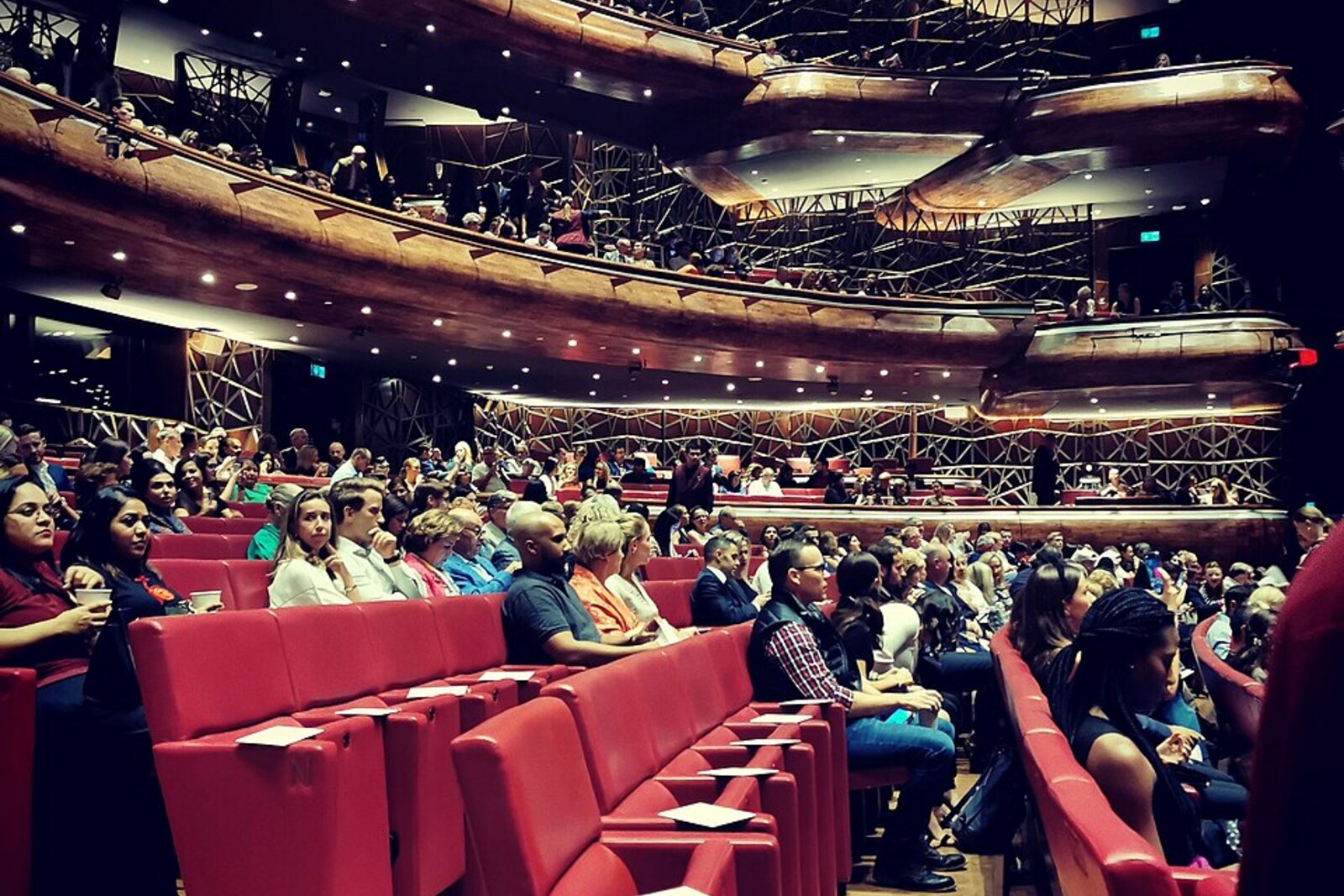
Look around first
What to notice
- The ship-like silhouette of the building, its pointed prow, the bright-pink interlacing of Declaration, and the passages between the letters.
The story of the place
The pointed prow and long hull of Dubai Opera repeat the silhouette of a dhow, a vessel on which coastal residents caught fish, dived for pearls, and carried goods between ports. By the creek, where the Bani Yas tribe settled, water once fed the settlement and linked it with the outside world. That is why the theater’s appearance preserves the memory of maritime Dubai, which existed before oil rigs, highways, and skyscrapers. The pink calligraphic structure nearby leaves passages between the letters, so the square at the entrance remains a place for walking.
Among Dubai’s giants, this building seems almost intimate. Burj Khalifa rises nearby, a fountain show plays out on the water, and an entire city of shops is hidden behind the facades of the mall. Architect Janus Rostock was given a task he himself considered almost impossible: to devise another striking image for such a setting and keep it from dissolving among already famous landmarks.
The answer was the Arabic sailing vessel, the dhow. Dubai Opera’s outline reveals its hull, prow, and superstructure. But Rostock was not speaking merely of a beautiful maritime metaphor. Behind the form lay the story of the Bani Yas tribe, whose members settled by Dubai Creek. Before oil rigs, skyscrapers, and expressways appeared, the prosperity of this place depended on water. Dhows returned with fish and pearls, carried goods, and linked the harbor with other ports. They brought here not only cargo, but the very possibility of the future city.
That is why the opera looks like a ship that ended up on land not by mistake. The old trading vessel seems to have moored among the towers and turned into a theater. Inside, in place of pearls and bales, there are voices, music, and audiences; in place of a distant sea route, there is a program that can carry the audience from one country and era to another in just a few evenings.
Janus Rostock himself grew up in Denmark and decided to become an architect at the age of eight. His example was his grandfather, who headed an architectural practice. The childhood decision proved remarkably lasting: decades later, the grandson was entrusted with a project on one of the most prominent sites in modern Dubai. Construction began in two thousand thirteen and lasted three years.
The first evening took place on August thirty-first, two thousand sixteen. Plácido Domingo came onto the stage—a singer whose name itself sounded like a statement of the scale of the new venue. The Barber of Seville followed on the program. Dubai, usually described with the words “money,” “speed,” and “technology,” suddenly began to speak the language of grand operatic tradition as well.
On opening day, Stefano Pace, representing the Giuseppe Verdi Italian Opera Fund, recalled an old prophecy: for decades, opera has been declared a dying art. But the new theater in the middle of a young city proved the opposite. In his words, opera remained alive, appealing, and even appetizing. That last word captured the mood of the opening especially well: the audience was being offered not a monument to a venerable genre, but something bright, sensual, and intended for this evening.
Jasper Hope, the venue’s first director, put it more simply. For him, the main result was that the city’s residents and guests had, for the first time, a permanent opportunity to hear live performance of this caliber. Dubai had no shortage of grand spectacles before, but here the important thing was precisely human uniqueness. A recording can be played again, the fountain will repeat its program, and light on a facade will come on according to schedule. A live voice exists only in the moment when the singer takes a breath and the hall falls silent with the singer.
In front of the building, this serious theatrical world meets the bright-pink calligraphic sculpture Declaration. It was created by the artist eL Seed. The interwoven Arabic letters resemble writing, ornament, and an urban structure all at once. The sculpture has none of the usual distance of a museum exhibit: passages remain between the letters, lines surround people, and the calligraphy itself becomes part of the square.
This approach grew out of a very personal story. eL Seed was born in France to a family of people from Tunisia. In nineteen ninety-eight, while still a teenager, he painted a wall in a Paris suburb. A woman shouted from a balcony and threatened to call his mother. The young artist sincerely did not understand the outrage: the wall was gray, he had bought the paint himself, and he had done the work himself. In his eyes, a dull surface had received a new life, which meant everything had only become better.
At the time, it was an almost ordinary teenage dispute with the city. The real artistic turn came about ten years later. eL Seed was working as a business consultant in Montreal and created Arabic calligraphy in public space for the first time. The letters connected with his family background unexpectedly became his own artistic language. The day before his daughter was born, he left his job and decided to devote himself entirely to art.
Calculation and risk combine well in this biography. The consultant was used to making plans, while the street artist understood that an urban work begins to live without the author’s permission. People touch it, walk around it, photograph it, and interpret it in their own way. That is why, in Dubai’s Declaration, the possibility of walking through the letters and climbing onto the structure was deliberately left in place. The work was not separated from the square by an invisible wall.
Then a viewer appeared whom no cultural program had anticipated. A bird settled inside the sculpture and built a nest. The artist himself told this story later. The detail is almost everyday, but it turns the calligraphy into a real urban place: the letters became not only a statement, but also a shelter.
An unexpected resemblance emerges between the pink sculpture and the ship-shaped building. Dhows once carried things and people, calligraphy carries meaning, and the theater carries a voice through the space of the hall. Everything here is connected with movement and, at the same time, with return. The ship comes into the harbor, the spectator comes to a performance, the artist returns to the language of his family, and the bird returns to its nest.
Janus Rostock said that the most rewarding part of the profession begins after construction is complete. The architect returns to a finished building and discovers that people use it not quite as intended, and sometimes even better. Dubai Opera became precisely such a place. The building had to withstand the company of the city’s records, but it acquired its own strength not because of its height. It works thanks to the people who fill it with voices, walk among the pink letters, and turn a grand architectural gesture into part of an ordinary evening.
In this finale of the route, Dubai reveals its favorite device once again. It takes an old image—a trading vessel or Arabic script—and places it in an entirely new setting. But the past here does not lie under glass. The ship becomes a stage, the letters become a space for play, and a bird’s nest appears among lines of steel. The city’s most convincing symbols prove to be alive precisely because the city lets life treat them in its own way.
Deeper into the story
A cultural stage in a district of spectacles
Dubai Opera shows that Downtown Dubai sells not only shopping and skyline. The theater adds another form of evening time to the district: a ticket, a hall, acoustics, backstage, and a schedule that competes with the fountain for attention.
Useful on site
The exterior can be read from outside; tours and performances are only with tickets, according to the schedule and the availability of the operating venue.
Checked: June 27, 2026. Check the official source before visiting.The architecture and sculpture can be viewed from the square. Plan a visit to the hall and a performance separately; without an event, the interior theater area may be inaccessible.