 Guide On Map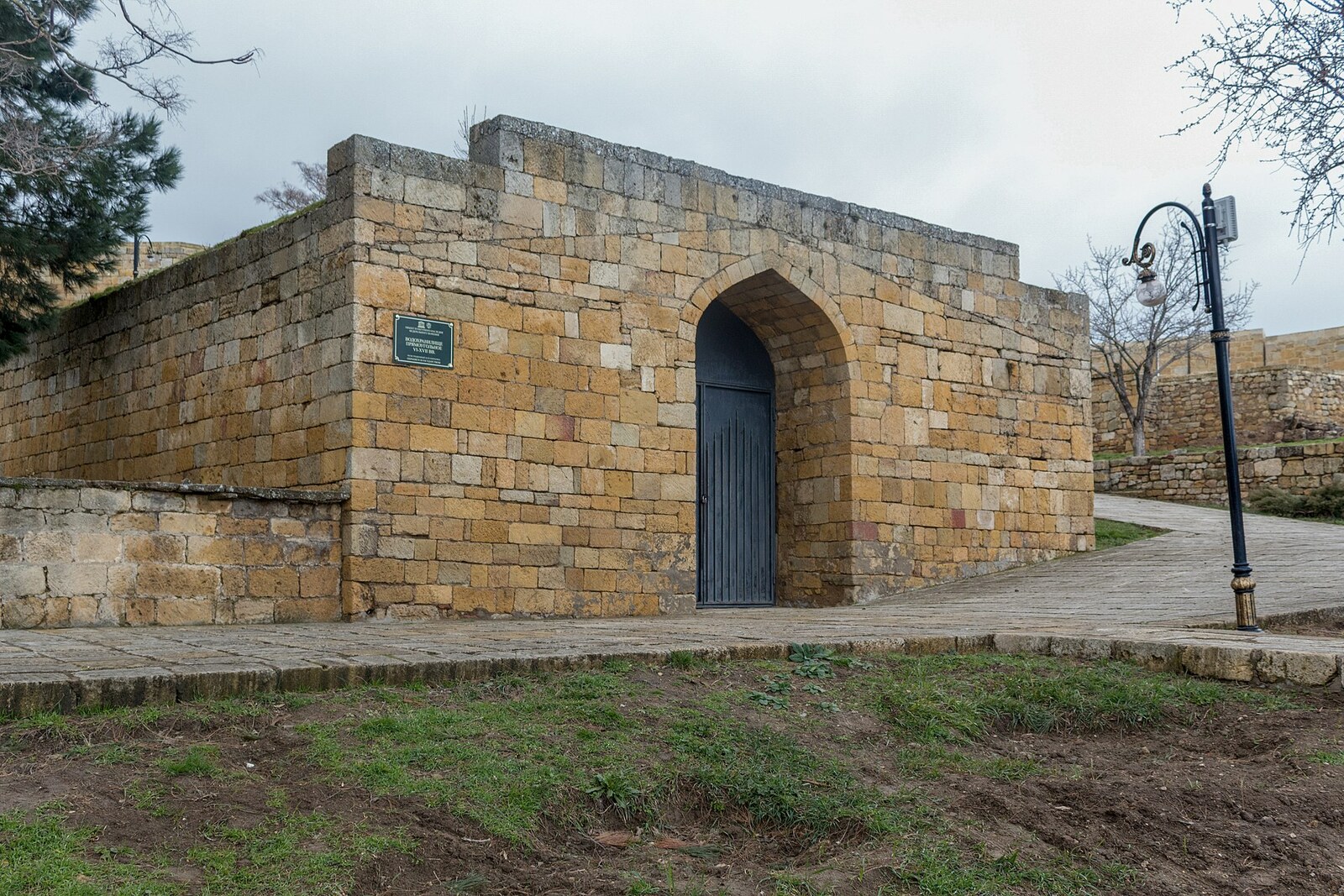
Look around first
What to notice
- Cross-shaped stone vaults
- The main entrance portal
- Stone water channels
The story of the place
Inside the citadel stood the khan's court, with a two-story residence, an inner courtyard, and an octagonal pool. Only one portal survives from the main building, while nearby underground stone vaults meet in a cross above the reservoir. Water came here from mountain springs through stone channels and clay pipes, while other lines branched off for palace needs. Officials, attendants, soldiers, and servants lived and worked at the palace.
In seventeen seventy-four, Derbent's defense was commanded by Tuti-Bike, the city's woman ruler and the wife of Fath Ali Khan. Her own brother, Amir Hamza, besieged her. He was the utsmi, the hereditary ruler of neighboring Kaitag. He wanted to take Derbent from her husband.
This family war had been prepared by Fath Ali Khan's own decisions. After annexing Derbent, he married Tuti-Bike to become related to Amir Hamza and secure the northern border of his domains. In return, the khan promised to give his sister in marriage to the hereditary ruler, the utsmi, but gave her to another ruler. The alliance collapsed. Fath Ali Khan placed his wife in charge of frontier Derbent: their kinship was supposed to restrain her brother.
By then, a new palace already stood in the citadel. Fath Ali Khan built it in seventeen sixty-eight and moved his residence here. It was a two-story building with an inner courtyard and an octagonal pool. Nearby were the chancery, storerooms, soldiers, attendants, and palace servants. Tuti-Bike was given charge of an entire household designed both for receiving ambassadors in peacetime and for a siege.
When Fath Ali Khan was defeated by an alliance of Dagestani rulers and retreated, Amir Hamza came to Derbent. According to a widespread account by local historians, he told his sister that her husband had been killed and that his body was being brought to the gate for burial. Tuti-Bike did not believe her brother and refused to let the procession in. Amir Hamza then surrounded the city.
The siege lasted more than nine months. Tuti-Bike directed the garrison and the fortress guns; by the end of the defense, ammunition was running short and famine had begun in the city. Meanwhile, Fath Ali Khan asked Russia for military help. In the spring of seventeen seventy-five, a Russian detachment of five thousand men approached Derbent. Amir Hamza lifted the siege, and Fath Ali Khan kept the city and later recovered his lost domains. His request to accept the khanate under Russian protection while preserving its independence was rejected.
Beside the palace stood a reservoir used specifically in the khan's time. Exactly when its cross-shaped vaults were built has not been established; because of its shape, the structure was even considered an early Christian church. Archaeologists did, however, find water pipes from the eighteenth and nineteenth centuries: stone channels and clay pipes brought water here from mountain springs, while other lines drew it away for household needs. The gates could be locked and the woman ruler, officials, servants, and garrison kept inside the citadel only if there was a supply of water within the walls.
Excavations preserved another part of palace life as well. Near the reservoir, archaeologists found a pit from the middle of the eighteenth century, where a damaged table service had been discarded: local jugs and cups, Iranian faience ware, and a Chinese porcelain plate. Such items were too expensive for servants; the khan's family used them.
In seventeen ninety-six, the palace was still standing intact. Ten years later, it was already described as ravaged by wars and neglected by Fath Ali Khan's heirs. After Russian troops occupied Derbent, the palace rooms were converted into soldiers' barracks. Of the two-story residence, the main entrance portal survives; the damaged table service was found in the ground, while water still flows through the old pipes into the underground reservoir.
Useful on site
Access during Naryn-Kala's opening hours: daily 09:00–18:00; individual sections may be temporarily closed off with barriers.
Checked: date not specified. Check the official source before visiting.Visit only the open sections: underground rooms and archaeological areas may be inaccessible or only partly visible.