 Guide On Map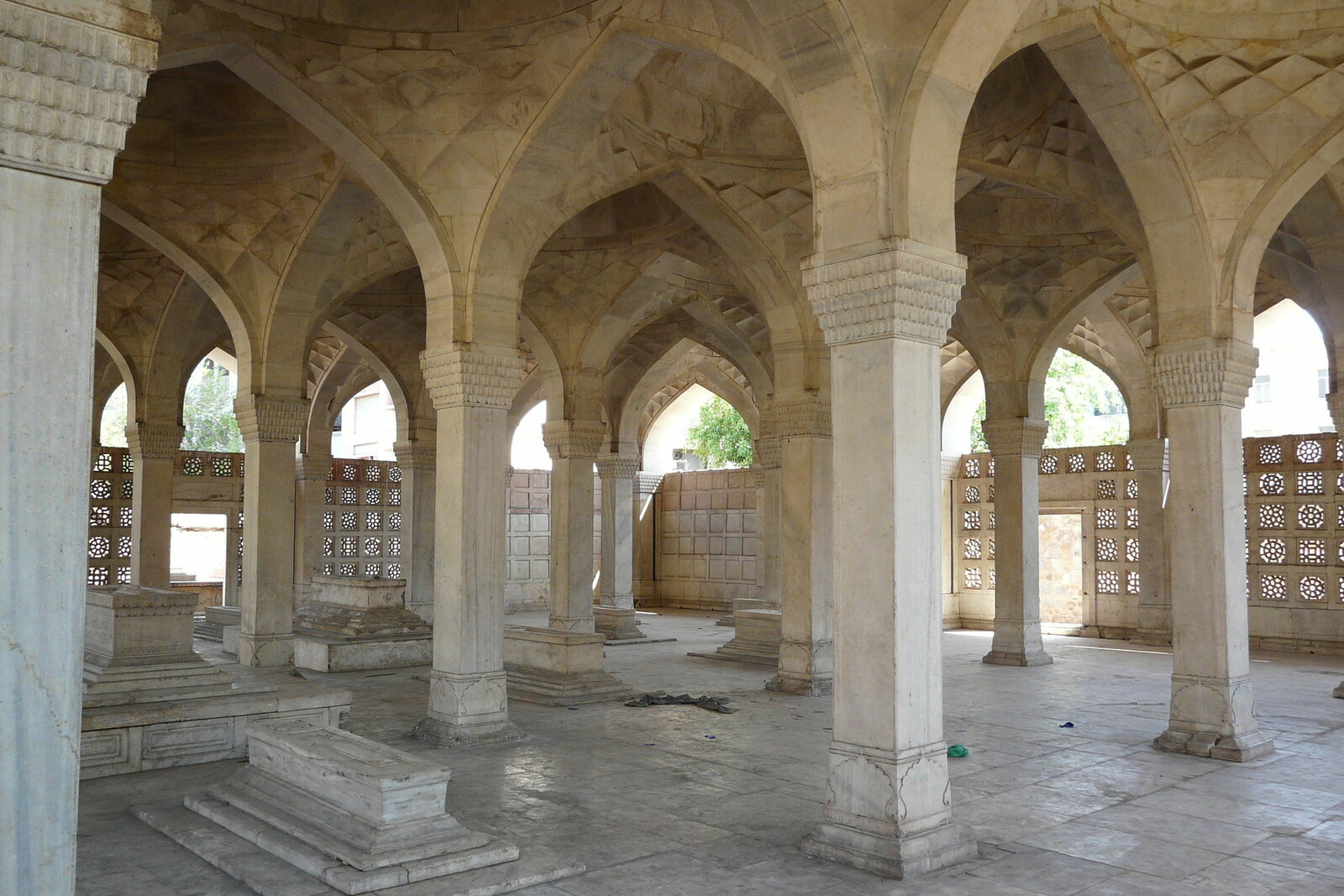
Look around first
What to notice
- Marble columns
- Low interior domes
- Carved screens
- Ataga Khan's Tomb of red sandstone
The story of the place
“Chausath” means sixty-four, and “khamba” means column. The name literally counts the marble supports. The number does not add up at once: inside, the columns stand singly; along the outer rows, they are paired; and at the corners, they are grouped in fours. They support twenty-five low domes, concealed from outside by a flat roof. The white-marble hall is designed as the mausoleum of Mirza Aziz Koka and his family.
Aziz was called Koka, meaning milk brother, because his mother, Jiji Anga, nursed the future emperor Akbar. The boys grew up at the same court. Later, Aziz commanded troops and governed Gujarat several times. But he chose the site for his grave because of his father.
Aziz's father, Ataga Khan, served as Akbar's chief minister. In fifteen sixty-one, the emperor gave him a post that another court family had expected. Its chief military man was Adham Khan, the son of another of Akbar's wet nurses. After Ataga's appointment, he retained his command but lost his former access to the emperor's decisions.
Half a year later, Adham Khan came with armed men into the audience hall of Agra Fort and ordered Ataga Khan to be stabbed to death. The murderer then tried to get to Akbar himself. The emperor ordered Adham Khan thrown from the fortress terrace. The first fall did not kill him, and the order was carried out a second time.
Aziz received his own share of this killing: he had to bury his father. By fifteen sixty-seven, he had built Ataga Khan's Tomb by the dargah of Nizamuddin. The red-sandstone tomb still stands beside it.
Nearly six decades later, Aziz prepared the neighboring site for himself. By sixteen twenty-four, the white-marble hall was ready. In its screens and columns, researchers find similarities to the buildings of Gujarat, the province Aziz governed for a long time. He died there as well, in Ahmedabad. His remains were transported across half the country to Delhi and buried in the mausoleum prepared for him.
The sixty-four columns cover the grave of a man who, after his death, was returned from Gujarat to his father. Ataga Khan's Tomb of red sandstone still stands a few steps from the son's white hall.
Useful on site
Daytime exterior access; access to the courtyard may depend on local restrictions and events.
Checked: June 28, 2026. Check the official source before visiting.View the pavilion from different sides: the density of the columns and the light between them change the space with every step. Do not confuse Ghalib's neighboring grave with the burials inside the hall.