 Guide On Map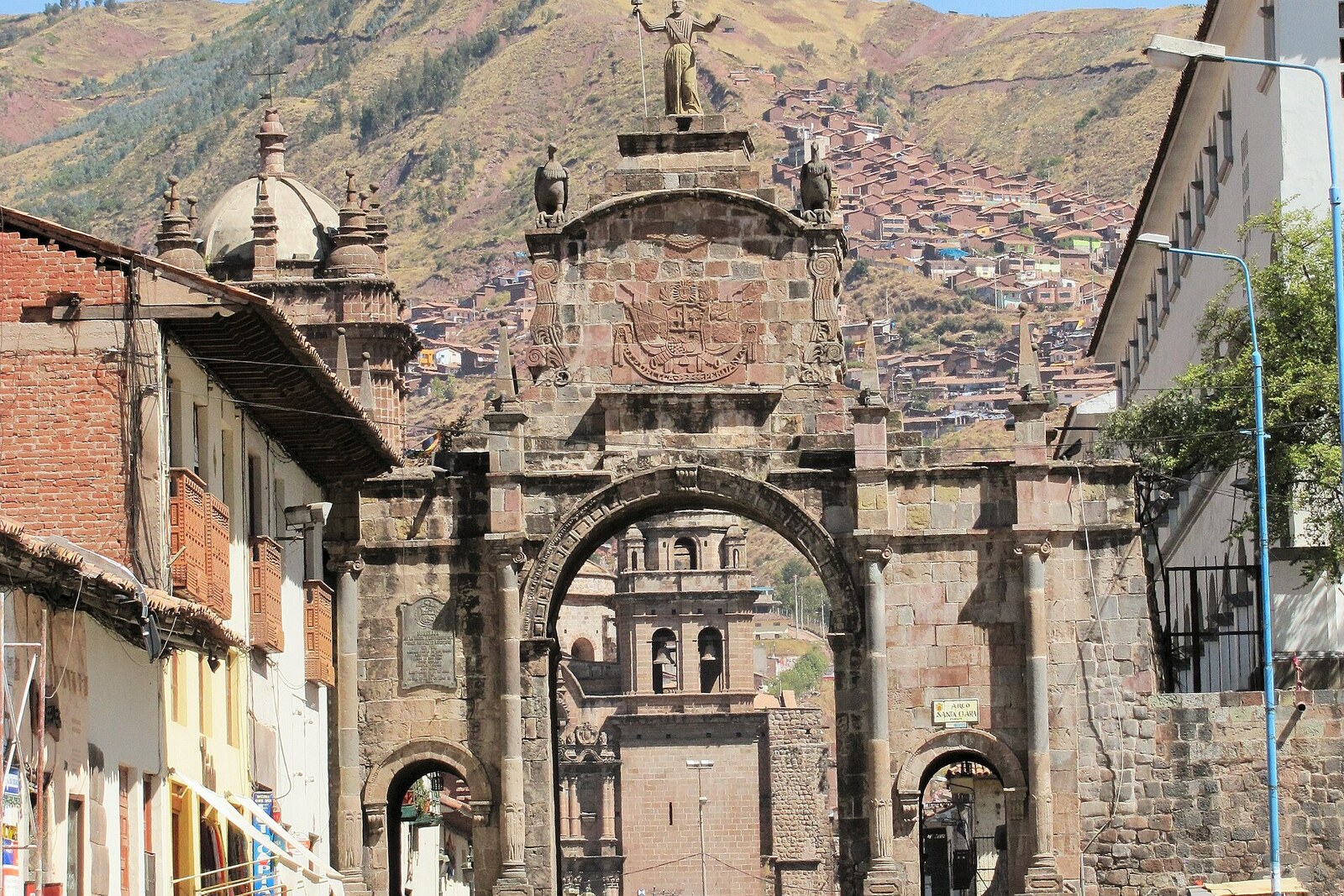
Look around first
What to notice
- Tall central opening
- Two side openings
- Coat of arms above the central opening
- Shield below the coat of arms
The story of the place
The arch stands across an active street: the road passes through the tall central opening, while the two side openings are left for pedestrians. Its current name comes from Calle Santa Clara and the monastery farther along it. Its first dedication was different.
In eighteen thirty-five, Bolivia's president Andrés de Santa Cruz ordered a triumphal arch erected here in honor of a state that did not yet exist. He sought a union between Bolivia and Peru, and the opportunity arose during the Peruvian civil war. Peru's interim president, Luis José de Orbegoso, trying to hold on to his office, invited the Bolivian army against his military rivals—Agustín Gamarra and Felipe Santiago Salaverry. Santa Cruz entered Peru with his own plan already in place: to divide the country into northern and southern states, then unite them with Bolivia.
For the people of Cusco, this plan concerned their livelihoods. Local families wove tocuyo and bayeta—plain cotton and wool fabrics that had once been sold as far away as silver-rich Potosí. After the border with Bolivia appeared, old trading ties weakened, while imported fabrics pushed aside Cusco's craftspeople. A union between southern Peru and Bolivia promised to reconnect those markets.
In August eighteen thirty-five, Santa Cruz defeated Gamarra at Yanacocha near Cusco, then defeated Salaverry near Arequipa. After these victories, twenty-three representatives from Cusco, Puno, Arequipa, and Ayacucho gathered in Sicuani. They declared their lands the South Peruvian State and granted Santa Cruz the powers of supreme protector. In October eighteen thirty-six, he proclaimed a Confederation of Bolivia, the South Peruvian State, and the North Peruvian State.
The arch was erected on the road that ran from Cusco's main square toward the ancient route to Contisuyu and had served for centuries as one of the city's entrances. Travelers moving between the center and the southern districts passed beneath the emblems of the new union. The stone structure cemented Santa Cruz's victory where his project had received especially strong support.
The union lasted three years. In January eighteen thirty-nine, opponents of the Confederation routed Santa Cruz's army at Yungay. On February twentieth, he resigned as protector and soon left for exile in Ecuador. Gamarra, whom Santa Cruz had defeated near Cusco, returned and became president of a restored, unified Peru. The South Peruvian State disappeared along with its borders and institutions.
The arch was not dismantled. The Confederation's coat of arms survives on its façade, with the shield of the Republic of Peru below it. Both symbols stand above the same central opening through which the street still passes today.
Useful on site
The arch is accessible around the clock; it is part of a city street.
Checked: June 28, 2026. Check the official source before visiting.View the upper details from a safe spot outside the roadway. Step back a few paces to see the difference between the lower base and the later upper section.