 Guide On Map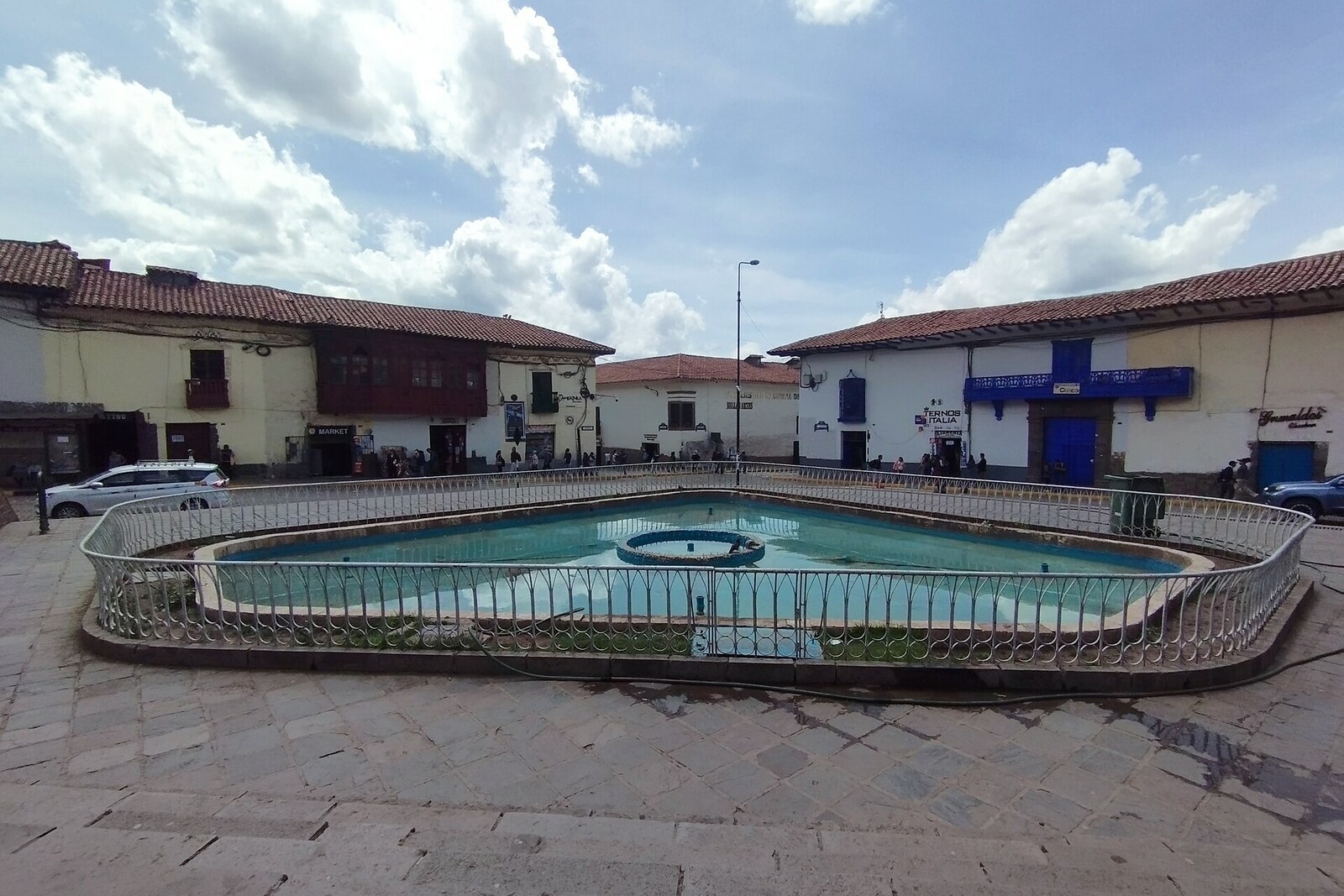
Look around first
What to notice
- The fountain in the center of the square
- Flowerbeds and the botanical garden
- The church façade
- The school façade
The story of the place
The flowerbeds and fountain in the middle of Plaza San Francisco occupy the site of a market that never came to be. By nineteen twenty, the foundations had already been poured and the first columns erected here. The plan was to build market pavilions across almost the entire square.
Vendors had used this place long before the project appeared. From at least seventeen seventy-eight onward, a baratillo—a market for small, inexpensive goods—gathered here on Saturdays. In nineteen ten, part of the food trade was moved here from Cusco's main square, and market stalls began appearing every day. The women selling provisions lived on their daily takings; they had no permanent premises. A newspaper reported quarrels between female customers and women vendors, while municipal officials demanded that police officers be posted to keep watch over order and cleanliness.
The square suited merchants because of its location. Roads from several densely populated neighborhoods converged here, and produce delivered from the southwest did not have to be carried through the entire center. The city would receive fees for stalls without buying expensive land: the square itself belonged to the municipality. Supporters of construction promised vendors permanent places and cleaner food trade.
In nineteen nineteen, Mayor José Ángel Escalante, who was seeking the construction of a permanent city market, chose Plaza San Francisco. Many residents supported him in an open newspaper poll. The following year, workers began construction.
Opponents of the project painted a very literal picture of the future: a large building would block the façades of the church and the Colegio de Ciencias, while carts, customers, and merchants would fill the narrow streets of the center. They wanted to preserve a park with fountains in front of the school. The view of the church was especially important, since the square took its name from it. Franciscan friars settled here in fifteen forty-nine, and in fifteen seventy-two Viceroy Francisco de Toledo ordered a church built for them, dedicated to Saint Francis of Assisi—an Italian friar who founded the order whose members took a vow of poverty. The square's name refers to the saint, although the story of its creation also includes another Francisco: the viceroy.
When the columns had already risen above the foundations, engineer Roberto Gering presented a different calculation. He was responsible for the technical justification of the construction and proposed a site by the Monasterio de Santa Clara, then on the edge of the city. Water and drainage could be brought there, the route along which produce was delivered passed nearby, and space remained around it for future trade. Members of the construction council and city residents supported him, and work on the square was halted.
In nineteen twenty-one, the new mayor, Manuel Silvestre Frisancho, adopted Gering's proposal. The nuns agreed to cede part of the monastery's land, and in nineteen twenty-five merchants received the covered San Pedro Central Market where it stands today. No visible trace of the foundations and columns remains on Plaza San Francisco.
Today, temporary fairs and festive and religious events are held here; at Christmas and during Holy Week, market stalls once again occupy part of the square. Then the vendors remove their counters, and the fountain and botanical garden remain once more in the center—exactly where construction of the permanent market stopped at the columns.
Useful on site
The square is open around the clock; fairs and events take place irregularly.
Checked: June 28, 2026. Check the official source before visiting.Stay closer to the edge of the square so as not to obstruct the main flow of people, and compare its boundaries with the dense development around it.