 Guide On Map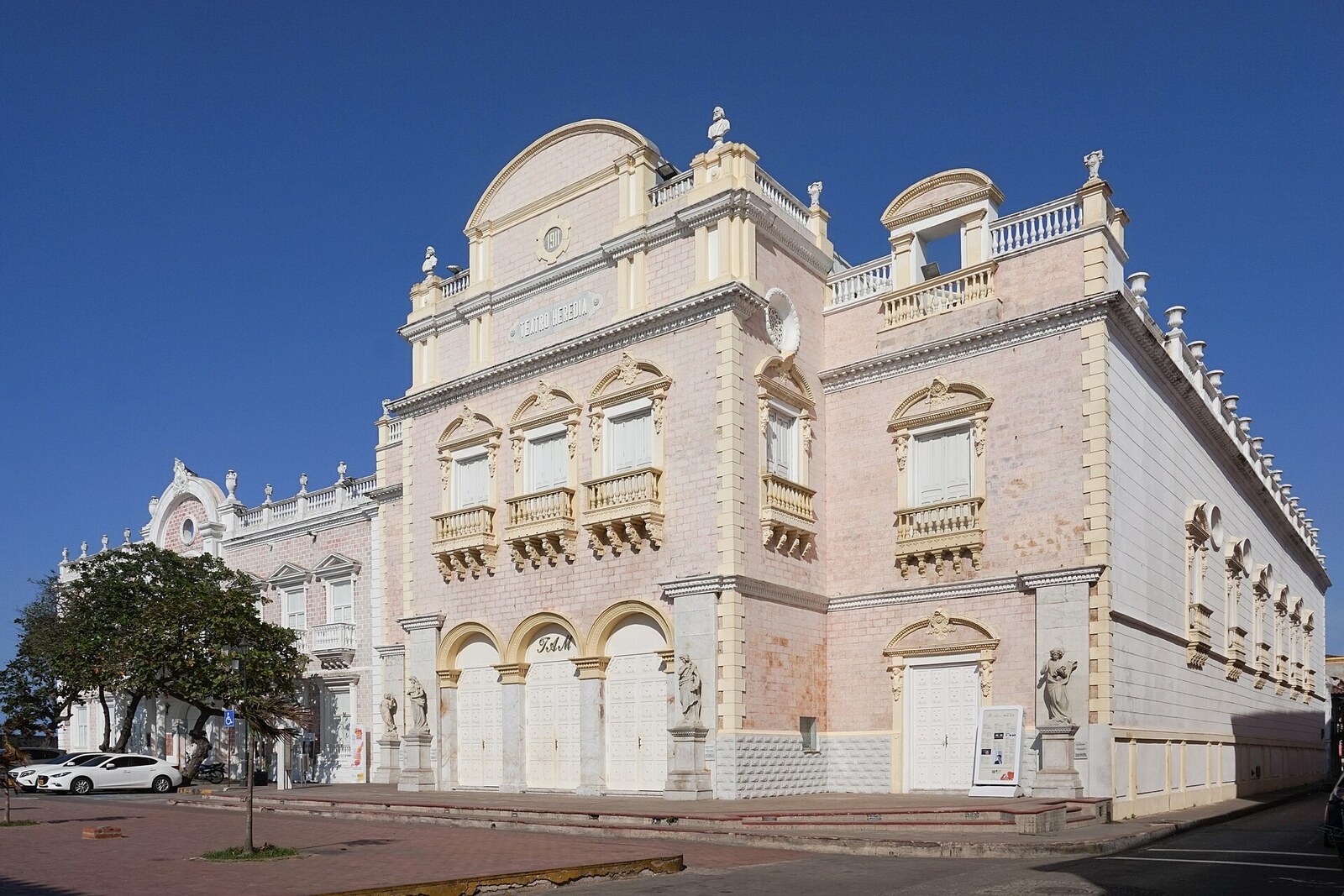
Look around first
What to notice
- Stone inscription reading “Teatro Heredia”
- Horseshoe-shaped auditorium with tiers of boxes
- Cedar screens
- Round ceiling painting with nine muses
The story of the place
The present theater occupies the structure of the former Chapel of La Merced, which stood abandoned for a long time. Its three-aisled church walls preserved the familiar appearance of a church on the outside, but a horseshoe-shaped auditorium with tiers of boxes was created inside for city residents. A stone inscription with the old name remains on the facade, and a circle with nine muses is visible beneath the auditorium ceiling. Today, concerts resound within these walls, and there are plays, film screenings, and literary gatherings.
In June nineteen eighty-two, Cartagena architect-restorer Alberto Samudio Trallero began dismantling the auditorium. Workers removed the box balconies, carved cedar screens, doors, and plaster decorations. His colleague Rafael Lemaitre publicly stated that the remains of the old theater had been turned into a pile of rubble. Samudio replied that the details had not been destroyed: they had been measured and stored away to be returned after the load-bearing structures were reinforced.
There was indeed plenty to dismantle. In nineteen seventy, municipal services closed the theater because it was unsafe. Samudio had visited as a schoolboy for one of the last major concerts: a Cuban pianist played before a packed hall. When the architect returned with a restoration plan, part of the floor had collapsed, there were gaping holes in the ceilings, and the balconies were broken.
The building’s origin complicated the work. At the beginning of the twentieth century, Governor Enrique Luis Román commissioned architect Luis Felipe Jaspe to create a public city theater. The abandoned Chapel of La Merced was set aside for it. Jaspe used its three-aisled structure and placed a horseshoe-shaped auditorium with tiers of boxes inside it. The theater opened in nineteen eleven, for the centenary of Cartagena’s independence. Behind the churchlike facade, the layout of an opera house has been concealed ever since.
Samudio had to save both this shell and the theater enclosed within it. There was enough money only for separate stages; work stopped and resumed. The architect donated his drawings free of charge, paid for part of the research himself, and sought support from presidents, mayors, businesspeople, and artists. The removed details lay in storage for years before they began to be installed again.
The renewed auditorium needed a new theater curtain. Samudio first approached artist Alejandro Obregón, but Obregón became seriously ill and died in nineteen ninety-two. The architect then invited Enrique Grau, a painter from Cartagena. Grau agreed to accept money only for materials. For nearly two years, he worked here on the curtain, seven meters high and nine meters wide, and then on a round ceiling painting with nine muses. The seventy-eight-year-old artist climbed to the ceiling on fifteen-meter scaffolding even with an orthopedic collar around his neck.
On July thirty-first, nineteen ninety-eight, a concert was given here again. The twenty-eight-year closure ended, and Samudio later received a national architecture prize for this restoration.
That same year, the theater received its present name. Since nineteen thirty-three, it had been named after Pedro de Heredia, the Spanish founder of Cartagena; a stone inscription reading “Teatro Heredia” still remains on the facade. The new name recalls Adolfo Mejía Navarro, a composer who combined classical music with Caribbean rhythms. In nineteen forty-five, Mejía selected programs for Sociedad Pro-Arte Musical de Cartagena and prepared its festivals. The first festival had to be held in another hall: Teatro Heredia was already too dilapidated by then.
Concerts, plays, film screenings, and literary gatherings now take place here. The cedar screens and plaster decorations stand where Samudio promised to return them, and above them hangs the nine-meter circle painted by Grau during the final stage of the theater’s rescue.
Useful on site
Cultural venue; visiting depends on events, rehearsals, work, and advance requests through the official contact.
Checked: July 1, 2026. Check the official source before visiting.Ordinary entry inside is not guaranteed: visits are tied to performances or a separate arrangement. From outside, do not linger in front of the entrance during events.