 Guide On Map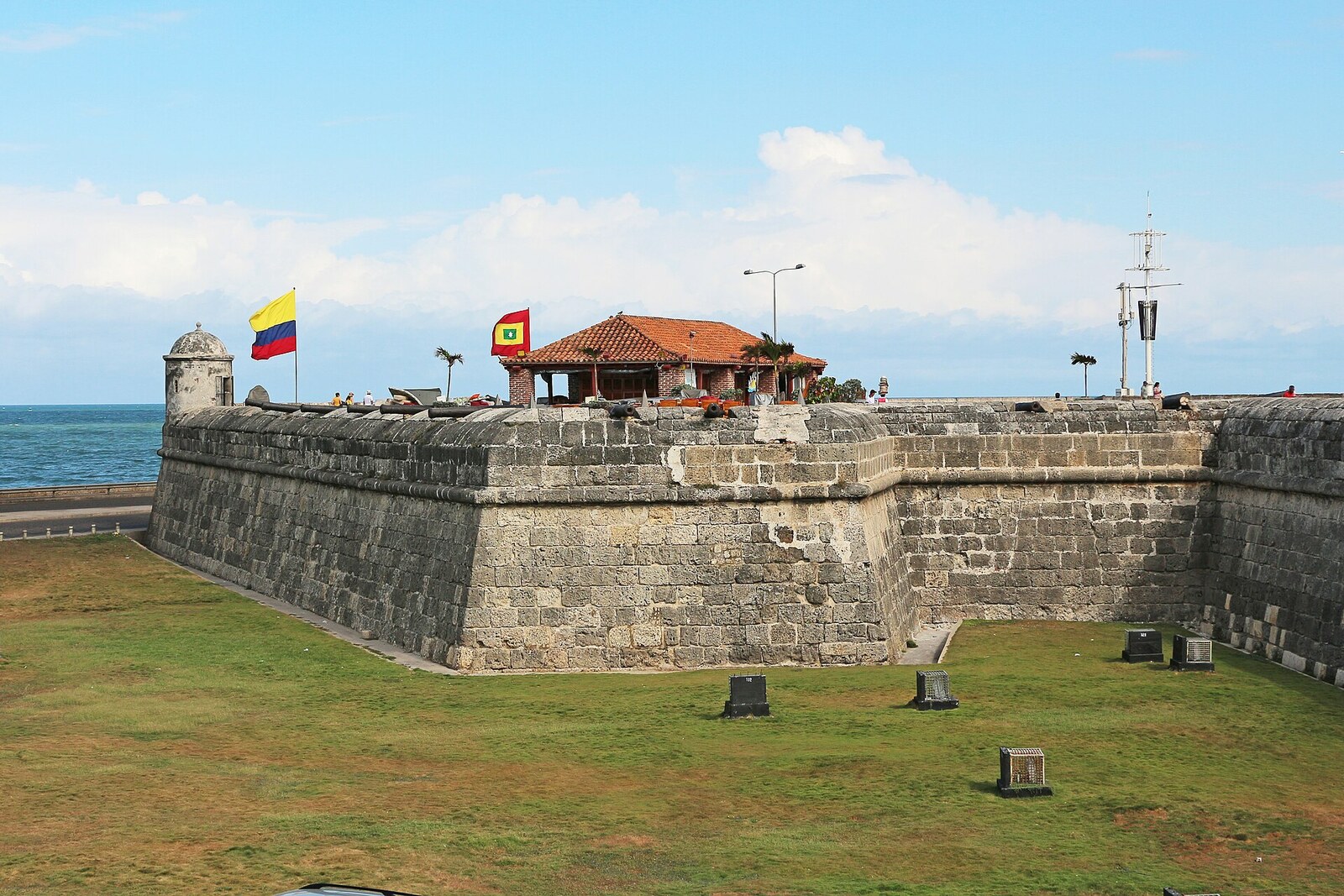
Look around first
What to notice
- The stone pentagon of the bastion
- The ramp
- Vaults on either side of the ramp
- The upper plaza
The story of the place
The bastion's five sides project beyond the city wall line: from them and from the side platforms, fire could be directed along the shore and at neighboring fortifications. In sixteen fourteen, the first large bastion of the new stone defensive ring was laid here. The neighboring gate and Dominican monastery gave the structure its present name. The ramp leads up to an open public plaza, while the vaults on either side once led to the lower gun platforms.
In February fifteen eighty-six, a narrow isthmus still stood where the present stone pentagon—the Santo Domingo Bastion—now stands. The Caribbean Sea reached it from one side, and the waters of the inner harbor from the other. Horsemen and carts entered Cartagena through a passage about fifty paces wide.
Governor Pedro Fernández de Busto was preparing to stop an English squadron here. Twenty days before it appeared, the residents received a warning from the city of Santo Domingo on the island of Hispaniola: Francis Drake had captured it. Drake commanded a naval expedition that Queen Elizabeth I had sent to attack Spanish possessions.
Drake needed plunder. Investors financed the expedition, and written contracts entitled its participants to a share of what was captured. Ordinary sailors could count only on wages and meager rations. Before reaching Cartagena, the English had missed Spanish ships carrying American treasures, and the ransom for Santo Domingo proved far smaller than expected. Cartagena served the trade route through Nombre de Dios, where riches from the Pacific side of the continent were brought in. Drake hoped to recoup the expedition's costs here.
The residents had time to send away their families and their most valuable possessions. Fernández de Busto requested reinforcements in Tolú and Mompox and gathered arquebusiers, pikemen, horsemen, Indigenous archers, and free Black marksmen. There was little lead and gunpowder, so this isthmus was made the decisive line of defense.
An English participant in the expedition described its defenses. The defenders built a stone wall and a ditch across the passage. They left an opening for carts and cavalry, but blocked it with upright wine barrels packed with earth. The edge of the barrier reached the sea. Six cannons fired directly down the road, while another eleven guns were placed on two galleys in the inner harbor to fire at the passage from the side. Several hundred marksmen and pikemen stood on land and aboard the vessels.
Christopher Carleill, who commanded the English land detachments and sought to open Drake's way into the city, landed his men at the entrance to the harbor. At night, he led the column along the water's edge. The defenders had strewn the usual road with sharpened stakes and poisoned some of their tips, but the English passed farther down, along the strip of shore exposed at low tide. Because of this, most of the fire from the fortification did not stop them.
Carleill forbade his marksmen to return fire until the detachment came right up to the barrier. The English fired a volley beside the barrels and struck with their pikes. Their pikes were longer, and they had more armor. The barrels were knocked over. According to English testimony, Carleill personally killed the defenders' standard-bearer, who had remained by the breach. The others retreated, and the attackers burst into the streets. By dawn, the city had been captured.
Drake's men held Cartagena for six weeks. While the ransom was being negotiated, they set fire to the outer houses. The residents had to collect one hundred ten thousand ducats, mainly in silver. Women from wealthy families offered gold jewelry, pearls, and emeralds, but the English accepted only part of it: they needed money. The plunder still failed to meet expectations, and disease continued to carry off Drake's men. He abandoned the planned campaign through Nombre de Dios to Panama and led the squadron away.
After the capture, the Spanish Crown commissioned engineers to block this very passage with a permanent stone fortification. Bautista Antonelli prepared the design, Cristóbal de Roda adapted it to the terrain, and Governor Diego de Acuña secured the start of the work. In sixteen fourteen, the first stone of the first large bastion in the city's defensive ring was laid where the barrels had been knocked over. It projected forward from the wall line: guns on its faces and side platforms could fire on the coastal approach and neighboring sections of the fortifications.
At first, the bastion was called the San Felipe and Santa María Bastion. It received the name Santo Domingo from the neighboring gate and Dominican monastery. Dominic de Guzmán was a Castilian priest who founded the Order of Preachers; he had no connection to the defense of Cartagena. The saint's name passed to the military structure from the monks who lived nearby.
Today, the top of the bastion serves as a public plaza, part of which is occupied by a restaurant. Vaults survive on either side of the ramp, once leading to the lower gun positions. The stone pentagon stands across the very passage where Carleill's men knocked over the earth-filled barrels.
Useful on site
The plaza is exposed to sun and wind; choose a calm spot along the inner side and do not block the way for other visitors.