 Guide On Map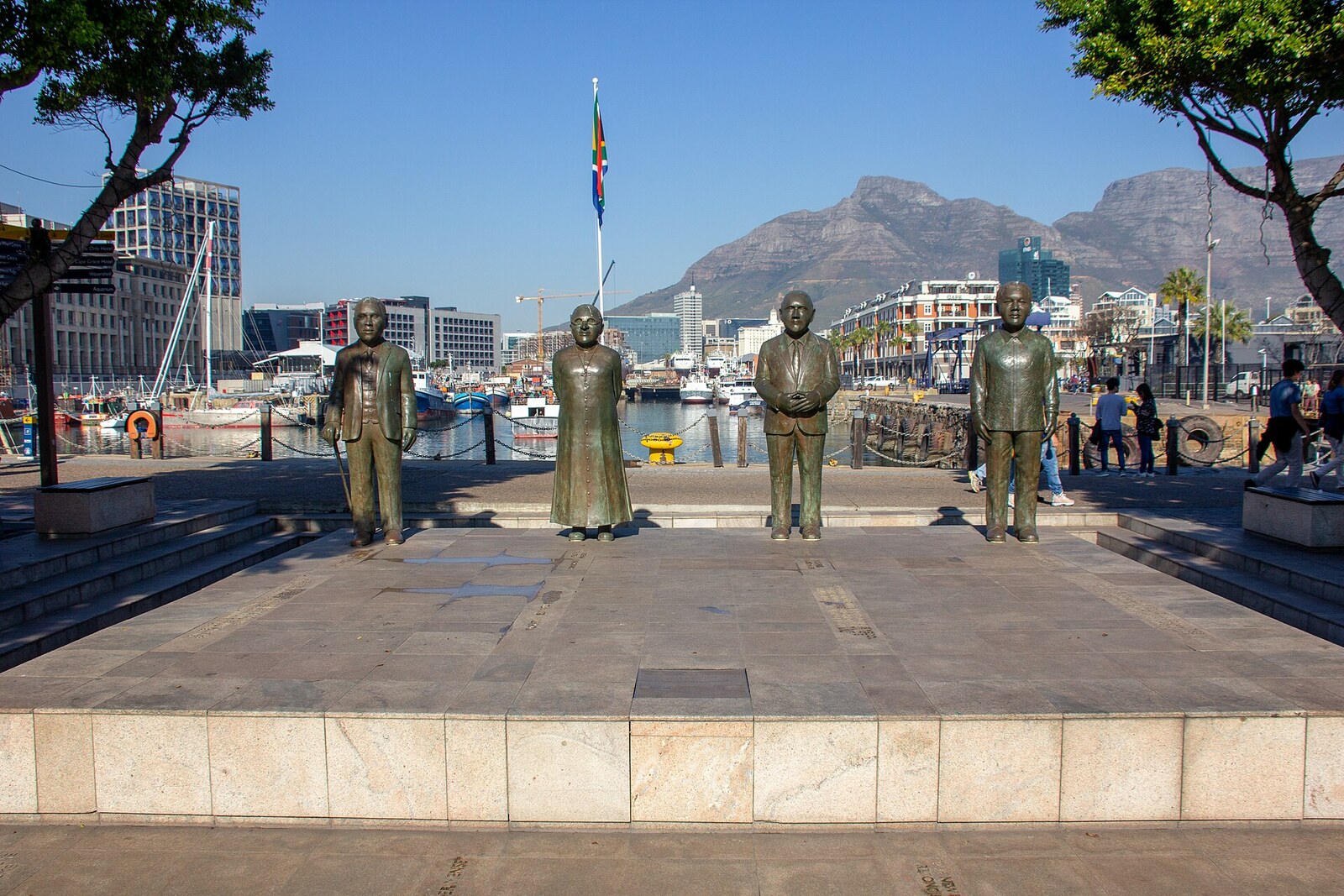
Look around first
What to notice
- Four bronze figures
- Low “Peace and Democracy” composition
- Granite with inscribed words
- Robinson Dry Dock
The story of the place
By Robinson Dry Dock, the granite underfoot brings together several bronze figures in a semicircle, slightly taller than human height; a low composition in the same metal lies before them. The square was created on the busy waterfront so that the memory of peaceful resistance to racial segregation would not remain inside official buildings. Words chosen by the memorial's heroes are inscribed in the granite, while a separate bronze group recalls women and children, whose participation often disappears behind the names of political leaders. The artist first modeled it in clay at her home, and only afterward did the work take on its bronze form.
In December two thousand three, the bronze figures were not yet here. Three living South African Nobel Peace Prize laureates arrived at the site by Robinson Dry Dock. Nelson Mandela, a former political prisoner and leader of the African National Congress, had worked to secure elections involving all citizens. Frederik Willem de Klerk, the country's last president under apartheid—a system of legally enforced racial segregation—opened negotiations to end it. Anglican Archbishop Desmond Tutu advocated a nonviolent transition to equal rights. The fourth laureate, the late chief Albert Luthuli, was represented by his daughter Albertina.
They were awarded at different stages of one long struggle. Luthuli received the prize for nonviolent resistance to apartheid: the South African government barred him from leaving his place of residence and only temporarily allowed him to travel to receive the award. Tutu was honored as a leader who succeeded in uniting opponents of racial segregation around a peaceful campaign. Mandela spent twenty-seven years in prison. De Klerk ordered the ban on the African National Congress lifted and Mandela released. In nineteen ninety-three, the Nobel Committee awarded them a joint prize for ending apartheid through negotiations and preparing the country's democratic order.
Here, Mandela, de Klerk, and Tutu signed a commemorative plaque officially proclaiming Nobel Square. Yet during the ceremony, the honorees themselves began to object to the future memorial's overly narrow meaning. Tutu said that the real heroes were ordinary South Africans and that the square was dedicated to them. De Klerk also gave credit to the people represented by the laureates. Albertina Luthuli recalled that her father had not lived to see the universal elections of nineteen ninety-four and would have wanted above all to cast a ballot into the box himself.
The site was chosen for the busy V&A Waterfront. Its management company provided the plot, and the provincial government paid for the memorial. The province's premier, Ebrahim Rasool, explained the choice by saying that people from all over the world come here: the memorial was meant to stand where millions of visitors would see it, not only participants in official ceremonies.
From ten invited artists, the commission selected Claudette Schreuders and Noria Mabasa. Schreuders received four portraits and, for the first time, took on bronze figures of this size. Mabasa was initially offered work on the same series of laureates, but she decided to make a separate composition. That is how the fifth sculpture, “Peace and Democracy,” appeared, dedicated to the participation of women and children. Mabasa modeled the first version in clay at her home in Limpopo Province; a mold was then taken from it, and the work was cast in bronze.
On December sixteenth, two thousand five, South Africa's Day of Reconciliation, Tutu and de Klerk returned here for the unveiling. Mandela and Luthuli were represented by their families. The four laureates now stand in a semicircle, slightly taller than human height, with words they chose inscribed in the granite at their feet. Mabasa's low bronze composition is placed before them. The four figures have world-famous names; the fifth places in that same row the people Tutu spoke of in the empty square two years earlier.
Useful on site
Open daily 09:00–21:00. Free access.
Checked: June 28, 2026. Check the official source before visiting.Walk around the sculptures to view them without the usual frontal perspective. The square is busy—do not block the passage if you linger by the figures.