 Guide On Map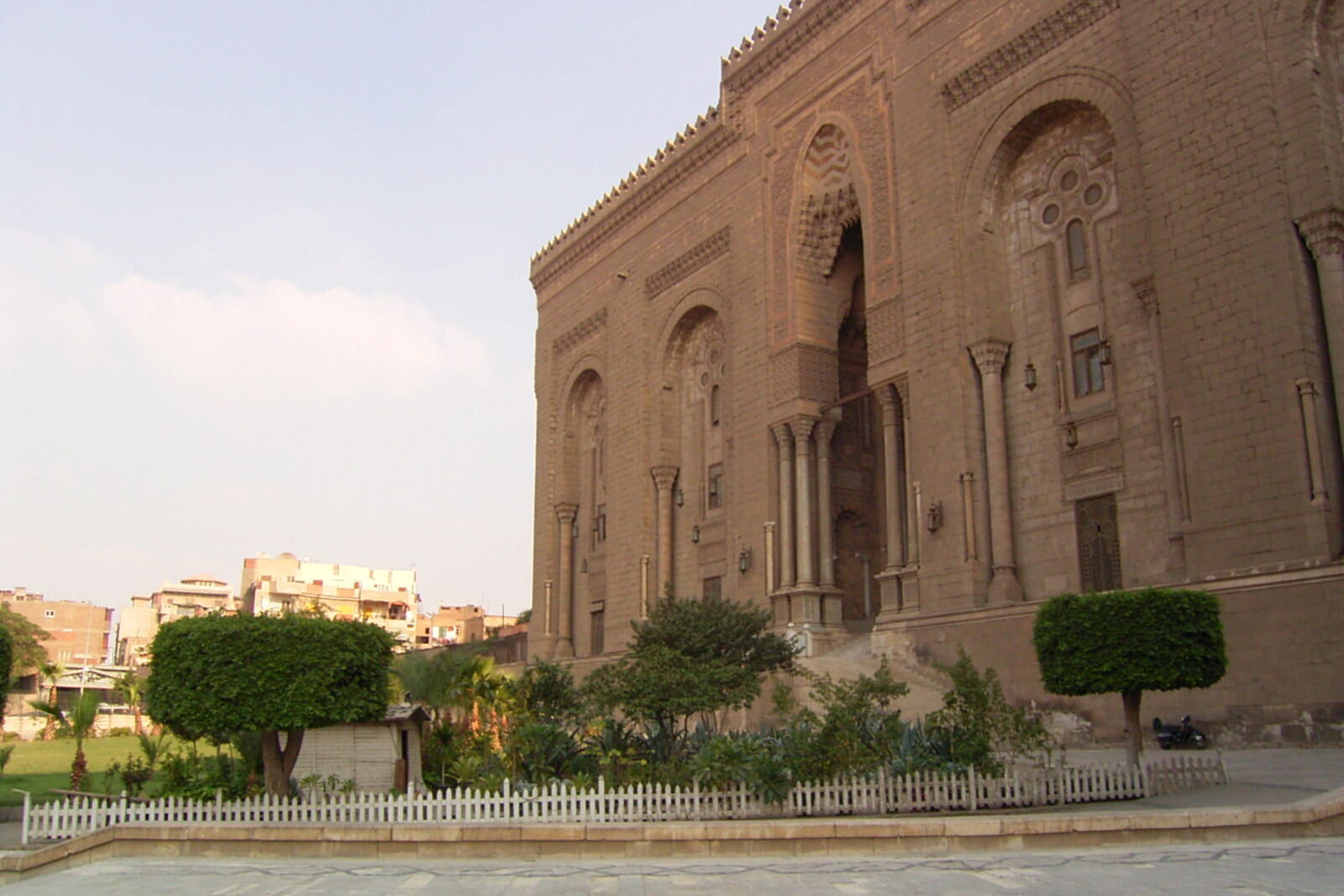
Look around first
What to notice
- Mamluk façade
- Northern mausoleum
- Marble tombstones of Hushyar and Ismail
- Tomb of Ali Abu Shubbak al-Rifa'i
The story of the place
Imam Ahmad al-Rifa'i is not buried here. The founder of one of the oldest Sufi brotherhoods died in the twelfth century, and his grave is in Iraq. The Cairo name arose thanks to a small zawiya—a house for prayer and Sufi gatherings—that stood on this site. It contained the tomb of Sheikh Ali Abu Shubbak al-Rifa'i, who was called Ali al-Rifa'i. Pilgrims came to his grave, and the name of the zawiya later passed to the present mosque.
In eighteen sixty-nine, Hushyar Hanim, the mother of Ismail, Khedive of Egypt, ordered the old Sufi tombs to be enclosed within an enormous new building. They could not be moved. A burial place for the patron herself and her descendants was to be arranged beside them. Hushyar chose a site opposite the Mosque-Madrasa of Sultan Hassan, and the architect Hussein Pasha Fahmi was to give the new mosque the same Mamluk scale. Ismail paid for the work from his personal treasury.
The plan began to crumble along with the stone. The builders chose a material that was easy to polish, but after drying its surface flaked away, and individual blocks cracked under the weight of the masonry. Costs rose. An invited European architect proposed reworking the plans and dismantling the part already built. Hushyar refused, and the dispute with her son halted the work.
The minister of public works, Ali Pasha Mubarak, found another solution: to cover the prayer hall with a large iron dome. A European firm agreed to carry out the order for thirty thousand Egyptian pounds. Ismail approved the proposal, Hushyar rejected it again, and demanded that work continue according to Fahmi's design.
When the walls had risen to about two meters, Ismail was told the full cost of the intended building. He tried to transfer the construction to a government department, but by then debts had already brought Egypt's finances to bankruptcy. In eighteen seventy-nine, the Ottoman sultan, under pressure from Britain and France, deposed Ismail and exiled him from Egypt. The work stopped the following year.
Hushyar died in eighteen eighty-five. She was buried in the northern mausoleum among unfinished walls. Ten years later, Ismail died in Istanbul. According to his will, his body was brought to Cairo and laid beside his mother. Both ended up in the family mausoleum they had commissioned at a time when the mosque was still unfinished.
Only in nineteen oh six did Hushyar's great-grandson, Khedive Abbas Hilmi II, commission Max Herz to finish the building. Fahmi's plans for the upper part, the domes, and the interior did not survive. Herz designed them himself, preserving the already built foundation and the Mamluk models. The mosque opened in nineteen twelve—forty-three years after Hushyar's order.
In the northeastern burial chamber, Hushyar's marble tombstone stands beside Ismail's tombstone. In a separate room, the tomb of Ali Abu Shubbak al-Rifa'i has survived; from it this place received the name Al-Rifa'i. The grave of Ahmad al-Rifa'i himself remained in Iraq.
Useful on site
Daily 09:00–17:00; admission with a combined ticket for Al-Rifa'i Mosque and the Mosque-Madrasa of Sultan Hassan. Access may change during prayers and local ceremonies.
Checked: June 27, 2026. Check the official source before visiting.Not all burial spaces are necessarily open at the same time; respect barriers and the prohibition on photography if it is indicated. Even without entering, you can compare the mosque's façade and height with the Mosque-Madrasa of Sultan Hassan.