 Guide On Map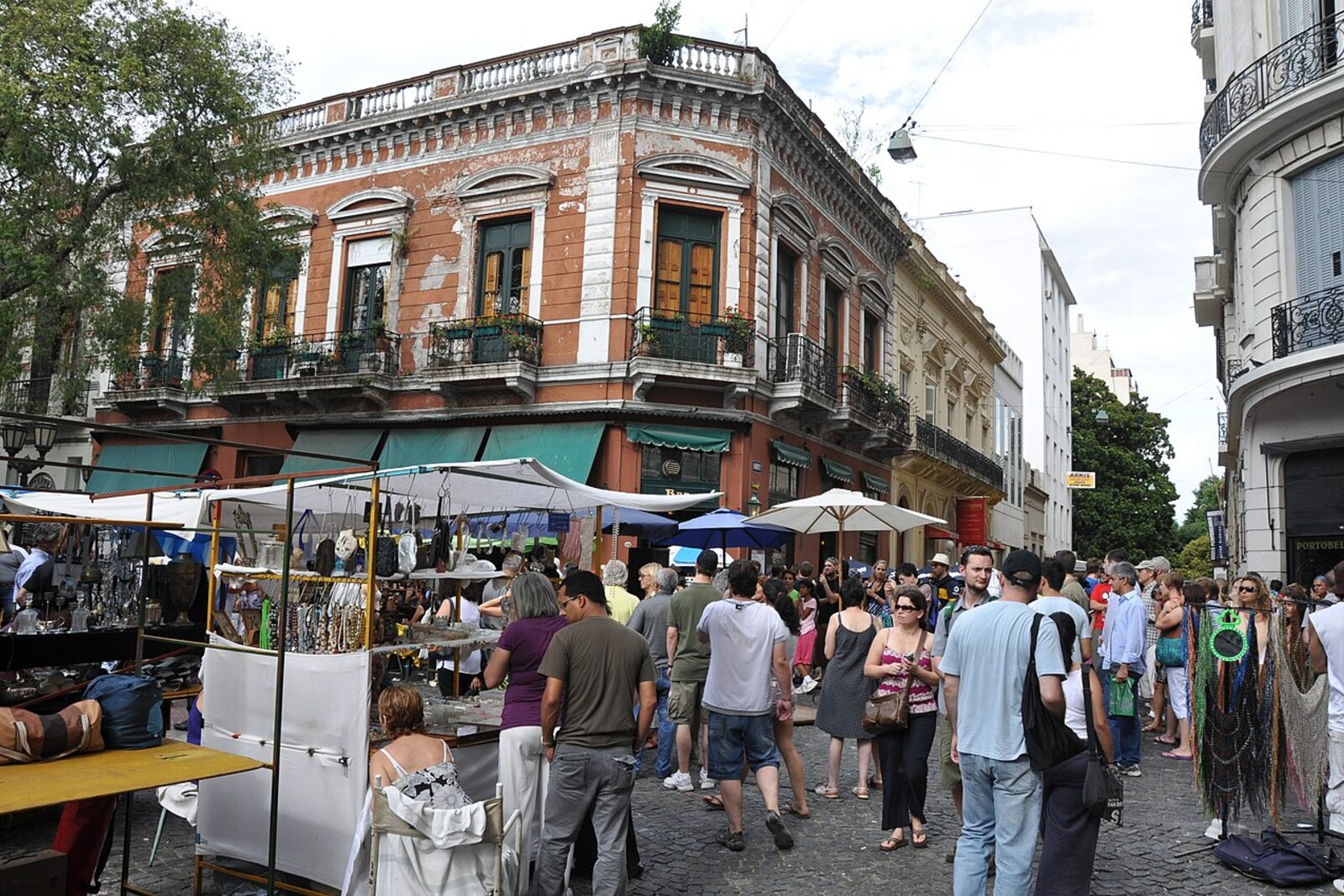
Look around first
What to notice
- The square's paving
- Iron counters
- Gray awnings
- Antique objects
The story of the place
On Sundays, antique dealers fill Plaza Dorrego. Their counters hold things from city homes: tableware, lamps, books, toys, jewelry, and objects whose original purpose sometimes has to be clarified with the seller. Tango is danced nearby. On other days, café tables are set out on the paving. This weekly routine began in nineteen seventy, thanks to José María Peña, Architect and Museum Director.
José María Peña, Architect and Museum Director, headed the Museum of the City of Buenos Aires and collected evidence of everyday life in Buenos Aires. He salvaged doors, balcony grilles, and door knockers from houses marked for demolition; he borrowed household items from acquaintances for temporary exhibitions. He was concerned both about the objects themselves and about San Telmo: the old neighborhood was emptying out, buildings were being altered or dismantled, and city residents had almost no reason to come here.
José María Peña, Architect and Museum Director, proposed setting up an open-air museum hall in the square, where old objects could be sold. Several officials objected: they considered the neighborhood run-down and expected empty rows to turn into a public embarrassment. For José María Peña, Architect and Museum Director, this was a professional test. He had no shop of his own; he was responsible for the experiment as director of the municipal museum.
They were given about a month to prepare. Newspaper notices appeared, inviting people to bring unwanted old things to the square. The municipality provided thirty iron counters with gray awnings, previously used at food fairs. The first sellers were mainly neighbors, rather than experienced antique dealers. On Sundays, José María Peña, Architect and Museum Director, came wearing a tie, walked through the rows, and made sure the participants displayed the promised objects and that the fair did not turn into a random bazaar.
He chose the place deliberately. Since eighteen twenty-two, the square had been called Plaza del Comercio—the Commercial Square. In eighteen sixty-one, a covered market was built here, and it stood until the end of that century. José María Peña, Architect and Museum Director, brought commerce back to its former address, but the merchandise was now the contents of the city's own old homes.
Within three months, there were already two hundred seventy counters instead of thirty. Sellers began lending and donating objects to the museum, while antique shops opened around the square and along Defensa Street. The fair brought shoppers and visitors to San Telmo before special protection was established for the neighborhood's old buildings. The Museum of the City of Buenos Aires still takes part in the work of the antique rows in the square itself; contemporary artists exhibit separately on Humberto Primo Street.
The name Dorrego belongs to a different story. On May fifteenth, nineteen hundred, the city named the former Plaza del Comercio after Colonel Manuel Dorrego—elected governor of Buenos Aires and leader of the Federalists, who sought a union of provinces with their own self-government. On December first, eighteen twenty-eight, General Juan Lavalle of the Unitarians seized Buenos Aires. Manuel Dorrego went to the province to seek support, was captured, and on December thirteenth was shot on Juan Lavalle's orders without trial near the town of Navarro. That episode is not connected with this square: Manuel Dorrego neither lived nor died here. His trace on Plaza Dorrego is the name on the signs. The Sunday rows belong to José María Peña, Architect and Museum Director's idea: old things are still sold in the square itself under the museum's supervision.
Useful on site
The square is always open; the fair operates on Sundays and depends on the weather, the season, and city rules.
Checked: July 1, 2026. Check the official source before visiting.On Sunday, the square is especially crowded: keep valuables with you and do not linger in the middle of the passageway. On a day without the fair, look at the shape of the square and its edges—the history of the place does not depend on the counters alone.