 Guide On Map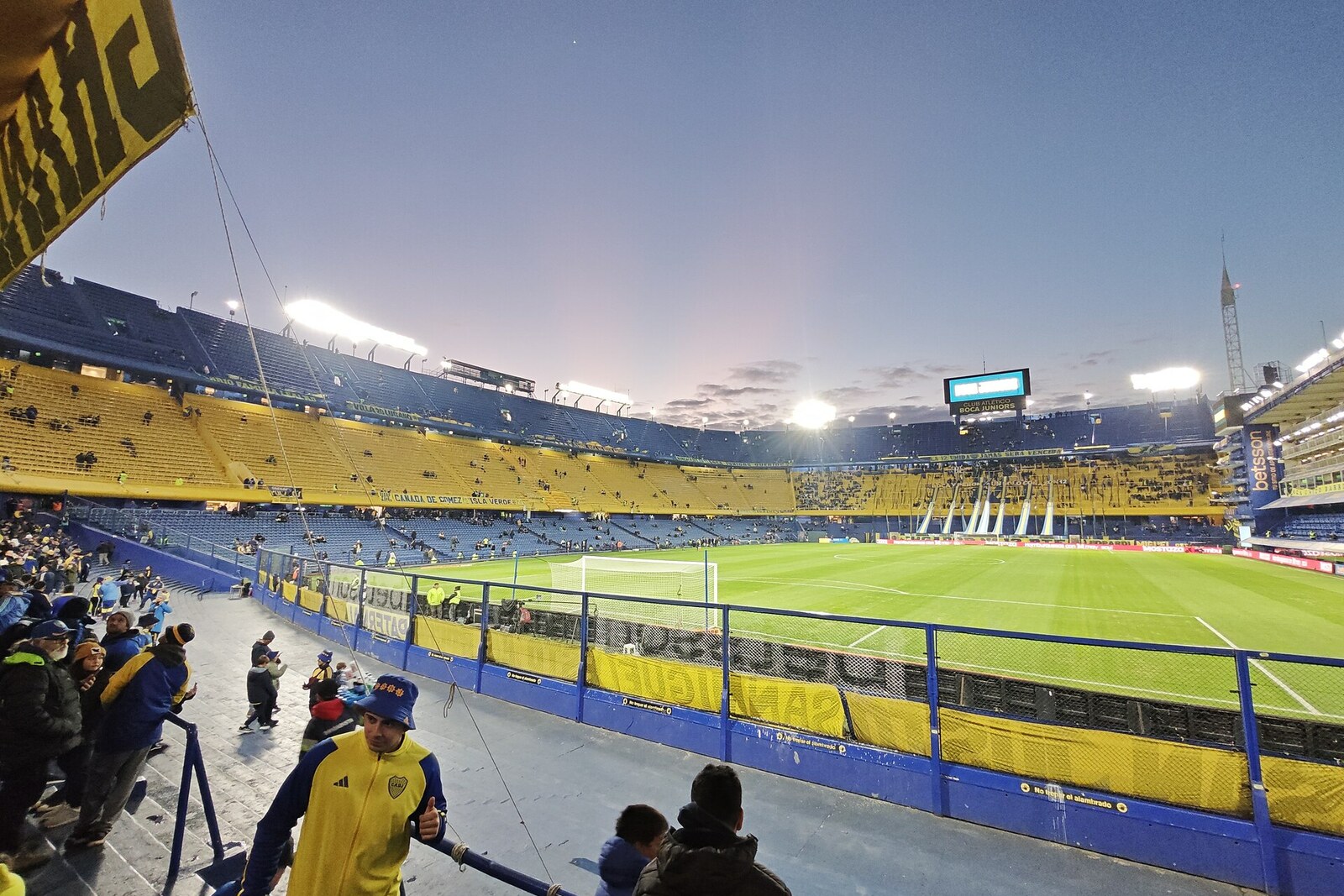
Look around first
What to notice
- Three concrete tiers
- An almost sheer row of boxes
- The official inscription on the façade
- Neighboring houses pressed close to the stadium
The story of the place
Beside house façades and the railway stands the home stadium of the football club from La Boca. Before the reinforced-concrete bowl, people gathered here in wooden stands built for twenty-five thousand people. Now, on one side, an almost vertical chain of boxes runs along, while on the opposite side three concrete levels overhang one another above the field. The official name Alberto José Armando remains on the façade, although in the city the stadium is more often called La Bombonera.
In nineteen fourteen, Boca Juniors tried to move to the suburb of Wilde, south of Buenos Aires. The distance and poor play cost the club about one thousand two hundred members: people stopped paying their dues. Two years later, the directors brought the team back to La Boca. After that experience, the site of a future stadium became a condition of the club's survival.
Since nineteen twenty-four, wooden stands for twenty-five thousand spectators had already stood on this plot. The number of fans was growing, and in the early nineteen thirties the club's members decided to buy the land. President Camilo Cichero pushed for a concrete stadium on this very site—between streets, the railway, and neighboring houses.
Dismantling the old stands meant leaving the team without a home ground for two years. Boca Juniors' directors reached an agreement with another city club, Ferro Carril Oeste. Instead of twenty-five thousand pesos, they gave Ferro Carril Oeste the northern wooden stand and four hundred ten seats, and paid for their transport and assembly in Caballito. In return, Boca Juniors received the right to play its home matches there and acquired defender Arcadio López.
Architect Viktor Sulčič, engineer José Luis Delpini, and surveyor Raúl Bes worked on the cleared plot. Sulčič had come from Europe, but Argentine institutions never recognized his Italian architecture degree. Delpini therefore signed the drawings and also calculated the reinforced-concrete structures.
There was nowhere here to spread an ordinary oval bowl across the ground. The designers placed three steep tiers one above another, with the upper rows projecting forward over the lower ones. Above the street and railway tracks, the stands extended beyond the boundaries of the field. There was still not enough room for a full fourth side: a narrow row of boxes was placed there. The first two tiers were completed by the opening, and the third was added in nineteen fifty-three.
The origin of the nickname has not been documented. According to engineer José Antonicz, a friend of Sulčič, the architect received a box of chocolates for his birthday. It reminded him of a model of a cramped stadium with one almost straight side. Sulčič began bringing the box to work meetings and called the project La Bombonera—“the chocolate box.” At first, his colleagues and the builders repeated the name, and then the club's directors did. By the opening, speakers were already referring to the stadium as La Bombonera.
On May twenty-fifth, nineteen forty, Boca Juniors played its first match here, a friendly against San Lorenzo. Arcadio López took the field for which his club had paid with an old stand. Boca Juniors won two to zero. The team then won all thirteen official home matches of the season here and became champion. López played sixty-two official matches for Boca Juniors, won one more cup, and last played for the club against Ferro Carril Oeste—the very club that had received the wooden stands.
Two old lapacho beams returned to Brandsen Street, eight hundred five, in two thousand seventeen. Green paint from Ferro Carril Oeste's stadium remained on them.
The official inscription on the current façade reads: Alberto José Armando Stadium. Since nineteen eighty-six, it had borne the name of Camilo Cichero, who organized its construction. In two thousand, the club replaced it with the name of Alberto Armando—the president who led Boca Juniors for more than twenty years, when the team won its first Copa Libertadores titles and the Intercontinental Cup.
On the Del Valle Iberlucea Street side, the almost sheer row of boxes still runs on, while opposite it three concrete tiers overhang one another. Behind the boxes, the street and the façades of neighboring houses begin immediately—the boundary of the plot into which Sulčič fitted his chocolate box.
Useful on site
Museo de la Pasión Boquense: daily 10:00-18:00, ticket office until 17:30; hours may change due to training sessions and matches.
Checked: June 28, 2026. Check the official source before visiting.From outside, the stadium's shape and position within the block are clearly visible. Plan the museum, tour, match, and access to the stands separately; unrestricted entry inside is not expected.