 Guide On Map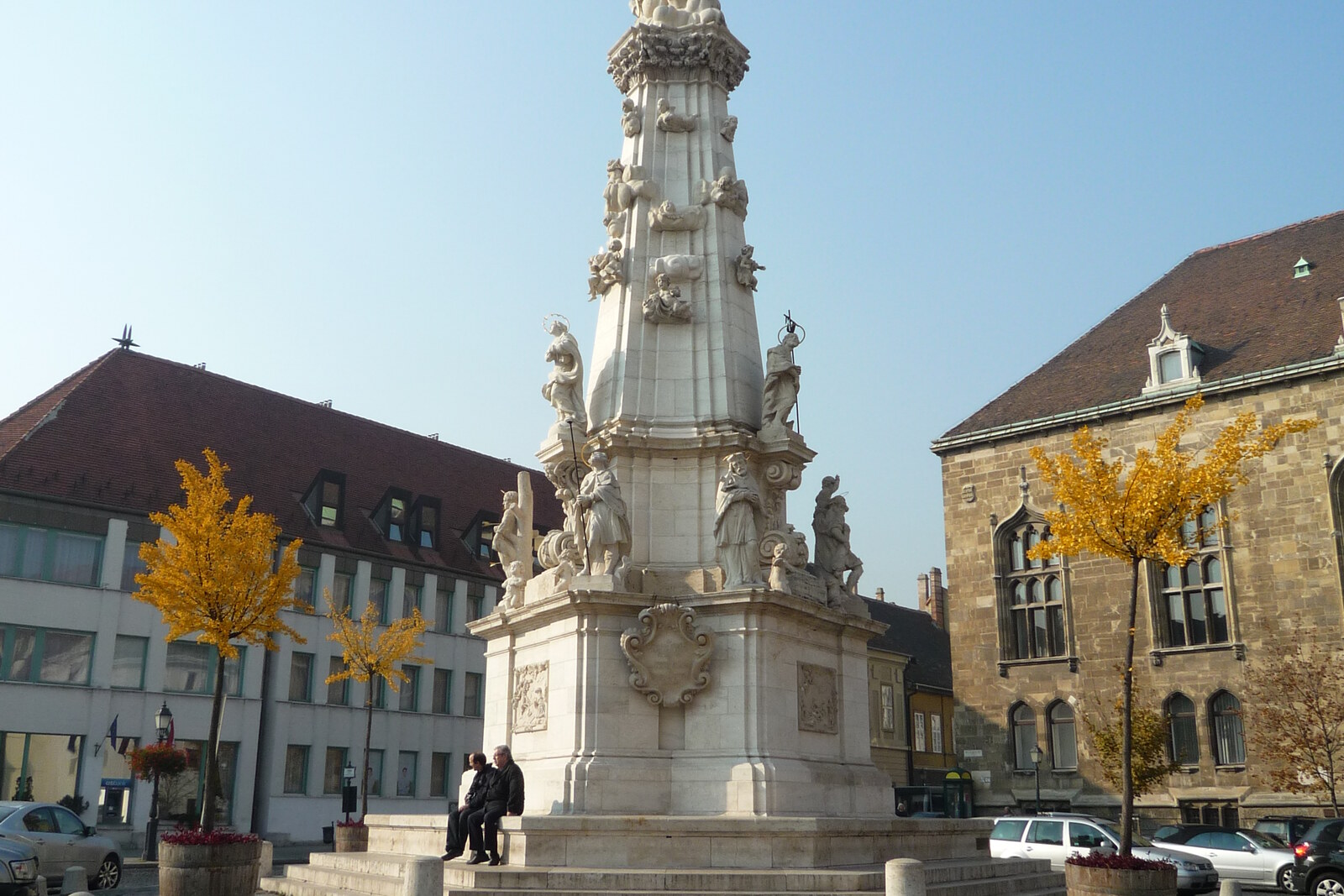
Look around first
What to notice
- A relief depicting the plague
- A statue of St. Roch
- A statue of St. Sebastian
- Figures of the Holy Trinity
The story of the place
In December sixteen ninety-one, the Buda City Council—Buda was then still a separate city—publicly promised to erect a Holy Trinity column here. Plague was raging in the city. The council imposed quarantine, checked arrivals, closed the baths, and restricted the wine trade. The Jesuits tended the sick, buried the dead, and persuaded the townspeople that sanitary measures should be supplemented by a collective vow of repentance.
A site between the parish church and the town hall was chosen for the column. Only a few years earlier, a block of houses had stood here; it was destroyed during the siege of sixteen eighty-six. Now residents were removing stone rubble, opening up the space in front of the church. The City Council's vow was meant to stand right by the church doors, in view of the townspeople and the priests who demanded that it be fulfilled.
Money was raised through donations. Craftsmen and merchants who had recently resettled in ruined Buda were paying heavy wartime taxes, so fundraising proceeded slowly. The hired sculptor Johann Philipp Preiss was to carve the figures for one hundred fifty forints, board, and lodging. He received the first payment, lived in Buda for about three months, slipped away, and left tavern bills in place of the statues. The City Council had to pay them. The stonecutter Bernát Ferretti continued the work, but without money construction stopped again.
The Jesuits did not let the councilors forget the vow made during the epidemic. They pressed for new collections, residents asked for help beyond the city, and the imperial family sent donations. Only in seventeen hundred was the foundation laid. In seventeen oh six, the column was finally consecrated—fifteen years after the first vow—and some of the intended figures were never completed. From that time on, civic and church ceremonies were held around it.
Three years later, the plague returned. For the people raising money for a protective vow, this meant that the first column had not delivered them from the disaster. In June seventeen oh nine, the councilors made a new vow: to put up a larger and richer monument on the same site. The old column was given to the suburb of Újlak, while Fülöp Ungleich and Antal Hörger were commissioned to make the present one. It was consecrated on June eleventh, seventeen thirteen.
The reason for the commission itself survives on the base: one of the reliefs depicts the plague in Buda Castle. Among the statues, St. Roch points to a plague sore, while St. Sebastian stands with arrows in his body. At the top are God the Father with a scepter, God the Son with a cross, and the Holy Spirit in the form of a dove—the Christian Holy Trinity to whom the residents appealed. One of the early names of this space already meant “at the column.” The square's present name became attached to the second column, while the first still stands in Zsigmond Square, in another part of Buda.
Useful on site
An open square with no ticket requirement; when the crowd is dense, it is better to view the column from several sides, rather than only from the frontal point by the church.
Checked: June 28, 2026. Check the official source before visiting.Walk all the way around the column: its story cannot be read from a single point. Do not go behind the barriers, and be mindful of people moving between the monument, the church, and the neighboring buildings.