 Guide On Map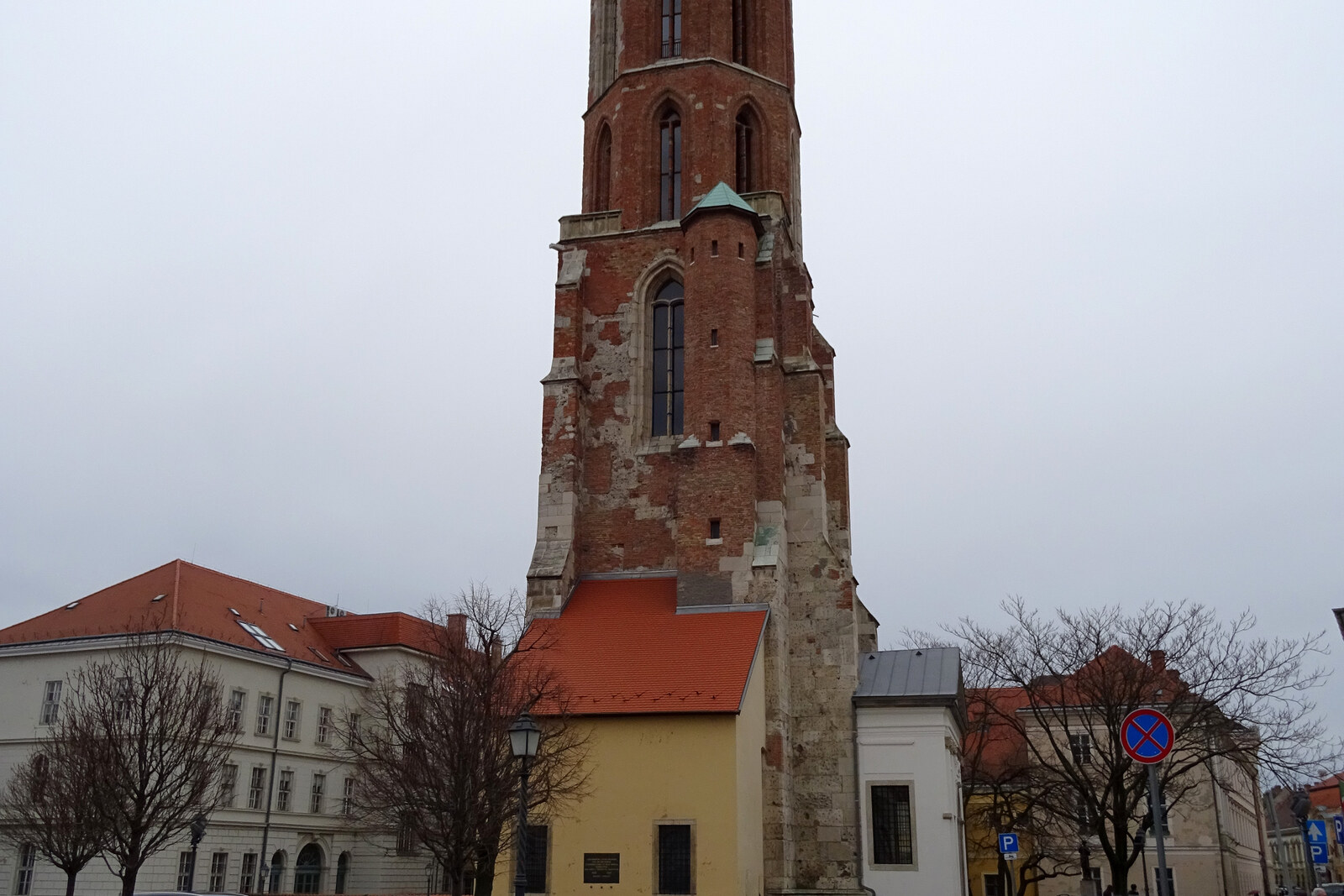
Look around first
What to notice
- Medieval tower
- Uncovered Gothic windows
- Door at the tower's base
- Stone lines of the vanished naves
The story of the place
The medieval tower stands here alone, while the church it adjoined disappeared long ago. Buda's Hungarian residents established their own parish here as early as the thirteenth century, dedicating it to Mary Magdalene; the tower was built before the western portal in the late fifteenth century. The uncovered Gothic windows reveal its old masonry, and the passage below once led people into the church. Nearby, low stone outlines repeat the shape of the naves, which now remain only on the ground.
On May eighteenth, seventeen ninety-five, Ignaz Martinovics was led out of the neighboring former Franciscan monastery and brought under guard to the church. A former monk, scholar, and leader of an uncovered conspiracy, he had sought to overthrow King Franz I. The court had already sentenced him to death, but the condemned man first had to be stripped of his clerical rank: secular judges could not execute a Catholic priest as an ordinary criminal.
Martinovics made his living teaching the natural sciences, then by sending secret reports to the imperial court. Under Leopold II, these reports brought him money and hope of a high office. After Leopold's death, the new king disbanded the former secret police; Martinovics lost a substantial part of his income, and soon afterward his position at court as well. He still tried to earn an appointment with new reports, but did not receive the post he wanted.
In the spring of seventeen ninety-four, Martinovics created two secret organizations. To moderate members, he offered Hungary's independence and reforms; to radicals, a republic and the abolition of estate privileges. He intended to lead both organizations himself. The conspiracy was uncovered a few months later.
During interrogations, Martinovics decided to save himself by his usual means—information. He named the participants, greatly exaggerated the movement's numbers, and even offered his services to the king. His testimony led to about fifty arrests. The leaders of the secret societies were held and tried in the former monastery building beside the church. Martinovics's own confession did not save his life.
On the morning of May eighteenth, he was told that his plea for clemency had been rejected. In the church, the condemned man was dressed in liturgical vestments, then these were removed one by one, along with the symbols of priestly rank. The bishop declared Martinovics defrocked and handed him over to the civil judges present. After the ceremony, the escort took him back into custody.
Two days later, before dawn, Martinovics and four other leaders of the conspiracy were put in chains, placed on carts, and taken through Vienna Gate to a field below the fortress. There Martinovics was set apart so that he could watch the execution of his four companions. He was beheaded last. The people he had named in the hope of returning to royal service died before his eyes.
The connection between this execution and the church was especially direct. Three years earlier, Franz I himself had been crowned King of Hungary here. By then, the Franciscans had already been expelled by decree of Joseph II, the furnishings had been removed, and the building remained closed to ordinary parishioners. In the empty church, a king was first crowned, and then a man convicted of trying to overthrow him was defrocked.
Its name was much older than these events. Mary Magdalene was a disciple of Jesus who, according to the Gospel of John, was the first to encounter the risen Christ. In the thirteenth century, Buda's Hungarian residents established their own parish here and dedicated the church to her; the documents do not say why they chose this particular saint. The townspeople built the stone tower before the western entrance in the late fifteenth century.
During the siege of nineteen forty-five, the church vaults collapsed, but architects believed restoration was possible. Kálmán Lux prepared a design, its estimate was approved, and repair work began. Then the military bishopric was abolished, restoration stopped, and in nineteen fifty the country's leaders ordered the church dismantled. Lux's design remained on paper. The architect-restorer József Csemegi managed to preserve the medieval tower: he uncovered the blocked Gothic windows and conserved the masonry.
The tower's lower rooms are now used for exhibitions, and a viewing platform has been arranged above. Behind the tower, low stone lines mark the walls of the vanished naves. The door at the tower's base was once the church's main entrance; the space where Martinovics's priestly vestments were removed now begins beyond it, under the open sky.
Useful on site
The square and tower can be viewed from outside as an open space; do not treat access inside as guaranteed without checking on the day, because the previous operator reported that its contract ended in January 2025.
Checked: June 28, 2026. Check the official source before visiting.Treat viewing the exterior as the main version of this stop. If the tower is open for climbing, check the visiting conditions on site; the narration does not depend on access above.