 Guide On Map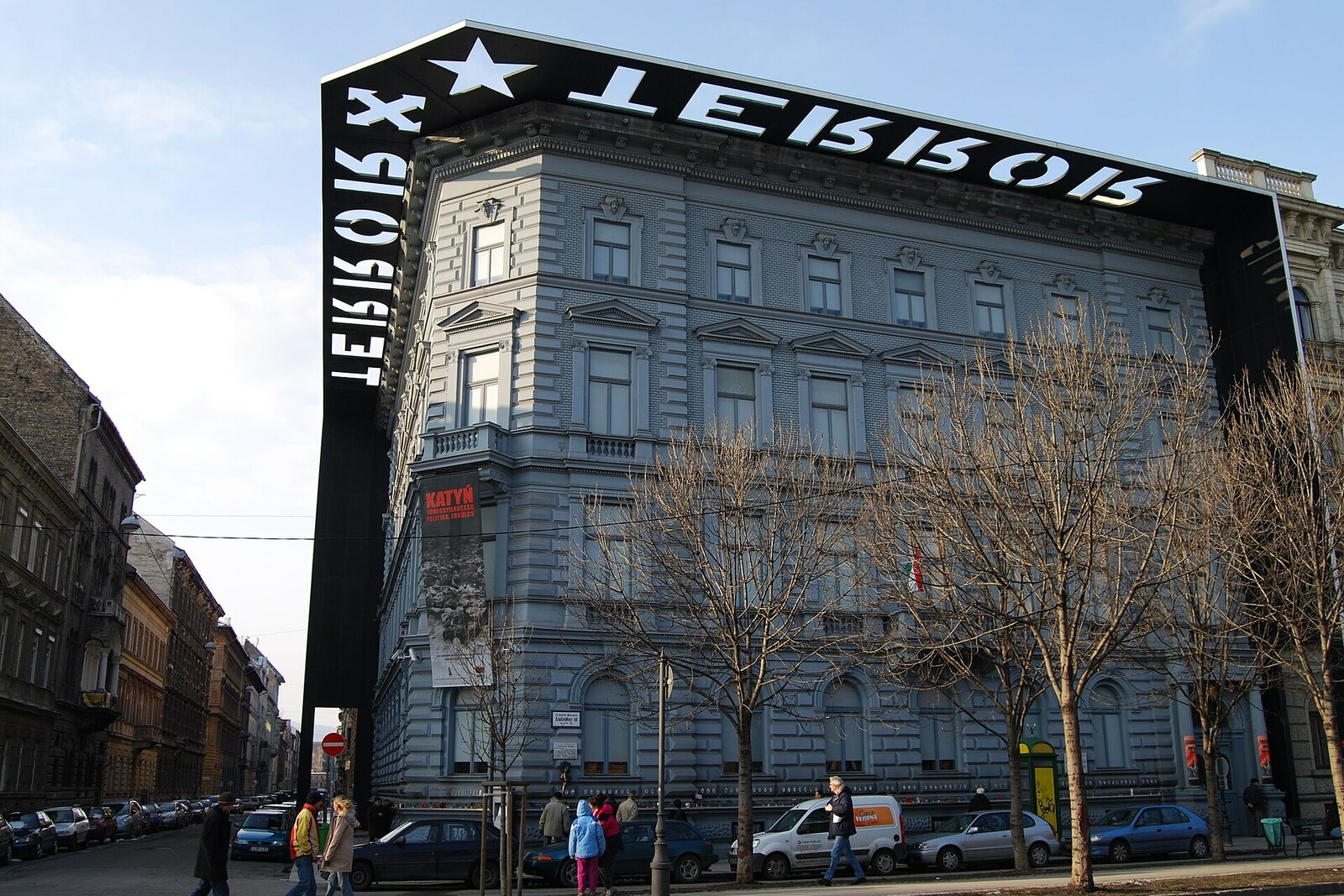
Look around first
What to notice
- House No. 60
- Neighboring houses
- Reconstructed basement cells
- The “Gymnasium” room
The story of the place
Behind the façade of number sixty Andrássy Avenue stands the House of Terror Museum, dedicated to people who were held prisoner within these walls and broken during interrogations. The basement cells were reconstructed from the memories of those who managed to leave this place: most traces disappeared with the departing employees. Underground, this house was connected to the neighboring ones, and the prison grew into a labyrinth whose boundaries remain unknown to this day. Only the upper room where people were tortured, cynically nicknamed the gymnasium, is authentic.
In February nineteen forty-five, fighting was still under way on the other bank of the Danube, while Péter Gábor was already heading the new political police in Pest. It was created on the Soviet model to find war criminals and opponents of the new regime. For its headquarters, the service took over number sixty Andrássy Avenue. Gábor later explained that the address had been chosen deliberately: the crimes of the previous year had originated here, so the guilty should receive punishment here as well.
Before Gábor arrived, supporters of Ferenc Szálasi, leader of the Arrow Cross Party, rented rooms in the house. In nineteen forty, Szálasi called the party headquarters the House of Loyalty. After his party seized the country in the autumn of nineteen forty-four, a prison was set up in the former coal storeroom. Jews, deserters, and resistance members were brought here; armed detachments set out from here to find new captives. People were interrogated, tortured, and killed.
The political police kept both the address and the basement’s purpose. Its employees took over the neighboring houses, connected the basement spaces, and created a prison labyrinth whose exact boundaries remain unknown to this day. The service changed its names and expanded its powers, while the circle of the accused had long extended beyond former fascists. One of the prisoners was Vendel Endrédy, abbot of Zirc Abbey of the Cistercian Order. Before being elected abbot, he taught mathematics and physics at a Budapest high school. In nineteen forty-eight, the state took over his order’s schools and, two years later, dissolved the monastic communities. Endrédy tried to preserve contact among the dispersed monks, corresponded with fellow monks abroad, and helped young novices leave the country. He knew that he was about to be arrested: the warning came while he was still on a trip to Rome. Yet he returned to Hungary, and in the autumn of nineteen fifty he was the last to leave the abbey, in order to hand it over to the appointed official.
Four days later, on October twenty-ninth, Endrédy was intercepted on his way to visit a relative and brought here. The first interrogation lasted eighteen hours. The investigators wanted the abbot to confess to espionage, conspiracy, and preparing to overthrow the state, and also to name the people with whom he had been in contact. Before one interrogation, he prayed to forget the names of his friends and betray no one.
For five weeks, Endrédy refused to sign the accusations of espionage and conspiracy. He was made to do squats until he lost consciousness, beaten, tortured with electricity, and given drugs that prevented him from thinking clearly. The turning point came when the investigators threatened to bring other monks and women he knew here and torment them before his eyes. He then signed false confessions.
In the summer of nineteen fifty-one, Endrédy was sentenced to fourteen years in prison. He was kept alone for almost all that time. So as not to lose his sanity and memory, the former teacher solved arithmetic problems in his head. The first book on mathematics or physics, which he had asked prison guards for over many years, was given to him on November first, nineteen fifty-six—the day of his release. A few months later, he was arrested again, then sent to live out his remaining days in a home for the elderly at Pannonhalma Archabbey. He was not allowed to return to Zirc. Only after his death in nineteen eighty-one was Endrédy buried in the church of his abbey.
The political police left the house after the events of nineteen fifty-six, and its employees destroyed many traces of the prison. That is why the basement cells in the present-day museum are reconstructions created from the memories of surviving prisoners. The death row cell shown there is also part of the exhibition: no official executions were carried out at this address. One torture room on the upper floor has survived in its original form; the employees called it the “gymnasium.”
The museum opened here in nineteen oh two and was named the House of Terror Museum in memory of the people who were imprisoned, tortured, and killed within these walls under two dictatorships. Next to the reconstructed cells are printed Endrédy’s words about his prayer before interrogation: he asked to forget the names of his friends. The basement itself had to be recreated from the memories of those who managed to leave this place.
Useful on site
The exterior is accessible from the street; the museum is usually open Tue–Sun 10:00–18:00, ticket office until 17:30, closed Monday.
Checked: June 28, 2026. Check the official source before visiting.The audio works outside; the museum exhibition is difficult in content and requires separate time to visit.