 Guide On Map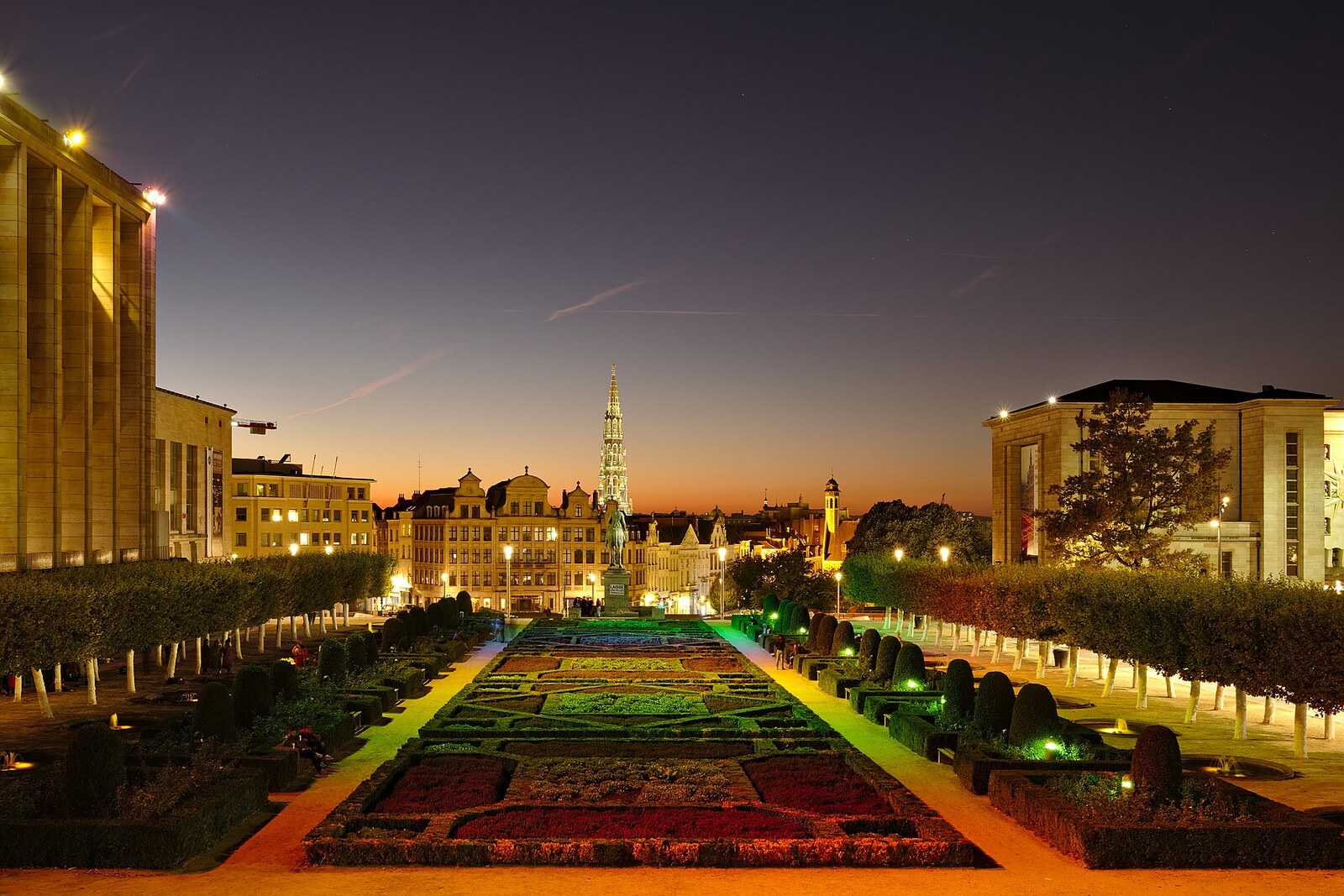
Look around first
What to notice
- Five square parterres
- Rows of fountains
- Clipped plane trees
- The upper terrace with its long flowerbed pattern
The story of the place
Five square parterres descend the slope toward the lower city; cross paths, fountains, and rows of clipped plane trees run between them. The garden stands on a concrete slab: conference halls operate beneath the flowerbeds, and a car park has been built there. Only one meter forty of soil was left for the roots, and from the upper terrace the individual flowerbeds form a long pattern.
In eighteen ninety-four, Charles Buls, the burgomaster of Brussels, presented the city council with a plan to redevelop this slope. The Saint-Roch Quarter stood here: narrow streets, stairways, dead ends, homes, and shops. Trade supported their owners, and taxes from these establishments made up a significant part of the city budget. Buls wanted to improve the quarter's sanitation while preserving its medieval street network and running only one gently curving road along the slope.
King Leopold II sought something different. He wanted to clear the hill for a museum, library, archive, and scientific institutions. The king began buying up plots in Saint-Roch, and the state subsidy to the city was made conditional on acceptance of the project by his architect, Henri Maquet. The council rejected Buls's proposal and agreed to the money. In eighteen ninety-seven, the homes and shops of Saint-Roch began to be demolished. Buls remained burgomaster for another two years and then resigned; his defeat in the dispute over the quarter was one reason for his departure.
But clearing the site did not bring the promised construction. In nineteen eight, parliament rejected Maquet's project, and a huge vacant lot remained where Saint-Roch had already been demolished. The name, however, took hold: as early as nineteen two, Maquet had titled his project “Mont des Arts”—“Mountain of the Arts”—because he intended to place the country's main cultural collections here.
The Brussels International Exposition of nineteen ten was two years away. Leopold II paid for temporary landscaping from his own funds and instructed Jules Vacherot, the former chief gardener of the Paris World's Fair, to conceal the vacant lot. Vacherot laid out terraces and stairways along the slope, created flowerbeds, water cascades, and a viewing area overlooking the lower city. The temporary garden lasted about forty-five years.
In the middle of the twentieth century, it was eventually dismantled to make way for the permanent Mont des Arts complex. The Congress Palace and a three-story car park were being built beneath the viewing area. Omer Vanaudenhove, the minister of public works, instructed his adviser on green spaces, René Pechère, to bring a garden back here. Pechère, who had previously headed Brussels's parks department, arranged five square parterres, cross paths, rows of fountains, and clipped plane trees on the concrete slab. From the upper terrace, the individual flowerbeds were meant to form one long pattern. The new garden was completed for the Brussels World's Fair of nineteen fifty-eight.
The trees and shrubs here have only one meter forty centimeters of soil; beneath it lie a drainage layer and a concrete slab. Conference halls and a car park are located under the flowerbeds. Nothing remains on the surface of Saint-Roch's streets or Vacherot's terraces.
Useful on site
Open city terrace; access and lighting may change due to events and maintenance.
Checked: June 28, 2026. Check the official source before visiting.Do not limit yourself to the central view: walk along the side paths and pause where the change in levels is noticeable.