 Guide On Map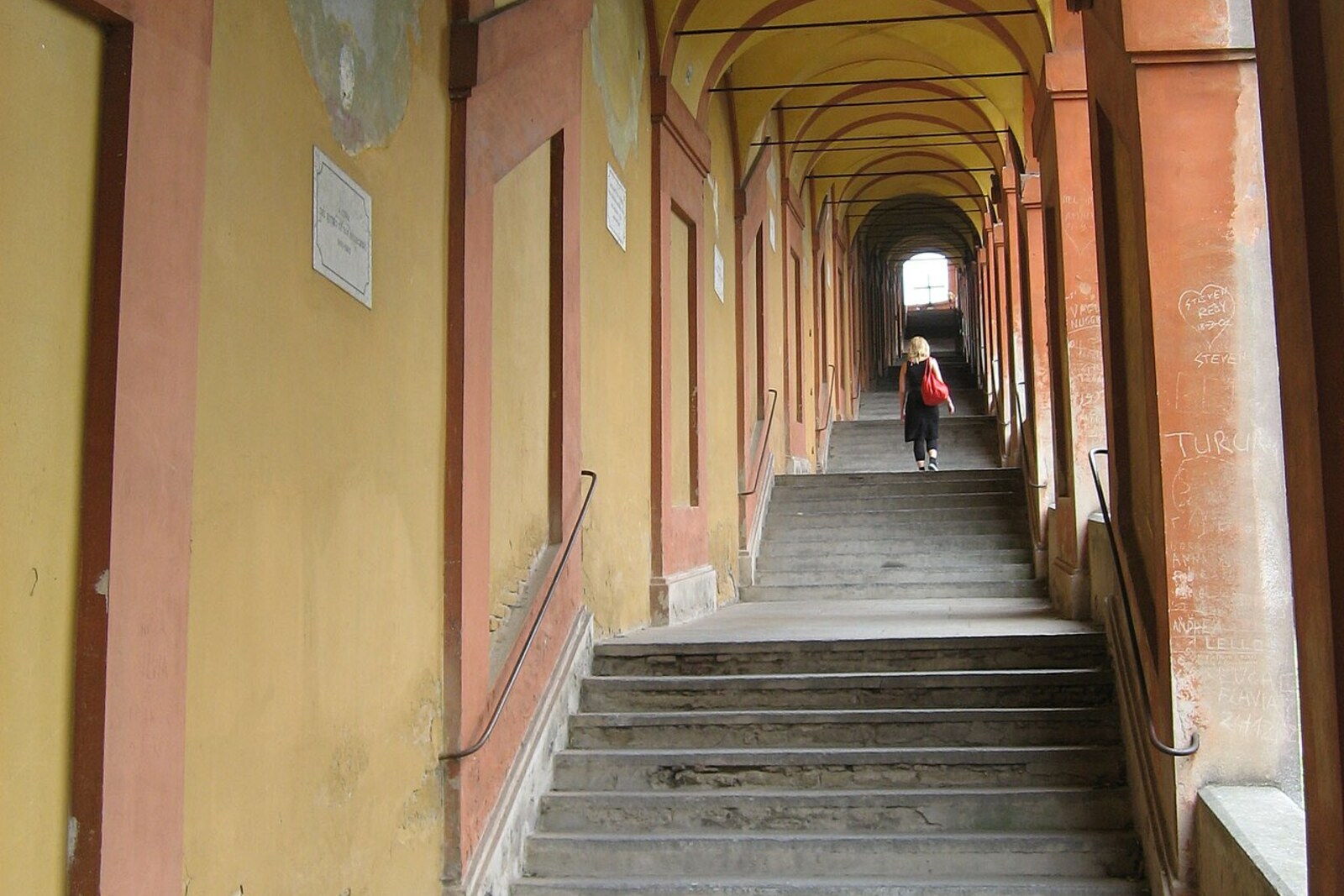
Look around first
What to notice
- An unbroken row of brick arches
- A commemorative medallion between the arches
- An image of the Madonna and Child in a lunette
The story of the place
Among the identical brick bays, two personal markers of this covered gallery have survived. In the lunette between the one hundred forty-second and one hundred forty-third arches remains an image of the Madonna and Child, commissioned by the servants of the Albergati family under their collective name. Ten bays earlier, a commemorative medallion marks the place where work began on this section of the route for pilgrims and the annual carrying of the Madonna di San Luca.
From Porta Saragozza, the portico runs across level ground along Via Saragozza. The icon's annual route had already been assigned to these gates, but beyond them the procession emerged onto an open road. The mile and a half of arches leading to Meloncello came before the climb up the hill.
In sixteen fifty-five, the Bologna Senate received two designs for a covered route and set both aside: there was no money for such construction. Lodovico Zenaroli returned to the idea. He was the chaplain of the Hospital of San Biagio, where pilgrims were received. His task was to secure a passage that could be used by both pilgrims and the procession carrying the Madonna di San Luca. After failing with the city treasury, he began collecting donations.
In sixteen seventy-three, Zenaroli formed a private committee. He was supported by Marquis Girolamo Albergati and Ferdinando Monti Bendini of the Confraternity of Santa Maria della Morte, which was responsible for carrying the icon. They obtained the Senate's permission and hired the architect Gian Giacomo Monti.
Construction began neither at the gate nor at the foot of the hill. On June twenty-eighth, sixteen seventy-four, workers laid the first section approximately in the middle of what is now the level stretch, between the one hundred thirty-second and one hundred thirty-third arches, opposite the Osteria del Moro, which existed at the time. From there, the portico was extended along the road, with individual arches and decorations paid for through donations.
The donors were not only marquises. Servants of the Albergati family commissioned an image of the Madonna and Child for the portico. It survives in the lunette between the one hundred forty-second and one hundred forty-third arches. Their earnings depended on one noble family, yet they left their commission under their own collective name—as servants of the Albergati family.
By seventeen oh one, the level section had reached Meloncello. In the same year, Zenaroli died in Pieve di Cento: he saw the completed road across the level ground, but not the completion of the entire portico. The Madonna di San Luca was carried beneath a continuous chain of arches for the first time only in seventeen seventeen.
The place where construction began is still marked by a commemorative medallion between the one hundred thirty-second and one hundred thirty-third arches. Ten arches farther on remains the Madonna paid for by the Albergati servants.
Useful on site
Access is free and available around the clock.
Checked: June 28, 2026. Check the official source before visiting.Walk at a steady pace and leave room for people coming the other way. For a stop, choose a widened section where the group will not block the gallery.